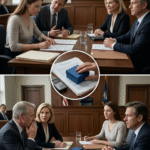
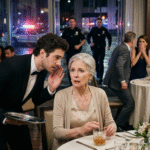
The temporary order required Graham to leave the townhouse within forty-eight hours.
He packed six suits, his watches, family photographs, and the whiskey decanter from the library.
The decanter belonged to him.
The library did not.
He found me at the breakfast table on his final morning.
I was reading the board’s updated compliance report.
He placed his keys beside my coffee.
“You made your point.”
“I documented your conduct.”
“You humiliated me.”
“You used my medical trauma in a presentation.”
His mouth tightened.
“I was trying to explain why the company needed stable leadership.”
“You were sleeping with the proposed replacement.”
“That wasn’t supposed to happen this way.”
I looked up.
It was the nearest he had come to honesty.
“How was it supposed to happen?”
He pulled out the chair across from me.
“You would step back.”
“Because you told everyone I was unwell?”
“You needed time.”
“To recover.”
“From you?”
He looked toward the windows.
Morning light touched the rooftops across the street.
“We were unhappy.”
I closed the report.
“You were dissatisfied.”
“There’s a difference?”
“Unhappiness asks what can be repaired.”
I folded my hands.
“Dissatisfaction looks for a younger woman and sends the bill home.”
He flinched.
“Sloane made me feel—”
“Do not finish that sentence.”
My voice was not loud.
He stopped anyway.
“I will not carry responsibility for how easy it was to flatter you.”
He stared at me.
“Did you ever love me?”
The question was obscene.
Not because it was cruel.
Because after everything, he still wanted my love entered into evidence for his defense.
His eyes changed.
“I loved you completely.”
I allowed the silence to settle.
“That is why you were able to hurt me completely.”
He looked down at his hands.
“I can end things with her.”
“You ended things with me.”
“I made a mistake.”
“You made hotel reservations.”
“Claire.”
“You created shell companies.”
“I panicked.”
“You showed investors a photograph of me after surgery.”
He closed his eyes.
“I’m sorry.”
The words arrived fifteen years too late and several million dollars short.
I believed he was sorry.
That did not make him safe.
“I know,” I said.
His eyes opened.
For one hopeful second, he mistook acknowledgment for forgiveness.
Then I pushed the keys back toward him.
“The car service is waiting.”
Sloane lasted eleven days.
Without access to company money, Mercer Sterling collapsed.
Her apartment had been leased through one of the shell companies.
Her driver had been paid by Sterling Hospitality.
The jewelry Graham gave her had been purchased with a corporate card.
She hired a lawyer and claimed she had believed every expense was authorized.
Some were.
Most were not.
To avoid criminal referral, she surrendered her claims to Mercer Sterling and provided full access to her communications with Graham.
The messages were worse than I expected.
Not because they were passionate.
They were logistical.
They discussed my public image, my hospital records, my trust documents, and which friends might support a narrative that I had become emotionally fragile.
Sloane asked whether I would fight the divorce.
Graham replied that I was too proud to make a scene.
She asked whether the Beaumont would become theirs.
He wrote, Once Claire is out, everything falls into place.
He never understood that I was not standing in his way.
I was holding the entire structure upright.
When Julia showed me the messages, she watched my face carefully.
“Do you need a minute?”
“That was not a legal question.”
I looked toward her office window.
Rain moved down the glass.
“I gave him fifteen years.”
“You also kept the other half of your life.”
“It doesn’t feel like half.”
“What does it feel like?”
I considered the question.
“Like a house after movers leave.”
“Empty?”
“Larger than I remembered.”
The financial investigation ended six months later.
Graham agreed to resign permanently, repay the misappropriated funds, surrender all unvested equity, and waive any claim against Ashford trust assets.
The district attorney accepted a plea involving falsified business records and breach of fiduciary responsibility.
He avoided prison.
He did not avoid consequence.
For a man like Graham, losing access was its own confinement.
No private dining rooms opened automatically.
No board members returned his calls within minutes.
No hotel manager upgraded his suite because of his last name.
The Sterling family retained a modest minority interest in the company.
Richard remained an honorary board member.
Victoria kept the Greenwich house after signing a new occupancy agreement with the trust.
I did not evict her.
Power did not require unnecessary cruelty.
She came to my office once after the settlement.
She wore gray and carried no handbag.
“I owe you an apology,” she said.
She seemed startled.
Women in our world were trained to soften truth before serving it.
I had lost the habit.
“I thought preserving the family meant preserving Graham,” she said.
“You were taught that men are the family and women are the preservation.”
She sat across from me.
“I should have warned you.”
“You should have warned him.”
Her eyes filled.
That surprised me.
“He told me you would never leave,” she continued.
I looked at the Beaumont courtyard below.
“He was right for a long time.”
“Why did you?”
“Because staying would have required me to lie for him.”
I turned back to her.
“I had already given him my love.”
“I was not giving him my integrity too.”
Victoria nodded.
Before leaving, she placed a small velvet box on my desk.
Inside was a gold cocktail pick shaped like a blackberry.
My mother had ordered two hundred of them for the original wedding.
“I found it in the Greenwich silver cabinet,” Victoria said.
“I thought it belonged here.”
After she left, I held the little gold berry in my palm.
For the first time since the gala, I cried.
Not for Graham.
Not for the marriage.
I cried for the woman I had been at twenty-nine, standing behind the ballroom doors with my mother’s cocktail in her hand.
She had not been foolish.
She had been brave enough to believe a promise.
There was no shame in that.
The shame belonged to the person who broke it.
THE WARMER KIND OF LUXURY
One year after the gala, the Beaumont reopened its rooftop lounge.
We removed Sloane’s mirrored walls and Graham’s imported marble.
Local artists filled the space with warm wood, hand-blown glass, and photographs from the hotel’s hundred-year history.
The new lounge did not look like a place designed to impress strangers.
It looked like a place people might remember.
Mateo created a new signature cocktail.
Blackberry.
He added rosemary and a small splash of champagne.
“What are we calling it?” I asked.
“The House Key.”
He placed the drink in front of me.
“Because surviving the night is good.”
He smiled.
“But knowing the place is yours is better.”
The opening benefited a foundation for women rebuilding careers after financial abuse.
We funded legal clinics, hospitality apprenticeships, emergency housing, and business grants.
Lorraine joined the foundation board.
Julia became its legal adviser.
Daniel refused a title and attended every meeting anyway.
The first scholarship went to a woman named Marisol Vega, who had left a twenty-year marriage with two suitcases and a talent for pastry.
Six months later, she became the Beaumont’s assistant pastry chef.
At the opening, she served tiny blackberry tarts beneath the same chandelier that had witnessed my humiliation.
People often asked whether I regretted allowing Graham’s announcement to happen publicly.
The answer was complicated.
I regretted the pain.
I regretted every employee who had to watch.
I regretted that my mother’s cocktail became part of something so ugly.
I did not regret standing.
Silence is not always weakness.
Sometimes silence is a locked door while you gather the keys.
Sometimes it is the space between discovering a lie and deciding what the truth will cost.
Sometimes it is a woman refusing to warn the people betraying her that they are standing on property she owns.
Graham sent flowers on the anniversary of the divorce.
White roses.
No note.
I donated them to the hospital where my mother had been treated.
Sloane moved to Los Angeles and started a branding consultancy under her middle name.
I heard she tells people the Beaumont scandal was a misunderstanding.
Perhaps she needs that version.
I no longer need anyone to understand mine.
The hotel is profitable.
The company is stable.
The Greenwich house remains with Victoria for as long as she wants it.
Richard sends me handwritten thank-you notes after every quarterly report.
The townhouse library has a new rug.
The whiskey decanter is gone.
The room looks better without it.
As for love, I stopped treating it like a vacancy that needed to be filled.
I have dinners with friends who knew me before Graham.
I take Sunday mornings slowly.
I travel without checking anyone else’s calendar.
I sleep in the center of the bed.
There is warmth in my life now, but it does not arrive disguised as rescue.
It comes through open kitchen doors, handwritten notes, late-night laughter, and the sound of hotel staff greeting me by name.
On the rooftop’s opening night, a young reporter asked me for one final comment.
She held her microphone carefully and glanced toward the bar where Mateo was serving The House Key.
“Mrs. Sterling,” she said, “what did you say when you realized your husband’s mistress had replaced your wedding cocktail with one named after herself?”
I looked across the room I had nearly lost by pretending ownership did not matter.
Then I thought of the gold menu, the crossed-out vow, and the woman in white waiting for me to break.
I smiled.
I said, “Remove the cocktail. Keep the security deposit.”