“Because part of it may be restitution.”
His face hardened again.
“Blackthorn is my home.”
“It was our home.”
“It was my home that I shared with you.”
“What about my mother?”
“She owns three houses.”
“She considers Blackthorn part of the family.”
“Your mother also considered another man’s child part of the family when she thought it came with trust money.”
“You hate us.”
“Hate requires continued intimacy.”
The elevator doors began to close.
Adrian placed his hand between them.
“Did you ever love me?”
There it was.
The question selfish people ask after betrayal, not because they doubt your love, but because they need proof that what they destroyed had value.
“Yes,” I said.
The answer surprised him.
“I loved you enough to give you authority no one else possessed.”
His eyes searched mine.
“And now?”
“Now I understand why my grandmother made it revocable.”
The doors closed between us.
The divorce lasted four months.
Adrian’s attorneys challenged the prenuptial agreement, the proxy provisions, the trust, and my competence.
They lost each time.
The forensic audit uncovered additional fraud.
Adrian had used company funds to purchase the Tribeca apartment where Sloane lived.
He had promised equity he did not own.
He had directed foundation donations toward organizations connected to directors whose votes he needed.
Federal investigators began asking questions.
Two board members resigned.
The company recovered most of the diverted money through insurance, clawbacks, and the sale of Adrian’s vested shares.
He was not left penniless.
That story would have been satisfying but false.
Men like Adrian rarely became poor.
They became less powerful, which wounded them more.
He moved into a rented townhouse in Manhattan and joined a private investment firm whose announcement described his departure from Hale-Caldwell as a planned transition.
No one believed it.
Sloane gave birth to a healthy boy in March.
She named him James.
Bennett was present at the hospital.
Adrian was not.
The custody case remained private.
Bennett petitioned for shared custody and established a trust for the child using his own money.
Sloane attempted to claim Adrian had promised lifelong support.
Her messages proved otherwise.
They also proved she had known the paternity was uncertain before the gala.
She lost her position at the company and returned the bracelet after our attorneys traced its purchase to the foundation.
I did not ask what happened to the ultrasound.
I did not want it destroyed.
The child had done nothing wrong.
The frame belonged to my grief.
The image belonged to his life.
Lenora requested a meeting six weeks after the divorce was finalized.
She came to Blackthorn on a gray afternoon in April.
The roses had begun to return.
I received her in the conservatory rather than the drawing room.
She was no longer wearing the family pearls.
For reasons I did not ask about, that pleased me.
“You changed the gates,” she said.
“I restored my grandmother’s initials.”
The ironwork now carried an H where the Caldwells had once installed a C.
Lenora looked toward the garden.
“Adrian says you have ruined him.”
“Adrian confuses consequences with persecution.”
“He lost his company.”
“He lost a job.”
“He lost his home.”
“He lost permission.”
Her mouth tightened.
“You always disliked us.”
“I spent eleven years trying to earn your affection.”
“You never needed it.”
“I know that now.”
For the first time, Lenora appeared old.
Not weak.
Simply tired.
“I should have stopped him,” she said.
“I thought the baby might give the family something hopeful after Rose.”
I looked at her until she lowered her eyes.
“You thought another woman’s pregnancy could replace my daughter.”
“When you say it that way—”
“There is no kinder way to say it.”
She folded her hands.
“I was afraid the family line would end.”
“Bennett is your son.”
“He never wanted the responsibility.”
“Neither did Adrian.”
Lenora’s eyes glistened.
“You have become very hard.”
I looked through the glass toward the first pale roses opening against the stone wall.
“I have become difficult to use.”
She left without asking to see the rest of the house.
A month later, the Hale-Rose Foundation opened its first maternal emergency wing at Greenwich Hospital.
The wing included private rooms for families experiencing pregnancy loss.
Each room had adjustable lighting, a separate exit for grieving parents, and trained counselors available at every hour.
No mother would be asked to walk through a cheerful maternity lobby carrying an empty bag.
No father would be permitted to dismiss her fear as panic without a clinician hearing her.
The foundation also created an emergency advocacy line for pregnant patients whose symptoms were being minimized.
Rose’s name appeared on a small brass plaque near the entrance.
Nothing about Adrian appeared anywhere.
At the opening ceremony, I wore a white suit and my grandmother’s watch.
Naomi stood beside me.
Mara attended from the back row and disappeared before photographs began.
Bennett sent a private donation.
I returned it.
The foundation did not need Caldwell money to honor a Hale child.
After the ceremony, a young woman approached me.
She held the hand of a little girl with red curls.
“I lost my first baby at thirty weeks,” she said.
“I saw the gala video.”
I prepared myself for sympathy.
Instead, she smiled.
“You looked like someone who had survived being told her grief made her weak.”
I glanced at her daughter.
The child was trying to count the roses embroidered along the edge of the ceremony program.
“Did you believe them?” I asked.
“For a while.”
She squeezed her daughter’s hand.
“Now I know grief is not a vacancy other people get to fill.”
The words stayed with me.
That evening, I returned to Blackthorn alone.
The house no longer felt empty.
It felt accurate.
The Caldwell portraits had been removed from the dining room and returned to Lenora’s townhouse.
My grandmother’s paintings remained.
The east wing had been closed for nearly a year.
I stood outside the nursery with my hand on the brass handle.
For months, I had believed entering would kill me.
Then Sloane entered it without permission and proved a room could be violated without losing what was sacred inside it.
I opened the door.
The silver stars remained on the walls.
The crib stood beneath the window.
The blankets were folded inside it exactly as I had left them.
Dust covered the rocking chair.
On the dresser sat Rose’s hospital bracelet, a lock of dark hair, and the small knitted cap she had worn.
I crossed the room and opened the curtains.
Late sunlight entered.
Nothing shattered.
I sat in the rocking chair.
For the first time since the hospital, I said my daughter’s name aloud when no one else was present.
“Rose.”
The room held it gently.
I cried then.
Not elegantly.
Not silently.
There was no audience to defeat.
No husband studying my weakness.
No family waiting to call me unstable.
I cried until grief felt less like a weapon someone had used against me and more like proof that love had existed.
When I finally stood, I carried the hospital bracelet downstairs.
The empty frame waited on the mantel.
I placed the bracelet inside it.
Not a photograph.
Not a replacement.
A truth.
WARM CONCLUSION
THE PORTRAIT I FINALLY TOOK
One year after the gala, Hale-Caldwell Medical Group officially became Hale Medical Group.
The shareholders approved the change with ninety-two percent support.
The company posted its strongest quarter in a decade.
The maternal emergency program expanded into twelve hospitals across Connecticut and New York.
Adrian appealed none of it.
By then, he understood that each courtroom gave me another place to enter evidence.
We spoke only once more.
It happened outside St. Bartholomew’s after the memorial service held on what would have been Rose’s second birthday.
I had not invited him.
He came anyway.
Snow softened the noise of Park Avenue.
He stood beneath the church awning with his hands in his coat pockets.
“I heard about the new hospital wing,” he said.
“It is a good thing.”
He looked toward the waiting car.
“Do you ever think we could have survived?”
I considered lying.
“Because of Sloane?”
“Because you believed my suffering was an opportunity.”
He nodded slowly.
“I was cruel.”
“I was afraid.”
“So was I.”
“That is not an excuse.”
It was the first honest thing he had said without being cornered by evidence.
He looked older than he had at the gala.
Less polished.
More human.
It did not make me want him back.
Sometimes remorse arrived after love had completed its burial.
“I am sorry about the frame,” he said.
The sentence was almost absurdly small.
Yet it was the closest he had come to understanding.
“It was never about the frame.”
I met his eyes.
“It was about what you believed an empty space allowed you to do.”
He looked down at the snow.
I entered the car without forgiving him.
Forgiveness was not required for peace.
That spring, a photographer from Boston came to Blackthorn for the foundation’s annual report.
She asked to take my portrait in the rose garden.
I nearly refused.
Then I remembered the silver frame.
I stood beneath the arbor at sunset while the first roses opened around me.
I wore no diamonds.
No wedding ring.
No armor disguised as couture.
The photograph showed a woman alone in a garden, one hand resting against the stone wall.
There was sorrow in her face.
There was also ownership.
When the print arrived, I carried it into the drawing room.
Rose’s bracelet remained inside the maternity frame.
I did not remove it.
I purchased another frame and placed my portrait beside hers.
One held the daughter I lost.
The other held the woman who survived.
The housekeeper found me there the next morning.
She asked whether I wanted the photographs moved to a more private room.
I looked at the two silver frames glowing in the sunlight.
“They belong where the whole family can see them.”
She smiled.
By family, I no longer meant bloodlines, surnames, or people who shared photographs at Christmas.
I meant those who treated love as care rather than access.
Naomi.
The nurses who remembered Rose’s name.
The physicians who built better rooms for grieving mothers.
The women who wrote to me after the gala and said they had stopped apologizing for surviving.
They became the family that remained when the performance ended.
The newspapers eventually found new scandals.
The gala video disappeared beneath newer outrage.
Sloane’s gold dress stopped appearing in search results.
Adrian’s name vanished from the business pages.
But the Hale-Rose Foundation continued opening doors.
Every year, the rose garden at Blackthorn bloomed.
Every year, I cut the first flower and placed it beside my daughter’s frame.
I never filled her space with someone else’s child.
I never pretended loss could be replaced.
Healing was not another pregnancy.
It was not a new husband.
It was not revenge performed beneath chandeliers.
Healing was the return of authority over my own story.
It was entering the nursery without fear.
It was allowing joy to stand beside grief without demanding that either one disappear.
It was knowing the people who had tried to erase me now had to live in a world shaped by my decisions.
Sloane had believed placing her ultrasound inside my frame made her the woman who completed the picture.
Adrian had believed calling it healing would make his cruelty sound merciful.
They were both wrong.
A woman’s wound is not an empty room.
It is not an invitation.
It is not property waiting for a new owner.
The frame had never been waiting for Sloane.
The house had never belonged to Adrian.
The company had never carried his power.
And the ending had never been theirs to write.
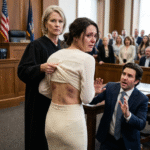
At the final divorce hearing, Sloane stood in the courthouse corridor and accused me of destroying everyone because I could not bear to see another woman happy.
I looked at the ultrasound she still carried inside a clear legal folder.
Then I looked at Adrian standing several feet away, unable to meet either of our eyes.
I said, “Healing does not wear another woman’s wound.”