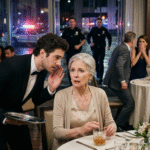
“Let’s not do this here.”
I almost admired her performance.
She had entered my home, worn my clothes, taken my mother’s jewelry, and replaced the blessing above my door.
Now she wanted boundaries.
A photographer called Grant’s name.
He immediately straightened.
The three of them turned toward the camera.
I continued to the Vale Trust table.
At eight fifteen, the program began.
Lenora delivered opening remarks about tradition.
She spoke of resilience, stewardship, and the Ashford family’s hundred-year commitment to American cities.
She did not mention that Ashford Development was eighty-seven years old.
She did not mention my mother.
Grant followed her to the stage.
Polite applause filled the room.
He approached the microphone with the smooth confidence that had once made investors trust him.
“For more than eight decades, Ashford Development has believed that buildings are more than structures,” he said.
“They are promises.”
I took a sip of water.
Miriam glanced at me.
I remained still.
Grant continued.
“Tonight, I am proud to announce Harbor Point, a visionary waterfront community that will redefine luxury living along the Connecticut coast.”
A rendering appeared on the screens behind him.
Glass towers rose above a marina.
The audience applauded again.
Grant smiled.
“Harbor Point represents a two-billion-dollar commitment to the future.”
That number was fiction.
The financing had collapsed forty-eight hours earlier.
Three lenders had withdrawn after learning Hawthorne House was not available as collateral.
Grant knew that.
He announced the project anyway.
Men like him often believed confidence could bully reality into cooperating.
Sloane stood near the stage.
Her hand remained on her stomach.
Grant looked at her.
“Great projects require great vision, and tonight I want to recognize the person who shaped Harbor Point’s identity.”
Sloane lifted her chin.
“Please welcome Sloane Mercer, our incoming executive vice president for brand and cultural strategy.”
Applause began uncertainly.
Sloane climbed the steps.
She kissed Grant’s cheek.
Every camera in the ballroom captured it.
Then she approached the microphone.
“Thank you, Grant.”
Her voice trembled with rehearsed emotion.
“Harbor Point began as a conversation about legacy.”
I watched her smile at the crowd.
“We asked what it means to build something that survives us.”
Grant moved beside her.
Sloane placed one hand over his.
“And tonight, that question is especially personal because Grant and I are expecting a child.”
The ballroom inhaled.
A hundred faces turned toward me.
That was the moment they had arranged.
The public replacement.
The official erasure.
The mistress transformed into mother.
The wife reduced to witness.
Sloane looked directly at me.
There was triumph in her eyes.
I smiled.
Not because I was happy.
Because she had reached the exact point at which there was nowhere left to hide.
Arthur rose from his table.
He walked toward the stage.
Grant’s smile faltered.
Arthur accepted a second microphone from the event coordinator.
“Ladies and gentlemen, I apologize for the interruption.”
The room became silent.
“As chairman of the independent board of Ashford Development, I must correct several materially inaccurate statements.”
Grant stepped forward.
“Arthur, this is not on the program.”
“No,” Arthur said.
“It is not.”
He faced the audience.
“Harbor Point has not received final financing approval.”
Whispers spread across the ballroom.
“Furthermore, Grant Ashford was terminated as chief executive officer this morning following evidence of unauthorized transactions and attempted misuse of company and trust assets.”
Someone dropped a glass.
It shattered near the bar.
Grant’s face turned white.
Sloane gripped the podium.
Lenora remained motionless.
Arthur continued.
“The board has referred its findings to outside counsel and the appropriate financial authorities.”
Grant reached for the microphone.
Arthur stepped back.
“This is defamatory.”
“It is documented.”
“You cannot announce this here.”
“You announced a nonexistent project to current investors.”
Grant looked toward me.
He finally understood.
Not everything.
But enough.
“You did this,” he said.
The microphone carried his voice across the ballroom.
Every guest heard him.
I rose from my chair.
The black silk of my gown moved quietly around my ankles as I walked toward the stage.
No one spoke.
Arthur offered me the microphone.
I took it.
Grant stared at me with naked hatred.
Sloane’s hand had fallen away from her stomach.
“Good evening,” I said.
My voice sounded calm through the speakers.
“My mother, Evelyn Vale, believed buildings were promises too.”
The screens behind us changed.
My mother’s portrait appeared above the ballroom.
She stood at a construction site in a white hard hat, one hand resting on a rolled set of plans.
“She believed a promise was only valuable when the person making it had the means and character to keep it.”
A second image appeared.
It showed the original 2009 investment agreement between the Vale Heritage Trust and Ashford Development.
The highlighted paragraph identified the trust’s controlling voting interest.
“For seventeen years, the Vale Heritage Trust has been the majority voting shareholder of Ashford Development.”
A murmur moved through the guests.
Lenora closed her eyes.
“The Ashford family has led the company publicly, and my family has supported that leadership privately.”
I looked at Grant.
“That arrangement depended on trust.”
He took one step toward me.
“Claire, stop.”
I did not look away.
“That trust has been violated.”
The next screen displayed a simple chart of transfers from Ashford Development to Meridian Coastal Partners.
Sloane stared at her name on the screen.
“The board has evidence that eighteen million dollars was diverted through contracts connected to Meridian Coastal Partners.”
“This is a lie,” Sloane said.
Her microphone was still on.
Miriam rose from our table.
“Ms. Mercer, your counsel has received copies of the contracts.”
Sloane looked toward Grant.
He did not look back.
“The board also discovered an attempt to pledge Hawthorne House as collateral using a signature I did not provide.”
Grant’s face hardened.
“That house is marital property.”
I let the word settle over the room.
“Hawthorne House is owned by the Vale Heritage Trust.”
The screens changed again.
The deed appeared.
My name was printed beneath the trust designation.
Grant stared at it.
Sloane whispered something I could not hear.
I turned toward her.
“You were correct about one thing.”
She looked at me.
“Old blessings do not protect a home by themselves.”
Her lips parted.
“A home is protected by the people willing to defend what was entrusted to them.”
The ballroom doors opened.
Two investigators from the company’s outside forensic firm entered with counsel.
They were not police officers.
They did not need to be.
Their presence was enough to tell every investor in the room that the scandal was real.
Grant moved toward me.
“You planned all of this.”
“I planned to tell the truth in the same room where you planned to replace it.”
His voice dropped.
“You are humiliating the mother of my child.”
Before I could answer, a man near the side entrance stood abruptly.
Nolan Pierce.
Ashford Development’s former chief financial officer.
Nolan had resigned six weeks earlier, citing family reasons.
He was married.
He was also staring at Sloane as though the floor had disappeared beneath him.
Sloane saw him.
The blood drained from her face.
Grant followed her gaze.
The silence between the three of them became visible.
Nolan turned and walked out.
Grant looked back at Sloane.
“What was that?”
“Nothing.”
“Why is he here?”
“He was invited.”
“Why did he look at you?”
“I don’t know.”
I did.
The forensic accountants had found hotel charges connected to Meridian.
The same Manhattan suite had been booked under Nolan’s corporate card during three weekends when Grant was traveling.
Security footage from the hotel had been obtained through counsel that morning.
Sloane had entered the suite with Nolan.
She had left twelve hours later.
I had not planned to mention it at the gala.
Some truths deserve a courtroom, not an audience.
Grant’s instincts finally caught up with the evidence.
“How many weeks?” he asked.
Sloane stepped away from the podium.
“Grant, not here.”
“You said eleven.”
“I am eleven weeks.”
“Nolan resigned six weeks ago.”
“Grant.”
“When was the last time you slept with him?”
A shock moved through the room.
Sloane’s composure collapsed.
“It was before us.”
“Before us?”
Grant laughed once.
The sound was empty.
“We have been together for nine months.”
She reached for him.
He stepped back.
“Is the child mine?”
Tears filled her eyes.
They were the first genuine thing I had ever seen on her face.
“I believe so.”
The phrase destroyed whatever remained of him.
Not because she had betrayed his marriage.
Because she had made him feel replaceable.
Grant turned toward me.
For one absurd second, he looked as though he expected comfort.
I gave him none.
Miriam came to the stage.
“The board presentation is concluded,” she said.
“Dinner service will resume in the east ballroom.”
No one moved.
Luxury has its own form of hunger.
The guests did not care about dinner anymore.
They wanted the final ruin.
I handed the microphone to Arthur.
Then I walked down the stairs.
Grant called my name.
I kept walking.
He caught my wrist near the first row of tables.
Daniel moved instantly, but I lifted one hand.
Grant loosened his grip.
His face was close to mine.
“You knew about Nolan.”
“I knew there were questions.”
“You let her announce the pregnancy.”
“I did not write her speech.”
“You let me stand there.”
“I stood alone for months.”
His eyes flickered.
My voice was quiet.
“You loved the version of yourself reflected in my loyalty.”
“That is not fair.”
“Neither was wearing my mother’s earrings to celebrate your affair.”
His hand fell away from me.
I moved toward the ballroom exit.
Behind me, Lenora approached the stage.
For the first time in her life, she had no speech prepared.
PART FIVE: THE DEED, THE BLOOD TEST, AND THE LAST DOOR
The gala photographs appeared online before midnight.
One showed Sloane and Grant holding hands beneath the Ashford crest.
Another captured Arthur approaching the stage.
The most widely shared image showed me walking away while Grant stood behind me, surrounded by shattered glass and white orchids.
The headline read, THE WIFE WHO OWNED EVERYTHING.
I hated it.
I did not own everything.
I owned a house, a controlling trust interest, and the right to stop a man from using both.
I had lost fourteen years.
No deed could return them.
No board vote could erase the nights I questioned my instincts.
No viral photograph could restore the dignity Grant had spent months trying to take from me.
Winning did not feel like champagne.
It felt like waking after surgery and realizing the part that hurt you was gone.
The relief came with blood.
Grant challenged the divorce.
He claimed Hawthorne House had become marital property through his contributions.
His attorneys produced invoices for renovations.
Every invoice had been paid by the Vale Heritage Trust.
He claimed he had increased the value of Ashford Development.
The board produced evidence of the opposite.
He claimed the prenuptial agreement was unfair.
Miriam produced video from the signing fourteen years earlier.
Grant had arrived with two attorneys.
He had negotiated for six weeks.
He had insisted on a clause protecting his premarital shares.
He had laughed when my attorney proposed an infidelity provision.
“I have nothing to worry about,” he said on the recording.
The clause was simple.