I held his gaze.
He finally understood.
The apartment had belonged to me.
The estate had belonged to me.
The controlling shares had belonged to me.
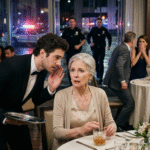
The restaurant where he tried to buy my silence operated in a building owned by my trust.
The hospital room where his lies collapsed carried my mother’s name.
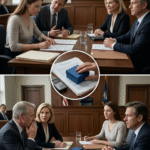
Even the courtroom litigation was funded by insurance policies approved under my authority as controlling shareholder.
Thomas had believed very little belonged to me.
In reality, almost every room in which they tried to erase me had been held open by my family’s money.
The final divorce hearing took place on a bright October morning.
Julian looked thinner.
The polished confidence was gone.
His suit fit badly across the shoulders, and the silver at his temples had become more visible.
The judge approved the settlement.
Neither party would receive spousal support.
Our separate property remained separate.
Julian waived all claims to the Ashford and Rosewood trusts.
I waived any claim to the small amount of personal property he retained.
The marriage ended with signatures.
No shouting.
No dramatic confession.
Just ink crossing paper beneath fluorescent lights.
Outside the courtroom, Julian asked to speak to me alone.
Rebecca remained twenty feet away.
He stood near a tall window overlooking lower Manhattan.
For several seconds, he said nothing.
Then he held out a small velvet box.
Inside was my wedding ring.
I had left it on the bathroom counter the morning after the hospital confrontation.
“I thought you might want it,” he said.
“I don’t.”
“It belonged to your grandmother.”
“The center stone belonged to my grandmother.”
I removed the diamond from the setting before filing for divorce.
“The setting belongs to you.”
He closed the box.
“I did not know.”
“You did not ask.”
“That seems to be the answer to everything.”
“It explains more than you think.”
He looked through the window.
“My father is taking a plea agreement.”
“I know.”
“Sloane wants full custody.”
“Thomas will not contest it.”
“She named the baby Ever because of you.”
“She named the baby Ever because she wanted to replace me.”
He flinched.
“Is there a difference?”
I adjusted the sleeve of my coat.
“Wanting someone’s life is not the same as understanding what it cost.”
He looked at me.
“Did you ever hate her?”
“For a while.”
“And now?”
“Now I think she mistook access for security.”
He gave a tired laugh.
“That sounds like something your father would say.”
“He said it about you.”
The laugh disappeared.
“Of course he did.”
People passed us in the corridor.
Attorneys.
Court clerks.
Couples walking toward endings of their own.
Julian turned the velvet box in his hand.
“Were you ever going to tell me about the company?”
“When?”
“When I knew you loved me more than what my father built.”
His eyes closed briefly.
“And did you ever know?”
“I thought I did.”
The honesty hurt him more than anger would have.
“I loved you, Alexandra.”
“You loved how your life felt beside me.”
“That is not fair.”
I looked at him steadily.
“What was unfair was allowing me to undergo procedures you knew I did not need.”
Shame moved across his face.
“I was afraid.”
“So was I.”
“My father said the report could not be accurate.”
“You let him protect your pride with my pain.”
“I thought if Sloane had my child, it would prove the doctors wrong.”
“And when the test proved the baby was not yours?”
His silence stretched between us.
“You announced her anyway,” I said.
“The stock was unstable.”
“There it is.”
“I had employees depending on me.”
“You had an image depending on you.”
He looked down at the box.
“What happens to Vale Meridian now?”
“We are changing the governance structure.”
“Are you changing the name?”
“Eventually.”
His jaw tightened.
“My family built that company.”
“Your family nearly destroyed it twice.”
“What will you call it?”
“Ashford Meridian.”
He absorbed the answer.
The Vale name would disappear from the buildings, documents, and developments Thomas had once treated as monuments to himself.
Julian’s eyes became wet, though he did not cry.
“You planned to erase us.”
I stepped closer.
“You erased yourselves.”
He looked at me for a long time.
Then he asked the question men like Julian ask only after power stops protecting them.
“Is there any chance you could forgive me?”
“I already have.”
Hope appeared in his face.
I ended it gently.
“Forgiveness is why I can stand here without hating you.”
“It is not an invitation back into my life.”
His shoulders lowered.
“What am I supposed to do with that?”
“Become someone who does not need another person’s silence to feel powerful.”
I walked away.
He did not follow.
Six months later, the company unveiled its new name.
The headquarters remained in the same tower, but the boardroom changed.
I removed Thomas’s limestone walls and Julian’s oversized portrait.
We replaced them with warm wood, local art, and a long window seat overlooking the city.
The room no longer resembled a cathedral.
It looked like a place where people were expected to work.
The recovered money from Camden Strategic Advisory funded the first year of the Ashford Legal Independence Program.
The program provided financial counseling, emergency representation, and private medical advocacy to women facing coercion inside powerful families.
We also created a protected trust for Ever.
The trust did not belong to Sloane.
It did not belong to Thomas.
It did not carry the Vale family’s voting rights.
It paid directly for the child’s health care, education, and future needs.
Rebecca questioned my decision.
“You are not responsible for her.”
“Her mother tried to destroy your marriage.”
“My husband destroyed my marriage.”
“That distinction is generous.”
“It is accurate.”
Ever had entered the world as a strategy.
I wanted at least one part of her future to exist without an adult using her as leverage.
Sloane moved to Connecticut after the hearings.
She sold the cream-and-gold nursery furniture and stopped speaking to reporters.
Once a year, the trustee sent me a formal report confirming that Ever was healthy.
I never visited.
I never interfered.
I simply made sure the money reached the child rather than the people who had built lies around her name.
Thomas served eighteen months in federal prison.
Julian avoided prison after cooperating with investigators and repaying part of the company’s losses.
He moved to Boston and began consulting for a midsize real estate firm.
His name disappeared from newspapers.
Occasionally, I received an email from him.
He never asked me to return.
He wrote about ordinary things.
A restaurant we once loved had closed.
The dogwood tree at his mother’s house had finally bloomed.
He had started seeing a therapist.
I rarely answered.
When I did, I kept my replies polite and brief.
Some doors do not need to be slammed.
They only need to remain closed.
# CONCLUSION
## A Life That Needed No Hashtag
Two years after the hospital confrontation, I returned to the Hudson Valley estate for the opening of a new maternal recovery center.
The wedding pavilion had been removed.
The gold dance floor was gone.
In its place stood a glass conservatory overlooking the river.
There were no magazine photographers.
No celebrity planners.
No champagne tower.
The women arriving that morning were not socialites or executives.
They were mothers recovering from difficult births, women leaving controlling marriages, and families who needed somewhere safe to begin again.
My mother’s name was engraved above the entrance.
My father’s favorite oak tree stood beside the path.
Rebecca joined me near the garden wearing a red coat and carrying two cups of coffee.
“You know,” she said, “normal people take vacations after dismantling dynasties.”
“I went to Maine.”
“You attended a corporate retreat in Maine.”
“There were boats.”
“You read audit reports on one of them.”
I accepted the coffee.
“Reading near water is still relaxing.”
She laughed.
Across the lawn, Daniel Hart was speaking with the architects who had designed the recovery center.
Daniel had joined Ashford Meridian eighteen months earlier to lead our sustainable housing division.
He was thoughtful, divorced, and unimpressed by wealth.
He also knew every detail of my past because he had read about it before our first dinner.
He never treated my history like a wound he had been hired to heal.
He never asked me to become softer so he could feel stronger.
We had been seeing each other quietly for six months.
There were no announcements.
No coordinated photographs.
No hashtags.
When he noticed me watching, he excused himself and walked across the lawn.
“The final inspection passed,” he said.
“I heard.”
“The east wing opens Monday.”
“I heard that too.”
He handed me a small brass key.
“What is this?”
“The private library.”
“I did not request a private library.”
“You requested a room where women could sit without being asked questions.”
“That sounds like a library.”
“That is what I told the contractor.”
I smiled.
Daniel did not ask what the smile meant.
He simply stood beside me as the first families entered the conservatory.
The morning sunlight touched the glass roof.
A little girl ran past us holding her mother’s hand.
Somewhere inside, a piano began playing.
For years, I had believed endings arrived with declarations.
A wedding vow.
A signed contract.
A public announcement printed in gold.
I understood now that real endings were quieter.
They were locks changed without ceremony.
Names removed from doors.
Money returned to the people who earned it.
Rooms rebuilt for better purposes.
They were mornings when you realized you had slept through the night without dreaming of revenge.
Daniel reached for my hand.
He did not grip it.
He left his palm open between us.
I placed my hand in his because I chose to.
Not because cameras were watching.
Not because a family expected it.
Not because a story needed a romantic conclusion.
The river moved beyond the trees.
Behind us, the estate that once hosted my perfect wedding had become a place where imperfect lives could begin again.
Sloane had named her baby after my wedding because she believed taking the word *Ever* would give her my future.
Julian had called it meaningful because he believed stories belonged to whoever announced them first.
They were both wrong.
A name could be stolen.
A photograph could be staged.
A marriage could be rewritten for the press.
But the truth remained patient.
It waited inside bank records, laboratory reports, ownership documents, recorded conversations, and the silence of a woman everyone had mistaken for weakness.
They thought I had lost the husband, the family, the company, and the ending.
What I lost was an illusion.
What I kept was everything real.
She named the baby after the wedding.
I named the truth.
And in the end, the truth was the only name that lasted forever.