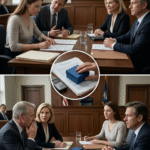
Vanessa had become useful as a witness.
Not as a woman.
He placed a yellow legal pad on the table.
At the top, he had written one sentence.
Stay still.
Judge Halpern entered at 10:32.
She was Black, late fifties, silver-rimmed glasses, no patience for theater.
Everyone stood.
Everyone sat.
The judge looked at the file.
“I have reviewed the emergency petition, supporting exhibits, and preliminary filings.”
Daniel’s attorney stood.
“Your Honor, this is a marital dispute being weaponized into a custody action.”
Judge Halpern looked at her over the glasses.
“Sit down, Ms. Vale.”
Marissa sat.
That was the moment I liked Judge Halpern.
The judge turned to Grant.
“Mr. Whitman, your filing is extensive.”
“I apologize for the volume, Your Honor.”
“I do not.”
A corner of her mouth moved.
Then disappeared.
She looked at Daniel.
“Mr. Shaw, this court is especially concerned by allegations of unauthorized genetic testing of a minor, misuse of medical records, and attempts to establish a narrative of maternal incapacity without court review.”
Daniel stood.
“Your Honor, I love my son.”
The sentence entered the room dressed in innocence.
The judge did not receive it.
“That was not my question.”
Daniel faltered.
Marissa rose quickly.
“My client is prepared to demonstrate that Mrs. Shaw has been under severe emotional distress and that Mr. Shaw acted out of concern for the child.”
Judge Halpern glanced at the file.
“By using the child’s trust in alleged financial transfers?”
Marissa paused.
“That allegation is unproven.”
“By authorizing genetic testing?”
“That was Mrs. Margaret Shaw.”
Margaret’s face did not move.
Judge Halpern looked at Margaret.
“Mrs. Shaw, you are not a parent of the minor child.”
Margaret leaned forward.
“I am his grandmother.”
“And currently alleged to have violated his privacy.”
Margaret’s lips pressed together.
The judge turned back to Marissa.
“Proceed carefully.”
Grant handed up the custody addendum my mother had mentioned.
Marissa objected.
Judge Halpern read it anyway.
As her eyes moved down the page, her expression changed from attention to dislike.
Not shock.
Judges hear too much for easy shock.
Dislike was worse.
It was considered.
“You signed an agreement granting your mother future trustee control over any male child’s inheritance?”
Daniel’s throat moved.
“It was a family estate planning document.”
Judge Halpern read again.
“It refers to a male issue of the marriage as a continuity asset.”
The words landed in the courtroom.
Continuity asset.
Not child.
Not son.
Asset.
Daniel closed his eyes.
Margaret said, “That language is standard in legacy planning.”
Judge Halpern looked at her.
“Not in my courtroom.”
A sound came from behind me.
I turned slightly.
Vanessa stood in the back.
She wore a navy maternity dress, flat shoes, and no pearls.
Her face was pale but steady.
A court officer opened the small gate.
She walked in with Elaine Voss.
“She changed her mind.”
I watched Vanessa approach the witness area.
Daniel saw her.
His face hardened.
Margaret’s eyes narrowed to slits.
Judge Halpern looked at the clerk.
“Who is this?”
Elaine stood.
“Your Honor, Elaine Voss, Shaw Global board ethics chair.”
The judge did not look impressed.
“This is family court, Ms. Voss.”
“Yes, Your Honor.”
Elaine handed a sealed envelope to the court officer.
“But this evidence concerns the child’s unauthorized genetic testing and the conduct of Daniel and Margaret Shaw.”
Judge Halpern sighed.
“Everyone in this family appears to enjoy envelopes.”
No one laughed.
The court officer delivered it.
The judge opened the envelope.
Inside were printed texts.
Vanessa took the witness stand.
She swore to tell the truth.
Her hand shook.
Marissa began immediately.
“Ms. Cole, you are currently involved in a romantic relationship with Mr. Shaw, correct?”
Vanessa looked at Daniel.
Then down at her hands.
Marissa blinked.
“You deny the affair?”
Vanessa lifted her chin.
“I deny the relationship.”
The room went quiet.
“It was an affair,” she said.
“And a transaction I was too foolish to understand.”
Daniel stared at the table.
Marissa recovered.
“Are you angry with my client?”
“Because he ended your affair?”
Vanessa laughed softly.
It was humorless.
She looked at Judge Halpern.
“Because he and his mother used my pregnancy to try to take a child from his mother.”
Margaret whispered something to Daniel.
The judge saw it.
“Mrs. Shaw, one more word and I will have you removed.”
Margaret went silent.
Vanessa testified for forty-three minutes.
She admitted she had gone to my office to humiliate me because Daniel told her I had agreed to resign and wanted a private exit.
She admitted Daniel gave her the earrings and said they were “family pieces Evelyn never appreciated.”
She admitted Margaret arranged private medical appointments and asked invasive questions about her pregnancy.
She admitted Daniel told her Noah would live “where the Shaw future was safest.”
She admitted she had seen draft documents describing me as unstable before I ever knew they existed.
Then Grant asked one question.
“Ms. Cole, did Mrs. Evelyn Shaw ever threaten you?”
“Did she ever offer you money for testimony?”
“Did she ever ask you to lie?”
Grant nodded.
“What did she ask you?”
Vanessa swallowed.
“She asked me if I wanted my child to be born into a family that only loved useful people.”
The courtroom went still.
That had been in the hallway outside the boardroom after everything fell apart.
Vanessa had stood by the elevators, mascara smudged, one hand on her stomach.
I had not comforted her.
I had not forgiven her.
I had only told her the truth.
She looked at Daniel then.
“I didn’t.”
Marissa’s cross-examination was elegant and vicious.
She called Vanessa jealous.
Ambitious.
Rejected.
Unreliable.
Vanessa took it.
Not bravely at first.
Then better.
By the end, she looked less like a mistress and more like a woman waking up inside the wreckage she had helped decorate.
When it was Daniel’s turn, he chose not to testify.
Grant looked unsurprised.
Margaret demanded to speak.
Her attorney tried to stop her.
She stood anyway.
People like Margaret Shaw mistake silence for permission and wealth for immunity.
Judge Halpern allowed it for three minutes.
That was all it took.
Margaret spoke of legacy.
Of stability.
Of the Shaw name.
Of my mother’s opportunism.
Of my emotional nature.
Of Noah’s duty to understand what he would inherit.
She did not say love once.
Not once.
Judge Halpern noticed.
When Margaret finished, the judge removed her glasses.
“Mrs. Shaw, I asked about the welfare of a child.”
Margaret lifted her chin.
“I answered.”
“No,” the judge said.
“You described an asset protection strategy.”
The words settled like dust after a demolition.
At 1:16 p.m., Judge Halpern issued her temporary ruling.
I would retain sole physical custody pending investigation.
Daniel would have supervised visitation only.
Margaret would have no contact.
All genetic records obtained without authorization were sealed and referred for review.
A forensic guardian would be appointed to examine any trust instruments involving Noah.
The court would refer possible medical privacy violations to the appropriate authorities.
Daniel stood motionless.
Margaret looked at me with such hatred that it felt almost intimate.
But hatred is not power.
Not when a judge has signed paper.
Outside the courtroom, reporters waited.
Of course they did.
Shaw Global had already leaked.
Or someone had leaked it for them.
Cameras flashed.
Questions flew.
“Mrs. Shaw, is it true your husband forged your resignation?”
“Did Margaret Shaw order genetic testing on your son?”
“Are you seeking control of Shaw Global?”
“Is Vanessa Cole pregnant?”
Grant guided me through the hall.
I kept walking.
Then I saw Noah.
Aunt Ruth had brought him from the private waiting room.
He stood near the elevator in his navy blazer, holding the dinosaur he had made from magnetic tiles.
He looked too small for the hallway.
Too beautiful for the storm.
I went to him.
Reporters shouted louder.
Aunt Ruth glared at them hard enough to ruin careers.
Noah looked up at me.
“Can we go home?”
I crouched before him.
His eyes moved past me to Daniel.
For one second, father and son looked at each other across the polished courthouse floor.
Daniel’s face broke.
Real this time.
Or maybe I wanted it to be.
Noah raised one small hand.
Not a wave.
Not exactly.
A goodbye a child did not understand yet.
Daniel did not move.
I took Noah’s hand.
We walked away together.
Not toward victory.
Victory is too shiny a word for what survives betrayal.
We walked toward air.
Toward truth.
Toward a future no one else would draft for him.
CONCLUSION: THE HOUSE WITH THE LIGHTS ON
Six months later, the Shaw mansion went on the market.
The listing called it a historic East Hampton estate with old-world elegance, ocean views, and remarkable privacy.
It did not mention the library camera.
It did not mention the gold room.
It did not mention Margaret Shaw leaving through a side door while federal investigators entered through the front.
Rich houses are very good at pretending they have never heard screams.
Daniel resigned before the board could remove him.
The announcement said he was stepping back to focus on family and personal reflection.
That was the public language.
The private language came in subpoenas.
The forged resignation became part of a broader fraud investigation.
Dr. Helen Moritz lost her hospital privileges pending review.
Caleb Price, the security contractor, discovered loyalty had a shorter shelf life than immunity.
Northlake Management collapsed under forensic audit.
The Archer voting block transferred exactly as my mother had designed.
To the independent foundation board.
People called it a loss of control for the Shaw family.
I called it my mother keeping her promise.
Vanessa gave birth to a daughter in late winter.
She named her Clara.
No Shaw middle name.
No legacy initials.
No gold bracelet from Margaret.
She sent me a handwritten note on thick white paper.
It said, I am sorry for the office.
Only that.
Nothing theatrical.
Nothing self-forgiving.
I kept it in a drawer.
Not because I forgave her completely.
Because one day Clara might need proof that her mother tried to become better before the world decided what she was.
Margaret moved to Palm Beach and gave one interview about betrayal, modern marriage, and the tragedy of ungrateful daughters-in-law.
It aired on a Sunday morning.
Aunt Ruth watched three minutes, called her “a chandelier with rabies,” and changed the channel.
Noah laughed so hard orange juice came out of his nose.
That laugh healed something in the room.
Not everything.
But something.
Daniel saw Noah twice a month in a supervised family center with beige walls and board games missing pieces.
At first, Noah refused to go.
Then he went and came home quiet.
Then he went and came home angry.
Then, one evening, he came home and asked if people can love you and still hurt you.
I told him yes.
He asked if that made the hurt okay.
I told him no.
He thought about that for a long time.
Then he asked for pancakes for dinner.
We made them badly.
Aunt Ruth burned the first batch and blamed the stove.
Paige came to work for the Archer Foundation.
She still color-coded folders like national security depended on it.
Grant retired for exactly eleven days before becoming our foundation counsel emeritus, which apparently meant doing the same job with better lunches.
As for me, I did not keep the corner office.
I moved to a smaller one with windows that opened.
I put my wedding photo in a box.
Not facedown.
Not shattered.
Just away.
I hung a photograph of my mother beside my desk.
In it, she was laughing on a sailboat in Maine, hair blown wild, pearls in her ears, one hand lifted against the sun.
The earrings now sit in a velvet case at home.
I will give them to Noah someday if he wants them.
Or to someone he loves.
Or maybe I will keep them until they become only pearls again, not evidence, not grief, not proof that dead women can still win if they leave the right paper behind.
The night we moved into our new house in Connecticut, Noah carried his own pillow inside.
The house was not a mansion.
It had creaky stairs, blue shutters, a kitchen too small for three people and somehow perfect for two, and a maple tree in the front yard that dropped leaves like tiny gold letters.
Noah stood in the doorway of his new room.
“Can I paint it green?”
“Any green?”
“Within reason.”
“What’s reason?”
“Not neon.”
He nodded seriously.
Then he looked at me.
“Are we safe here?”
I wanted to say yes the way mothers in movies say yes.
Instantly.
Beautifully.
As if safety were a door you could lock once and trust forever.
But I had learned better.
I sat on the edge of his bed.
“We are honest here.”
He climbed beside me.
“And we protect each other here.”
He leaned his head against my shoulder.
“And nobody packs your office?”
I laughed then.
Really laughed.
The sound surprised us both.
“Nobody packs my office.”
Outside, dusk settled over the lawn.
A neighbor’s dog barked.
A car passed slowly.
Somewhere, far away, people were still whispering about the Shaw scandal over champagne and marble.
Let them.
I had spent years inside rooms where silence was mistaken for weakness.
I had watched my husband give my mother’s earrings to another woman.
I had watched his family call me unstable because they could not call me beaten.
I had watched judges, lawyers, board members, mistresses, and mothers-in-law learn the same lesson.
A woman does not need to scream to bring down a house.
Sometimes she only needs to sit still.
Watch carefully.
Save every receipt.
And when the time comes, place the black folder on the table.
Noah fell asleep against me before the movers finished downstairs.
I stayed there in the half-painted room, holding my son while the last light slipped through the blinds.
For the first time in a long time, no one was watching through glass.
No one was waiting outside the door with a lie.
No one was deciding what I deserved.
The house was quiet.
Not funeral quiet.
Not boardroom quiet.
Home quiet.
And in that quiet, I finally understood what my mother had tried to teach me.
Some betrayals do not end your story.
They introduce you to the woman who was supposed to write the rest.