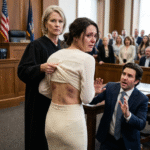
I felt it enter, and I refused to bleed where she could see.
“Madison,” I said quietly.
“You should be very careful about what you think you gave him.”
She smiled again.
“Are you threatening me?”
I glanced at the diamond ring.
“I’m warning you that Grant never pays full price for anything unless he expects ownership.”
For the first time, the smugness slipped.
Just a little.
Then Grant appeared behind her.
“Madison,” he said.
She turned quickly.
The fear on her face was gone before most people would have noticed it.
I noticed.
Grant looked at me.
“You’re done.”
I met his eyes.
He leaned close enough that only I could hear.
“You want the truth, Naomi?”
The music drifted behind us, rich and mournful.
“I gave this family what you couldn’t.”
The words should have shattered me.
Instead, they clicked into place.
Men reveal themselves when they think the knife is already in.
I held his gaze.
“You gave me jurisdiction.”
By midnight, the first photos were online.
By breakfast, Madison Reed was trending in Chicago society circles.
By noon, three gossip accounts had posted side-by-side images of me in black velvet and Madison in white satin.
The captions were brutal.
THE WIFE AND THE REPLACEMENT.
GRANT WHITAKER DEBUTS LOVE CHILD AT FAMILY GALA.
OLD MONEY, NEW SCANDAL.
I read none of the comments.
I was in Iris Chen’s office overlooking the river, signing emergency petitions.
On the conference table lay the hospital photo, the gala recording, the company ledger, and a sealed request for genetic testing.
Iris tapped the bracelet image with one manicured nail.
“This is the thread.”
Theo leaned back in his chair, his eyes bloodshot from three nights inside financial records.
“Not a thread.”
He tossed another folder on the table.
“A fuse.”
I opened it.
Inside was the Delaware LLC registration for Meridian Birth Partners.
The listed manager was a law firm that had represented Grant in a private trust matter.
The beneficial ownership trail went through two shell companies.
The final recipient was Madison Reed.
I looked at the transfer schedule.
Payments began eleven months earlier.
One week after I told Grant I was not ready to use a surrogate.
My throat tightened.
Iris saw it.
“I’m fine.”
“No, you’re functioning.”
“That is more useful.”
Theo slid another page toward me.
“There’s more.”
The page was a scanned clinic invoice from Havenbrook Fertility.
My eyes found the date.
Then the procedure code.
Then the embryo ID.
I stopped breathing.
Not metaphorically.
My body simply forgot.
Embryo E-4.
Our embryo.
Mine and Grant’s.
The one I had nicknamed Sparrow because the embryologist said it looked stubborn.
I had only told Grant that name.
Not his mother.
Not Iris.
Not anyone.
Theo’s voice softened.
The room blurred.
I pressed my palm flat against the table.
There are betrayals the heart can understand.
An affair.
A lie.
A secret child.
Then there are betrayals so intimate they do not enter through the heart.
They enter through the bone.
“He used one,” I said.
Iris was already standing.
“We don’t know that yet.”
“Yes,” I whispered.
“We do.”
The bracelet had proved he was with Madison.
The invoice proved he had gone somewhere worse.
PART 4: THE COURTROOM OF WHITE MARBLE
The emergency hearing was held eleven days after the gala.
Cook County Probate and Family Court was not glamorous, but on that morning, it looked like a battlefield dressed for a wedding.
Reporters waited outside despite the sealed filing.
Grant arrived with two attorneys, his father Malcolm, and the expression of a man insulted by consequences.
Madison arrived twenty minutes later in camel cashmere, dark sunglasses, and the diamond ring.
She carried the baby.
James.
Sparrow.
My son, maybe.
My almost impossible thought.
My stolen possibility.
The judge sealed the courtroom within three minutes and banned recording devices.
That did not stop the hallway from vibrating with rumor.
I sat beside Iris, wearing navy and no jewelry except my wedding ring.
I kept it on because Iris said symbols matter.
Grant looked at it once.
Then away.
Judge Eleanor Ward was in her sixties, with silver hair, sharp glasses, and the devastating calm of a woman who had raised children, buried a husband, and listened to rich men lie for thirty years.
She reviewed the initial motions in silence.
Then she looked up.
“Mrs. Whitaker is requesting emergency genetic testing, preservation of corporate and medical records, temporary restraint on removal of the minor child from Illinois, and a freeze on certain marital and corporate assets.”
Grant’s lead attorney stood.
“Your Honor, this is a vindictive filing by an estranged spouse attempting to weaponize a newborn child.”
Iris rose smoothly.
“My client is attempting to determine whether her genetic material was used without consent.”
The courtroom went still.
Madison’s face changed.
Not much.
Grant leaned toward his attorney and whispered.
Judge Ward looked at Iris.
“Basis?”
Iris placed the hospital photo on the evidence monitor.
Madison’s bracelet filled the screen.
A strange thing happens when private shame is enlarged for legal review.
It stops being gossip.
It becomes data.
Iris continued.
“The number printed beneath Ms. Reed’s name corresponds to a payment memo used by Whitaker Meridian Holdings to route funds to Meridian Birth Partners, an entity ultimately controlled by Ms. Reed.”
Grant’s attorney objected.
Judge Ward overruled him before he finished.
Iris presented the ledger.
Then the invoices.
Then the Havenbrook record.
When Embryo E-4 appeared on the screen, I heard Madison inhale.
Grant did not move.
That was how I knew.
He had prepared for accusations of cheating.
He had prepared for humiliation.
He had not prepared for the number.
Judge Ward removed her glasses.
“Mr. Whitaker, are you prepared to explain why a corporate payment code appears on Ms. Reed’s maternity bracelet and a fertility clinic invoice connected to embryos jointly owned by you and your wife?”
Grant’s attorney stood again.
“Your Honor, these are complex medical privacy issues.”
The judge looked bored.
“They often are.”
Then she looked directly at Grant.
“Answer through counsel if you prefer, but someone will answer today.”
Grant’s father Malcolm shifted in the back row.
For the first time, the old man looked less angry than worried.
Madison clutched the baby to her chest.
I watched her hand.
The diamond ring trembled.
Iris called our first witness remotely.
Dr. Helena Morris, director of Havenbrook Fertility, appeared on the screen with the gray complexion of a woman whose malpractice insurance had just become a prayer.
She confirmed six embryos had been stored under a dual-consent agreement.
She confirmed Embryo E-4 had been released for transfer nine months earlier.
She confirmed the file contained a consent form bearing my signature.
Then Iris displayed my passport record.
On the date my signature was notarized in Illinois, I was in London opening a clinical research center.
Iris displayed photos from the event.
There I was at a podium in a blue suit, standing beside the British health secretary while someone in Evanston was apparently signing away my embryo.
The judge’s mouth tightened.
“Dr. Morris,” she said.
“Who presented the consent?”
Dr. Morris swallowed.
“The request came through a private reproductive coordination firm.”
“Name?”
“Meridian Birth Partners.”
“Who paid?”
Dr. Morris hesitated.
Judge Ward leaned forward.
“Doctor.”
“Whitaker Meridian Holdings.”
Grant closed his eyes briefly.
A small motion.
A confession without words.
Then came the genetic report.
Emergency testing had been ordered quietly through the hospital when Iris filed the petition.
The results were not supposed to be dramatic.
Paper rarely is.
But when Iris read them aloud, the room seemed to lose oxygen.
“The minor child identified temporarily as James Reed Whitaker is genetically consistent with Grant Whitaker as biological father.”
Grant stared at the table.
“And genetically consistent with Naomi Ellison Whitaker as biological mother.”
Madison made a sound.
It was not grief.
It was disbelief that the game board had moved under her hands.
I did not cry.
He was asleep against Madison’s shoulder, one fist curled near his cheek.
His life had begun inside theft.
That did not make him stolen goods.
It made him a child who needed someone in the room to love him more than the argument.
Grant finally spoke.
“I did it for us.”
His attorney grabbed his sleeve.
Grant shook him off.
He turned toward me.
The courtroom blurred at the edges, but his face stayed painfully clear.
“You were drowning, Naomi.”
His voice grew softer, almost persuasive.
“Every pregnancy destroyed you.”
I said nothing.
“You said you wanted to be a mother.”
Iris touched my wrist under the table, warning me not to answer.
Grant leaned forward.
“I gave you a son.”
Judge Ward’s eyes sharpened.
I looked at him for a long moment.
Then I said, “You rented my body out of the room.”
The words landed harder than shouting would have.
Even Madison looked away.
Grant’s face flushed.
“That is not what happened.”
“You forged my consent.”
“I protected you.”
“You paid your mistress to carry my embryo.”
“She was a surrogate.”
Madison laughed once.
It was bitter and terrified.
“A surrogate?”
Grant turned on her.
She looked at him as if seeing, perhaps too late, the shape of the man holding her leash.
“You told me she agreed after the miscarriage.”
Iris stood.
“Ms. Reed, are you stating under oath that Mr. Whitaker told you Mrs. Whitaker consented?”
Madison’s attorney whispered fiercely in her ear.
Madison stared at Grant.
He shook his head once.
Small.
Deadly.
She swallowed.
Then she lifted her chin.
“He said Naomi was too unstable to be involved.”
A murmur moved through the sealed room.
“He said the baby would be raised by us until the divorce finalized.”
Her voice cracked on us.
“He said once the Whitaker trust recognized the child, everything would be secure.”
Judge Ward looked up.
“What trust?”
Iris had been waiting.
She opened another folder.
“The Whitaker Legacy Trust, Your Honor.”
Grant’s father stood.
“This is not relevant.”
Judge Ward did not look at him.
“Sit down, Mr. Whitaker.”
Malcolm sat.
“Under the amended terms executed by James Whitaker Sr., the first biological child born to Grant Whitaker during a lawful marriage receives a protected twenty-two percent beneficial interest in Whitaker Meridian Holdings.”
She turned a page.
“Until the child reaches twenty-five, voting control is exercised by the child’s legal mother, unless she is deemed absent, incapacitated, or has relinquished parental claims.”