Everyone knew.
No one said it.
That is the first rule of wealthy scandal.
Silence is not discretion.
It is appetite with better posture.
Grant stood near the entrance in a tuxedo, beautiful in the way polished weapons are beautiful.
His eyes moved over my bare left hand.
Then he stepped close enough to kiss my cheek for the cameras.
I turned my head slightly.
His lips met air.
A photographer caught it.
“You’re late,” he said.
“I’m exactly on time.”
“You removed your ring.”
“It was heavy.”
His smile stayed fixed for the cameras.
“You’re embarrassing yourself.”
“Am I?”
“People are watching.”
I looked around the ballroom.
Then I smiled.
“Try not to disappoint them.”
His hand closed around my elbow.
Not hard enough to bruise.
Hard enough to remind me of ownership.
I glanced down at his fingers.
He released me.
Across the room, Madison entered.
Red again.
This time in velvet.
A dress cut low enough to announce confidence and high enough to pass as elegance.
She wore no visible bump yet, but she moved with one hand near her abdomen, as if guarding a crown jewel.
Eleanor walked beside her.
That was the public declaration.
The mother had chosen the mistress.
The room changed temperature.
Conversations thinned.
Heads turned.
Phones tilted.
Grant saw them and cursed under his breath.
“Did you know she was coming with my mother?” he asked.
That was true.
But I was grateful.
Villains who choreograph their own downfall save everyone time.
Madison crossed the room like a bride walking toward a second altar.
She stopped in front of us and smiled at me.
I looked at Eleanor.
“Bold accessory.”
Eleanor’s mouth tightened.
Madison’s smile faltered, then sharpened.
“You look beautiful.”
“So do you.”
I let my gaze rest briefly on her stomach.
“Glowing, even.”
Grant stepped in.
“Enough.”
A bell chimed for dinner.
We took our seats at the head table.
The arrangement was obscene.
Grant in the center.
Me on his right.
Eleanor on his left.
Madison two seats away beside Preston Whitmore, Grant’s cousin and the company CFO.
Preston was handsome in a softer way than Grant, with sandy hair, nervous eyes, and a habit of laughing half a second late.
I had never trusted him.
Not because he was cruel.
Because he was weak.
Weak men create messes and call them tragedies.
Dinner arrived in silver-domed courses no one tasted.
Grant gave a speech about legacy.
Family.
Responsibility.
The future.
Every word landed like a rotten fruit.
Then Eleanor rose unexpectedly.
Grant’s head turned sharply.
That was not in the program.
Eleanor smiled at the room.
“My late husband used to say a family is not measured by its perfection, but by its capacity to endure.”
Soft applause.
Madison lowered her eyes with perfect timing.
I watched the cameras turn.
Eleanor continued.
“Tonight, as we celebrate the work of this foundation, I am reminded that compassion begins at home.”
My stomach went cold.
Grant whispered, “Mother, don’t.”
But Eleanor Whitmore had never obeyed her son when control was within reach.
She lifted her glass.
“To the next generation of Whitmores, wherever and however they arrive.”
The ballroom erupted in whispers.
Madison placed a hand on her stomach.
A photographer captured it.
Grant went white with anger.
Not shame.
Anger.
Because Eleanor had taken his scandal and made herself its author.
I sat perfectly still.
Then I stood.
The whispers died faster than the applause had.
Grant’s hand shot out under the table.
I stepped away before he could touch me.
I took the microphone from the stunned emcee with a polite smile.
“Thank you, Eleanor.”
My voice carried clearly through the ballroom.
“You have always had a remarkable gift for making private pain sound like a tax-deductible virtue.”
A few people gasped.
Someone laughed once and regretted it.
Grant stood.
“Sit down, Grant.”
The room froze.
No one spoke to Grant Whitmore that way.
Not in public.
Not with cameras rolling.
I turned back to the audience.
“I had prepared remarks tonight about literacy grants and hospital partnerships.”
I looked at Madison.
“But the evening has taken a more personal direction.”
Madison’s lips parted.
Eleanor’s face had gone marble-hard.
“I will not discuss a child who has no responsibility for the choices of adults.”
That line mattered.
I meant it.
No child deserves to be born into warfare.
But adults do.
“However,” I continued, “I will say this.”
I let the silence gather.
“Humiliation is not the same thing as defeat.”
A camera flash exploded.
“Betrayal is not the same thing as weakness.”
“And a wife who stays quiet is not always a wife who knows nothing.”
His eyes changed.
Fear.
Small.
Fast.
Real.
I handed the microphone back.
Then I walked out of the ballroom.
No running.
No trembling.
No tears.
Just the sound of my heels striking marble while five hundred people watched the first crack split the Whitmore name.
Outside the ballroom, Miles Renner waited near the coat check in a navy suit.
He was holding a leather folder.
“You did well,” he said.
“I spoke longer than planned.”
“You spoke just enough.”
Behind us, the ballroom doors opened.
Grant came out first.
Madison followed at a distance, pale and furious.
Eleanor moved like a queen approaching an execution.
Grant stopped in front of me.
“What have you done?”
“Nothing yet.”
Miles stepped forward.
“Mr. Whitmore.”
Grant’s eyes cut to him.
“Miles.”
“I am here as Mrs. Whitmore’s counsel.”
Grant laughed.
“You have got to be kidding.”
Miles opened the folder and handed him a document.
“Notice of proxy termination pursuant to the Hart-Whitmore marital addendum.”
Grant stared at the first page.
Then the second.
Then his face emptied.
Eleanor snatched the document from him.
Her eyes flew across the lines.
Madison whispered, “What is that?”
I looked at her.
“It is the part of the marriage Grant forgot to tell you about.”
Grant’s voice dropped.
“You can’t enforce this.”
Miles smiled.
“I drafted it.”
Eleanor looked up slowly.
“This requires proof.”
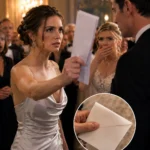
I reached into my clutch and removed a clear evidence sleeve.
Inside was the ultrasound photo.
The same one Madison had left on my table.
The timestamp faced outward.
The clinic label gleamed under the hotel lights.
Madison looked sick.
“Thank you for delivering it personally.”
Grant turned on her.
“You left it?”
Madison’s eyes filled with tears too quickly.
“I thought she deserved to know.”
“You thought I deserved to hurt.”
She looked at me then, really looked at me, and the hatred behind her pretty face was almost honest.
“You had everything.”
The mistress’s hymn.
As if marriage were a mansion with unlocked doors.
As if betrayal were redistribution.
As if wanting what belongs to another woman makes you brave instead of ordinary.
“I had a husband who lied, a mother-in-law who measured my usefulness in shares, and a daughter whose heart he kept bruising.”
I let my gaze move from her to Grant.
“You wanted the wrong prize.”
Grant folded the notice with shaking hands.
“This is corporate blackmail.”
“This is contract law.”
Miles added, “And tomorrow morning, Mrs. Whitmore will be recognized as the voting authority over her holdings.”
Eleanor’s voice went quiet.
“You will destroy Lily’s legacy.”
“I’m separating it from yours.”
Behind us, the ballroom doors had opened again.
Guests hovered, pretending not to listen.
One man had his phone angled too high.
Grant noticed.
His face shifted back into public mode.
He lowered his voice.
“Come home.”
I almost pitied him then.
Not because he deserved it.
Because he believed control was a door I would always walk back through.
“I am home,” I said.
“Just not with you.”
Then Miles and I walked out into the Manhattan night.
By midnight, the clip had spread everywhere.
Amelia Whitmore tells billionaire husband to sit down.
Wife leaves gala after mistress pregnancy toast.
Whitmore scandal explodes at charity event.
By morning, my face was all over Facebook, TikTok, and the gossip sites.
Some called me cold.
Some called me iconic.
One woman commented, She did not cry because she had receipts.
That one made me smile for the first time in three days.
PART 4: THE PATERNITY TRAP
Grant filed for emergency marital mediation on Monday.
That was lawyer language for panic in a tailored suit.
His petition asked for privacy, temporary reconciliation counseling, and a mutual non-disparagement agreement.
It also asked that Lily remain in the marital home with both parents until resolution.
The last line made my blood go cold.
Not because I feared shared custody.
Because Grant had never once read Lily’s bedtime chapter unless I placed the book in his hand.
Now he wanted proximity.
Not to parent.
To bargain.
My attorneys filed the next morning.
Divorce.
Primary physical custody.
Forensic accounting.
Enforcement of the prenup addendum.
Preservation of electronic records.
Subpoenas for Grant’s corporate devices, Madison’s company communications, and all medical-related scheduling records voluntarily shared with Grant through his accounts.
Miles called it a clean opening strike.
I called it breathing.
Grant called me eleven times.
I answered none.
On the twelfth call, he left a voicemail.
“You’re making me into a monster because I made one mistake.”
I listened to it once.
Then I forwarded it to Miles.
Mistake.
That word again.
A mistake is forgetting an anniversary.
A mistake is sending the wrong attachment.
A mistake is buying whole milk when the house drinks oat.
Missing your daughter’s play to attend your mistress’s ultrasound is not a mistake.
It is a choice wearing cologne.
The first hearing took place at the Stamford Superior Court, in a room too plain for the size of the lives being dismantled inside it.
Grant arrived with three lawyers.
Eleanor arrived with pearls.
Madison arrived in pale blue maternity couture though she was still barely showing.
I arrived in charcoal wool, carrying nothing but my phone and my father’s fountain pen.
Grant looked at me across the aisle.
For a second, I saw exhaustion in him.
Then I remembered Lily staring at the empty seat.
The softness left.
The judge was a woman named Patricia Caldwell, with silver hair, sharp glasses, and no visible patience for rich people confusing inconvenience with persecution.
Grant’s lead attorney argued first.
He spoke of family unity, media pressure, the emotional needs of the child, and the dangers of destabilizing Lily’s environment.
My attorney, Dana Cho, waited calmly.
Dana was younger than Miles, brilliant, and so composed she made silence feel expensive.
When she rose, she placed one photograph on the table.
Lily in her moonbeam costume, standing center stage.
Then she placed one empty reserved-seat card beside it.
Grant Whitmore.
The courtroom changed.
Not dramatically.
Courts do not gasp like ballrooms.
But the air altered.
Dana said, “On the evening Mr. Whitmore was scheduled to attend his daughter’s school performance, he informed his wife he was required at an emergency board meeting.”
She placed the ultrasound photo beside the seat card.
“Instead, records indicate he attended a prenatal appointment with Madison Rowe.”
Grant’s attorney objected.
Dana allowed him to finish.
Then she continued.
“The question today is not morality.”
She looked at the judge.
“It is judgment.”
Judge Caldwell looked at Grant.
He looked down.
Madison shifted in her seat.