I saw my father’s confidence falter.
My mother sat down again, but not fully. She hovered on the edge of the chair, as if still hoping to escape the room before truth could find her.
Grant recovered first. He always did. Panic, in him, turned into attack.
“Fine,” he said. “Let’s pretend any of this is real. Emma still abandoned the place. She doesn’t get to swoop in now and play saint.”
Meredith’s face softened in my direction. “Actually, Grant, that brings us to the financial records.”
I closed my eyes for one second.
Not because I was afraid.
Because there are humiliations you survive by telling yourself they are invisible, and when someone finally turns on the light, it hurts in a different way.
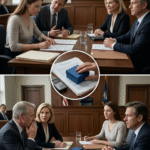
Meredith removed a stack of papers from a blue folder.
“Property taxes from 2019 through 2026,” she said. “Paid by Emma Whitaker from her personal checking account.”
She laid the first document on the table.
“Insurance premiums. Paid by Emma.”
Another document.
“Roof repair. Well pump replacement. Winterization. Caregiver invoices during Henry’s final summer. Prescription co-pays. Hospital parking and overnight lodging during his cardiac admissions. Paid by Emma.”
With each paper, the room became less a dinner and more a trial.
My aunt whispered, “I didn’t know.”
I wanted to turn to her and say, You never asked.
But I stayed still.
My father stared at the receipts as if they were written in another language.
My mother looked at me then. Really looked.
It would have meant more years ago.
Grant shoved back from the table. “Anyone can pay bills and act like a martyr. That doesn’t mean she owns the place.”
Meredith nodded once. “Correct. Payment alone would not transfer ownership. The trust does.”
“Then why bring up the bills?” Grant demanded.
“Because you submitted reimbursement claims to the estate stating you had paid those expenses personally.”
The room changed.
It was not silence now.
It was impact.
Grant’s mouth opened.
No sound came.
Meredith slid another page forward.
“This is your signed reimbursement request for $87,400 in cabin-related expenses. The estate account issued payment to Whitaker Development Group on your instruction.”
My father’s head snapped toward him.
Grant’s face reddened. “That was internal accounting.”
Meredith said, “It was false accounting.”
A title officer at the far end of the table suddenly became very interested in her water glass.
The representatives from Tahoma Ridge exchanged a look.
My mother whispered, “Grant?”
He turned on her. “Don’t look at me like that. Dad told me to keep things moving. The estate was a mess. I cleaned it up.”
“You claimed my payments,” I said.
My voice sounded distant to me. Not weak. Not angry. Just tired.
Grant looked at me with pure hatred because I had finally said the plain thing in front of witnesses.
“You didn’t need the money,” he said.
A laugh escaped me before I could stop it. Not loud. Not amused. Just disbelief finally finding air.
My mother flinched.
Grant leaned forward. “Oh, come on. Don’t act poor. You chose that nonprofit architecture job so everyone would think you were noble.”
“I chose work that didn’t require stealing.”
His eyes flashed.
For a moment, I saw the boy in the hallway, the broken glass, the blood on my leg, the lie already forming.
My father stood. “Enough.”
Again, not at Grant.
At the situation.
Meredith closed the folder with a soft, final sound. “There is more, Robert. But not here.”
Grant’s head whipped toward her. “More?”
Meredith looked at the Tahoma Ridge representatives. “Given the title defect, the sale cannot proceed. I recommend your company suspend all closing activities pending legal review.”
One of the representatives, a woman named Caroline Price, stood immediately.
“Tahoma Ridge had no knowledge of any trust dispute,” she said carefully. “We’ll be in touch through counsel.”
Grant stared as his buyer walked out.
That was the first thing he truly mourned.
Not Grandpa’s ashes.
Not the note.
The money.
My mother covered her mouth. Tears had gathered in her eyes, but I could not tell whom they were for.
My father looked suddenly older.
He turned to Meredith. “What are you implying?”
Meredith’s gaze cut toward Grant, then back to my father.
“I am not implying anything tonight. I am advising that the family meet at my office Monday morning. The trust will be reviewed. The estate reimbursements will be reviewed. The title will be corrected.”
Grant laughed harshly. “You think Emma can just walk in and take everything?”
“No,” Meredith said. “Henry already gave her what mattered. You are the one who tried to sell it.”
My brother looked at me then with a kind of raw disbelief, as if I had betrayed him by no longer being available to lose.
I stood.
Every person in that room watched me.
For most of my life, I had imagined what it would feel like to finally be believed. I thought it would feel like relief. Maybe triumph. Maybe justice.
It did not.
It felt like standing in a room full of people who had seen smoke for years and were only now admitting there had been fire.
I turned to Ray Ellis.
“Where is the urn now?”
He gestured to the box. “Here. We didn’t open the sealed inner container.”
Then I looked at Meredith. “Can Grandpa’s ashes be taken somewhere safe tonight?”
“Yes,” she said. “I’ll arrange it.”
My mother reached across the table. “Emma.”
I paused.
Her hand hovered between us, trembling.
For one dangerous second, I wanted to take it. Not because she deserved it, but because every ignored child carries a small, foolish graveyard of hopes. A mother’s hand. A father’s apology. A brother’s confession. A family that turns back in time.
But I was no longer twelve.
I was no longer standing in broken glass.
I picked up Grandpa’s note instead.
“Not tonight,” I said.
And I walked out of the Willowmere Club with my grandfather’s handwriting pressed against my chest.
Chapter 4: When the Golden Boy Finally Lost the Room
The meeting at Meredith Sloane’s office did not happen quietly.
Grant made sure of that.
By Monday morning, half the family had received a message from him claiming I had “weaponized Grandpa’s decline,” “planted emotional evidence,” and “colluded with an elderly attorney to seize family property.”
He sent it to the Whitaker family group chat at 6:12 a.m.
By 6:19, Aunt Marjorie replied with a praying-hands emoji.
By 6:22, Cousin Dana wrote, I always knew Emma resented Grant.
By 6:31, my mother wrote, Please everyone, let’s stay calm.
She did not correct him.
That hurt more than the original accusation.
I screenshotted the messages, then put my phone face down.
Meredith’s office occupied the twenty-third floor of a downtown Seattle building with a view of Elliott Bay. The waiting room smelled like leather, coffee, and old money pretending not to be afraid of paperwork.
When I arrived, Grant was already there.
So were my parents, Aunt Marjorie, two cousins, my father’s corporate attorney, a Columbia Trust Bank officer, and a forensic accountant named Denise Vale whom Meredith had apparently hired months earlier.
Months.
Grandpa had not only left instructions.
He had left a net.
Grant stood by the window, phone in hand, jaw tight. My mother sat rigidly on a sofa, pale beneath her makeup. My father paced near the conference room doors like a man waiting to enter a fight he had assumed was fixed.
When he saw me, he stopped.
“Emma,” he said. “Before this begins, I want you to understand something. Your grandfather loved all of us. Whatever documents Meredith has, they should be interpreted in that spirit.”
I looked at him.
“All of us?” I asked.
He frowned. “Yes.”
“Did that spirit include letting Grant call me a thief to twenty relatives this morning?”
My mother closed her eyes.
Grant shoved his phone into his pocket. “I called you manipulative.”
“Thank you for clarifying.”
My father’s mouth tightened. “This attitude is exactly why people struggle with you.”
There it was, even now.
Evidence had surfaced. Ashes had been found. Fraud had been named.
And somehow, my tone was on trial.
Meredith opened the conference room door. “We’re ready.”
Inside, folders waited at every seat. At the front of the room was a large screen. Beside it, Denise Vale arranged documents with the calm efficiency of someone who enjoyed numbers because numbers did not cry or lie to protect sons.
Meredith began with the trust.
Henry Hale had placed the cabin parcel into the Hale Land Preservation Trust six weeks before his final hospitalization. The trust’s primary purpose was to preserve the cabin and land as a noncommercial family retreat or, if the family refused that purpose, a community educational retreat for children who had lost parents or grandparents.
That made my throat tighten.
Grandpa had lost his own father at thirteen.
The triggering clause was precise.
If any beneficiary attempted to sell, develop, mortgage, demolish, or commercially transfer the cabin property without unanimous consent and without successor trustee approval, all management rights transferred immediately to me.
Not my mother.
Not my father.
Not Grant.
Me.
Grant leaned back in his chair with exaggerated boredom.
“This is a control document,” he said. “Grandpa was manipulated by whoever wanted control.”
Meredith clicked a remote.
A video appeared on the screen.
Grandpa sat in Meredith’s office, thinner than I remembered, but alert. His Mariners cap sat on the table beside him. He looked directly into the camera.
My mother gasped.
My father went still.
In the video, Meredith asked, “Henry, can you tell us why you are creating this amendment?”
Grandpa’s voice filled the room, rough and familiar.
“Because my family has a habit of calling greed practicality when it wears a good suit.”
Grant’s face went hard.
In the video, Grandpa continued.
“My daughter Patricia loves comfort more than truth. Robert loves appearances more than people. Grant loves winning more than belonging. Emma loves what lasts.”
My mother began to cry silently.
I could not look away.
Meredith asked, “Are you aware this may cause conflict?”
Grandpa laughed once. “Meredith, my family is conflict with better silverware.”
A sound moved through the room. Not laughter. Recognition.
Then Grandpa’s face softened.
“Emma will not ask for what she deserves,” he said. “That is why I am putting it in writing. She paid what they ignored. She came when they performed. She built what they sold in their heads before my body was cold.”
I pressed my fingers into my palm beneath the table.
On screen, Meredith asked, “What do you want done with your ashes?”
Grandpa looked down for a long moment.
“I want them at the cabin,” he said. “Not scattered for ceremony. Kept until the family shows me who they are.”
My mother covered her face.
Grant stood suddenly. “Turn it off.”
Meredith paused the video. “Sit down, Grant.”
He stared at her. Nobody spoke to him that way. Not in our family.
He did not sit.
Denise Vale stood next.
She was in her fifties, with silver curls and square glasses, and she carried a binder thick enough to end someone’s reputation.
“The estate reimbursement issue is separate from the land trust,” she said. “But it is relevant to attempted sale proceeds and beneficiary conduct.”