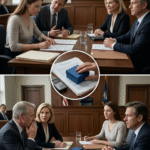
Inaccurate.
Another small word carrying a mountain.
I signed where Meredith marked.
Not because the words healed me.
Because they ended the argument.
My parents asked to see me in person after the hearing.
I agreed to meet them at a coffee shop in Wenatchee, not at their house, not at the club, not in any room where I had once been smaller.
They arrived together.
My father looked thinner. My mother looked older in a way makeup could not conceal. For the first time, neither of them seemed like a portrait of success. They seemed like two people who had built a beautiful home and discovered all the load-bearing walls were made of excuses.
We sat at a corner table while rain moved down the windows.
My mother spoke first.
“I don’t know how to apologize for all of it.”
I wrapped my hands around my coffee cup. “Then don’t start with all of it.”
She nodded, tears gathering. “I’m sorry for the cabin. I’m sorry for not knowing what you paid. I’m sorry for letting Grant say those things.”
I waited.
She swallowed. “And I’m sorry I made you easier to blame than to defend.”
That one reached me.
Not enough to erase.
Enough to enter.
My father looked down at his hands. I had never noticed how old they were. When I was little, those hands had seemed capable of fixing anything except the hurt inside his own house.
“I admired Grant because he reminded me of what I wanted people to see in me,” he said. “Confident. Decisive. Unafraid. I criticized you because you reminded me of what I avoided.”
He looked up.
“You saw the truth. Even as a child. And I punished you for making denial harder.”
My mother began crying.
My father’s eyes shone, but he did not let the tears fall.
“I failed you,” he said. “Not once. As a pattern.”
That was the closest thing to truth he had ever given me.
For a few seconds, the little girl inside me reached toward it with both hands.
Then the woman I had become gently stopped her.
“Thank you for saying that,” I said.
My mother leaned forward. “Can we start over?”
The old Emma would have heard a door opening.
The new Emma heard the missing word.
Over.
As if the past were a room we could repaint.
“No,” I said softly. “We can’t start over.”
My mother’s face crumpled.
I continued before pity could tempt me into lying. “We can start differently. Slowly. With boundaries. With no access to my finances, no family pressure, no messages through relatives, no conversations where Grant’s comfort becomes my responsibility.”
My father nodded immediately. My mother struggled, then nodded too.
“And the cabin?” she asked.
“The cabin stays in the trust.”
“Can we visit?”
I looked out the window. Rain blurred the town into watercolor.
I thought about Grandpa’s warning.
Listen only as long as your peace allows.
“You can come for the memorial service,” I said. “After that, visits will be by invitation.”
The words hurt them.
They freed me.
That spring, I drove to the cabin alone.
The road was muddy from snowmelt. The pines smelled sharp and clean. The porch sagged a little more than I remembered, and a raccoon had attempted war on the trash bin, but the cabin was still standing.
The firepit had been carefully dismantled during the recovery of Grandpa’s urn. Ray Ellis had marked each stone with chalk, because Ray turned out to be the kind of man who understood that some rocks were not just rocks.
I rebuilt it myself.
This time, I did not rush.
I set each stone with both hands. The rough ones at the bottom. The flatter ones along the ring. The imperfect ones where they belonged because Grandpa had always hated anything that looked too polished to be trusted.
Meredith came the next day with a small cedar box.
My parents came too.
So did three people who had truly loved Grandpa: his old neighbor Tom Alvarez, his church friend Mrs. Donnelly, and a retired nurse named Carla who had sat with him during nights when I had to drive back to Portland for work.
Grant did not come.
No one said his name.
We did not make the service grand. There were no flowers flown in from Seattle, no catered trays, no speeches about legacy delivered by people who had confused inheritance with affection.
We stood under the pines while the lake moved silver below us.
My mother held a tissue in both hands.
My father wore no tie.
Meredith read a prayer. Tom told a story about Grandpa fixing his generator during a storm and refusing payment except for a bowl of chili. Mrs. Donnelly laughed and cried at the same time. Carla said he always asked about her sons, even when his own chest hurt.
Then it was my turn.
I held Grandpa’s cedar box and looked at the firepit.
“I thought this place was where I came because I was needed,” I said. “But Grandpa knew the truth before I did. I came because this was where I was not too much or not enough. I was just Emma. And that was enough for him.”
My mother sobbed quietly.
I did not stop speaking.
“I spent a long time believing love meant staying available to people who only remembered me when something had to be carried. Grandpa left me this place, but more than that, he left me permission to stop carrying what was never mine.”
The wind moved through the trees.
I knelt by the firepit and placed the cedar box in a small stone niche we had built beside it, protected beneath a marker carved with his name.
Henry Hale.
Keeper of Honest Things.
Afterward, my mother approached me near the porch.
“I wish I had known how lonely you were,” she said.
I looked at her.
“You did know,” I said gently. “You just thought I could survive it.”
Her face folded with grief.
I touched her arm once. Not forgiveness. Not rejection. Just truth with a hand on it.
“I did survive it,” I said. “But I’m not going to keep proving that by letting it continue.”
She nodded, crying too hard to answer.
That summer, I took a leave from my firm and spent six weeks restoring the cabin.
Not to make it luxurious.
To make it sound again.
I repaired the porch with cedar boards that smelled like rain. I replaced the kitchen curtains with yellow linen like Grandma’s old ones. I refinished the table where Grandpa used to sort screws into coffee cans. I kept the dents. I kept the scratches. Not every scar needs sanding.
With Meredith’s help, I created the Henry Hale Retreat Fund, using recovered estate money and a modest grant from a local foundation. The cabin would host small weekend retreats for foster teens, grieving families, and scholarship students studying conservation, carpentry, architecture, or social work.
Children who needed a place where quiet did not mean invisible.
The first group arrived in August.
Five teenagers from Seattle.
A counselor.
Two volunteers.
One girl named Maya stood by the firepit with her arms crossed and said, “So we’re supposed to just sit around and talk about feelings?”
I smiled.
“No,” I said. “First we’re going to learn how to build a proper fire.”
She eyed me suspiciously. “Is that a metaphor?”
“Not unless you want it to be.”
By dusk, the kids were laughing, smoke curled into the clean evening air, and the lake held the sunset like a secret it did not need to sell.
I sat on the porch steps with a mug of coffee, watching sparks lift into the dark.
For the first time in years, my phone was silent.
No family group chat accusations.
No urgent requests disguised as love.
No apologies that needed me to manage the guilt behind them.
Just pine trees, lake wind, and the steady warmth of a fire built from stones Grandpa and I had chosen together.
A message came from my mother later that night.
I’m thinking of you. I hope the first retreat went well. No need to respond. I just wanted to say I’m proud of you.
I read it twice.
Then I set the phone down.
Maybe one day, those words would feel uncomplicated.
Maybe they wouldn’t.
Either way, I did not owe anyone immediate access to the healed version of me.
I looked toward the firepit.
Grandpa had hidden his ashes beneath it, yes.
But he had hidden something else there too.
A key.
A truth.
A final act of love from a man who knew that the quietest child in a loud family is often the one holding the whole house upright.
My brother said I never cared about the cabin.
My parents believed him because believing him had always been easier than seeing me.
Then Grandpa’s ashes were found beneath the firepit I built with my own hands.
And in the silence that followed, the family finally learned the difference between the child who wanted the land…
and the child who understood why it mattered.
Conclusion: The Place That Stayed
Years later, people in the family still referred to that night at the Willowmere Club in careful voices.
They called it “the misunderstanding.”
They called it “the trust issue.”
They called it “when everything came out.”
I let them call it whatever helped them sleep.
I knew what it really was.
It was the night my grandfather kept his last promise.
It was the night a golden child discovered applause could not notarize a lie.
It was the night my parents finally saw that regret is not a bridge unless the person they hurt chooses to cross it.
And it was the night I stopped confusing being needed with being loved.
The cabin still stands.
In winter, snow piles on the roof and the lake goes steel-gray beneath the mountains. In spring, wildflowers push through the dirt near the porch. In summer, children roast marshmallows at the firepit and learn how to stack stones so they hold. In fall, the pines drop needles over the path like gold thread.
Sometimes my parents visit on memorial weekends. They bring food. They ask before moving things. They do not mention Grant unless I do.
Grant eventually repaid the trust. He moved to Arizona and started a consulting company with a website full of words like strategy, integrity, and legacy. I hope, in some quiet part of him, he understands at least one of them now.
As for me, I learned that peace does not always arrive as forgiveness.
Sometimes peace is a locked gate.
Sometimes it is a signed deed.
Sometimes it is a firepit rebuilt stone by stone.
And sometimes it is sitting alone beneath the stars, holding a cup of coffee in the place where someone once loved you clearly enough to leave instructions for the day you finally chose yourself.
Grandpa’s final note is framed inside the cabin now, hanging beside the door where every guest can see it before walking out toward the lake.
The ink has faded a little.
The words have not.