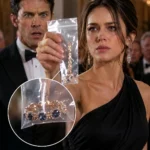
Adrian’s mouth opened.
No sound came out.
Nora spoke next.
“Effective immediately, Rose Elara Blackwell’s interests will be represented by her court-appointed property guardian, Evelyn Blackwell, under oversight.”
The crown did not fall.
It transferred.
Not to me, really.
To Rose.
To a baby sleeping in Brooklyn under a blanket embroidered with roses.
But I would hold it until her hands were strong enough.
Adrian stepped down from the stage and came toward me.
People moved aside.
Not out of respect.
Out of appetite.
He stopped inches away, his voice low.
“You think you can run my company?”
“I think I can stop you from running it into a grave.”
His laugh was bitter.
“You were an art history major.”
“And you were born on third base and called it leadership.”
Julian coughed into his fist.
Possibly to hide a laugh.
Adrian’s face flushed.
“This company is my blood.”
“So is Rose.”
That landed.
I saw it in his eyes.
For the first time, the truth of his daughter was not an accusation.
It was a mirror.
He hated what it reflected.
Margaret came to his side.
Her diamonds flashed under the lights.
“You will destroy everything Charles built,” she said to me.
“No, Margaret.”
I looked at the ancient temple behind her, stone moved across oceans so wealthy people could drink champagne beside it.
“Your family did that when you decided a baby was less important than a balance sheet.”
Her hand twitched.
For a second, I thought she might slap me.
Instead, she whispered, “You ungrateful little climber.”
Old insult.
Boring insult.
The kind women like Margaret kept for anyone whose family money was one generation newer than theirs.
I stepped closer.
“My father built hospitals in Queens after arriving in this country with two suitcases.”
My voice stayed soft.
“Your family built luxury suites and called it care.”
Her eyes widened.
“You will not speak to me like that.”
“I just did.”
A flash went off.
Then another.
By morning, that photo would be everywhere.
Margaret Hart, furious in diamonds.
Evelyn Blackwell, calm in black velvet.
Between them, Adrian, discovering that silence no longer belonged to him.
The board convened an emergency vote in a private gallery upstairs.
Nora advised me to say little.
That suited me.
Men with too much confidence often fill silence by confessing their incompetence.
Adrian did exactly that.
He raged about betrayal.
He accused Vanessa of hysteria.
He called Julian a bastard in front of three independent directors and the bank representative.
Then he accused me of seducing his dying father into changing the trust.
That was when the oldest board member, a retired judge named Samuel Pike, removed his glasses.
“Charles changed the trust because he knew you were unfit.”
The room froze.
Adrian turned slowly.
Samuel Pike folded his hands.
“I witnessed the amendment.”
Margaret looked as if she had been struck.
“You?”
“Yes,” Pike said.
“And I warned Charles it would split the family.”
“What did he say?” I asked.
Pike looked at me.
“He said the family was already split.”
Then he opened a leather folder.
“He also left a statement to be read if the amendment was challenged.”
Adrian said, “No.”
But Pike was already reading.
My son Adrian has mistaken inheritance for achievement.
My wife Margaret has mistaken control for love.
If Evelyn bears Adrian’s child, that child represents the only chance that Hart Meridian may one day belong to someone not yet corrupted by its power.
Until then, Evelyn is to protect that interest.
She has more dignity under pressure than any Hart I have raised.
The room remained silent after he finished.
I looked down.
Not because I was weak.
Because unexpected kindness can hurt worse than cruelty when you have gone too long without it.
Adrian’s face collapsed for half a second.
A boy appeared there.
A furious, unwanted boy who had spent his life trying to impress a father already disappointed in him.
Then the man returned.
Cold.
Cornered.
“He was manipulated,” Adrian said.
Pike sighed.
He closed the folder.
“He was observant.”
The vote passed.
Adrian was suspended as CEO pending investigation.
Margaret was removed as trustee.
A temporary executive committee took control.
I was appointed guardian representative for Rose’s voting interest.
When the meeting ended, Adrian remained seated.
Everyone else left.
I paused at the door.
I do not know why.
Maybe because marriage does not die cleanly even after betrayal.
Maybe because some part of me needed to see the ruins without music.
“I did love you,” he said.
The words came without performance.
That made them more dangerous.
I looked at the man who had once carried me barefoot through our honeymoon suite in Maine because the floor was cold.
The man who learned how I took my coffee.
The man who had pressed his palm to my stomach the first time Rose kicked and smiled like he had seen God.
That man had existed.
So had this one.
People are rarely lies.
They are choices.
“You loved being loved by me,” I said.
His eyes lifted.
“That is not the same thing.”
He swallowed.
For one second, I thought he might apologize.
Truly.
Fully.
Without strategy.
Then he said, “Let me see her.”
Not I am sorry.
Not I failed her.
Just access.
A demand dressed as longing.
“You will follow the court order,” I said.
“I’m her father.”
I held his gaze.
“You are her biological parent.”
His face tightened.
“You don’t get to decide what I am.”
“Neither do you.”
I opened the door.
“A child decides that over time.”
Then I left him there beneath portraits of dead men who had probably also mistaken ownership for love.
Outside the museum, rain had turned Fifth Avenue into a black mirror.
Nora stood under the awning, phone in hand.
“It’s done,” she said.
I looked at the city lights trembling in the street.
“It’s started.”
She nodded.
A car pulled up.
Julian stepped out first, then Vanessa.
They stood awkwardly beside each other, two people tied by a child neither had planned and both now had to deserve.
Vanessa looked at me.
“I’m sorry,” she said.
This time, she did not explain.
She did not defend.
She simply stood in the rain and let the words be small.
“I hope you mean that when it costs you something.”
She cried then.
Quietly.
Julian opened the car door for her.
As she got in, she looked back.
“Tell Rose I’m sorry someday?”
Her face fell.
“I won’t make my daughter carry adult apologies.”
Vanessa nodded through tears.
“Okay.”
It was the first decent thing I had seen her do.
Accept no.
Conclusion: What Rose Inherited
Spring came slowly that year.
Slowly.
Snow retreated from Brooklyn curbs in gray piles.
The cherry trees near the promenade opened pink against a clean blue sky.
Rose learned to laugh at ceiling fans.
She learned to grab my hair with shocking violence.
She learned that Mrs. Alvarez would sing old boleros if she refused to sleep long enough.
The court cases did not vanish.
They multiplied.
Fraud investigations.
Trust hearings.
Defamation claims.
Board reviews.
Custody evaluations.
Adrian submitted his sworn acknowledgment of paternity in March.
I read it once, then locked it in a fireproof safe.
Not because Rose needed proof of him.
Because one day, if she asked, I wanted to show her that the truth had always been there, even when adults were too cowardly to honor it.
He began supervised visits in April.
The first time, he arrived with a stuffed rabbit and eyes that looked as if sleep had become an enemy.
I watched through a glass panel as he sat in a child development center with Rose on a blanket between them.
He did not know how to hold her.
The specialist showed him.
Rose stared at him seriously, then tried to eat the rabbit’s ear.
Adrian cried.
Not beautifully.
Just one silent tear he wiped away before anyone could use it against him.
I felt nothing like forgiveness.
But I felt the shape of something quieter.
The knowledge that Rose deserved a future larger than my anger.
That did not mean open doors.
It meant strong locks, clear rules, and no poison in the well.
Vanessa had her son in May.
Julian acknowledged him the same day.
They named him Leo.
No Hart baptism made the papers.
No gala announced his arrival.
Just a small photo Julian sent me of a baby with dark hair and furious fists.
Poor kid already knows, he wrote.
I smiled despite myself.
Hart Meridian changed too.
Not overnight.
Empires do not become ethical because one woman walks into a wedding with a baby and an envelope.
But lights turned on in rooms that had been dark for generations.
Executive bonuses were reviewed.
Senior care complaints were reopened.
A whistleblower hotline actually answered calls.
The board appointed an interim CEO from outside the family, a woman from Chicago named Maren Liu who wore flat shoes, read every footnote, and terrified men who used charm as a business plan.
I remained guardian of Rose’s voting shares.
I learned balance sheets during nap times.
I learned that power is less glamorous than people think.
Mostly, it is meetings, signatures, and refusing to be rushed by men who benefit from confusion.
Margaret moved to Palm Beach.
She sent Rose a silver rattle.
I returned it.
Not dramatically.
Just with a note.
Gifts are not access.
In June, I took Rose to Newport.
Not to the chapel where I married Adrian.
To the beach below it.
The air smelled of salt and cut grass.
The old mansions watched from the cliffs, grand and ridiculous and beautiful in the way inherited things often are.
Rose sat on a blanket in a yellow dress, trying to understand sand.
I sat beside her, barefoot, my cream coat folded behind me.
For a long time, I listened to the water.
I thought about the altar.
The envelope.
The way people had gasped when I said my daughter was a shareholder.
I thought about the hospital room where Adrian had asked me to sign away Rose before she had even taken her first breath.
I thought about the woman I had been then.
Exhausted.
Still polite enough to tell the man destroying her to leave instead of calling security.
I loved her.
I wished I could go back and sit beside her bed.
I would take her hand.
I would tell her that one day, the same city laughing at her pain would repeat her words like a prayer.
I would tell her that calm is not weakness.
That dignity is not silence.
That a woman can be devastated and still be dangerous.
Rose looked up at me and smiled.
Two tiny teeth.
Adrian’s eyes.
My mouth.
Her own soul.
I lifted her into my lap and kissed her warm cheek.
“You inherited a company,” I whispered.
She slapped my necklace.
I laughed.
“But that is not the important part.”
The sun moved across the water.
A gull cried overhead.
Somewhere behind us, church bells rang for another wedding, another promise, another room full of people believing beauty could protect them from truth.
I held Rose closer.
“What you really inherited,” I told her, “was a mother who learned how not to disappear.”
She leaned her head against my chest.
For the first time in a long time, the quiet did not feel like waiting for the next blow.
It felt like morning.
And when the tide came in, it erased every footprint on the sand except the ones we had not made yet.