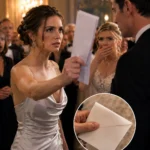
I walked in carrying a paper bag of prenatal vitamins and saltines.
Vanessa was standing at the marble island eating strawberries from a crystal bowl.
Bare legs.
Bare feet.
Nathaniel’s shirt.
My wedding china stacked behind her like witnesses.
For a second, neither of us moved.
Then she smiled.
Not guilty.
Not startled.
Smug.
“Oh,” she said.
“You’re home.”
I looked at the shirt first.
Then the strawberries.
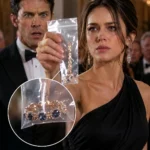
Then the diamond tennis bracelet on her wrist that Nathaniel had told me was for a corporate raffle.
“Where is my husband?”
She tilted her head.
“Shower.”
The world did not tilt.
That surprised me.
I had always imagined betrayal would be dramatic.
Glass breaking.
Breath gone.
A scream tearing itself out.
But real betrayal is often quiet.
It arrives fully dressed and helps itself to your fruit.
I set the vitamins on the counter.
“You should leave.”
Vanessa plucked another strawberry from the bowl.
“I was going to.”
“Now.”
She leaned against the marble, comfortable in a house where my name was on the deed and my body was carrying the Blackwood heir.
“You know, he said you’d be elegant about this.”
I laughed once.
It sounded like someone else.
“Did he?”
“He respects that about you.”
“No, Vanessa.”
I walked closer.
“He relies on it.”
Her smile thinned.
The shower turned off upstairs.
Water pipes groaned inside the walls.
I lowered my voice.
“Put on your clothes and leave through the back.”
“You don’t want to wait for Nate?”
“No.”
“Afraid of what he’ll say?”
I glanced at her bare legs.
“Afraid of what I’ll do if you’re still wearing my husband’s shirt when he gets downstairs.”
She left with her dress clutched to her chest and her chin high.
Nathaniel came down twelve minutes later in a towel, wet hair pushed back from his forehead, handsome in the careless way that had ruined my judgment at twenty-six.
He saw me sitting at the kitchen table.
He saw Vanessa gone.
He saw the bowl of strawberries between us.
Then he sighed.
Not apologized.
Sighed.
“Claire.”
I remember that most.
His exhaustion.
As if my discovery were an inconvenience to him.
As if fidelity had been a minor household rule I was overreacting to.
He sat across from me.
“We need to talk.”
I put one hand over my stomach.
“Our daughter can hear you.”
His expression flickered.
Just for a second.
Then the man I married disappeared behind the man his father had raised.
“We don’t know it’s a girl.”
“I do.”
“You know what I mean.”
I stared at him.
“No, Nathaniel.”
“I really don’t.”
He looked out toward the garden where white camellias were opening after rain.
“I never meant for it to happen this way.”
That sentence is a coward’s favorite blanket.
It covers nothing.
“Then how did you mean for it to happen?”
He rubbed his jaw.
“It’s complicated.”
I stood slowly.
“Tax law is complicated.”
“Heart surgery is complicated.”
He closed his eyes.
“Don’t make this theatrical.”
“Theater requires an audience.”
I looked toward the staircase.
“Apparently you already sent her home.”
His face hardened.
There it was.
The penalty for making him feel small.
Nathaniel Blackwood could cheat, lie, and spend corporate money on a mistress, but he could not forgive a woman for forcing him to see himself clearly.
“I’m not happy,” he said.
“You were happy enough when you wanted me to help rebuild the Savannah property.”
“That’s work.”
“You were happy enough when I sat beside your mother through chemo.”
“That’s not fair.”
“You were happy enough when I signed the prenup your father demanded.”
His eyes snapped back to mine.
“You signed because you wanted the name.”
I smiled.
Small.
Cold.
Wrong woman.
“I signed because I wanted you.”
For one second, shame crossed his face.
Then pride killed it.
“You always knew what this family was.”
“Yes,” I said.
“I just didn’t know you were the weakest part of it.”
He slapped the table.
The bowl jumped.
A strawberry rolled onto the floor.
I did not flinch.
That angered him more than any scream would have.
Two weeks later, I went into early labor.
Maybe it was stress.
Maybe it was biology.
Maybe my daughter had already decided she wanted out of that house before it turned into a courtroom.
The hospital room was too bright.
Everything smelled like antiseptic and crushed ice.
Nathaniel arrived an hour before surgery with his mother, Eleanor Blackwood, behind him in pearls and beige cashmere.
Eleanor had a talent for looking sympathetic without offering comfort.
She kissed my forehead like a queen pardoning a servant.
“Claire, darling,” she said.
“Let’s keep calm.”
I looked at Nathaniel.
He had not shaved.
His eyes were red.
For one wild second, I thought fear had brought him back to me.
Then I saw Vanessa’s name flash across his phone.
Eleanor saw it too.
Neither of them said a word.
After Lily was born, she weighed four pounds and two ounces.
A tiny, furious thing with translucent skin and fists like commas.
The nurse held her near my face for three seconds before they rushed her away.
I turned my head on the pillow and whispered, “Nathaniel.”
He was standing by the wall.
Far away.
Too far away.
“Go with her,” I said.
He did not move.
“She’s your daughter.”
His mouth tightened.
“My attorney advised me not to acknowledge paternity until testing.”
The room changed.
Not because of the machines.
Not because of the fluorescent light.
Because love left.
It did not slam the door.
It simply stood up, gathered its coat, and walked out without looking back.
Eleanor touched his arm.
“Nate.”
But she did not sound horrified.
She sounded annoyed that he had said the quiet part aloud.
I had just been cut open.
I was numb from the chest down.
My daughter was fighting for air in another room.
And my husband was protecting his assets.
That was the night I became still.
The nurses called it shock.
My mother called it strength.
Evelyn later called it useful.
I called it the end.
Nathaniel filed for divorce three days later.
Vanessa moved into the King Street apartment two weeks after that.
The newspapers reported that Nathaniel Blackwood had been “seen supporting longtime family friend Vanessa Vale through a private health matter.”
Private health matter.
That was what they called a mistress with a company-funded pregnancy.
While Lily slept in an incubator, Vanessa attended a museum gala in emerald satin and stood beside Nathaniel beneath a chandelier.
A photographer caught her looking straight into the camera.
Her hand rested low on her stomach.
Nathaniel’s hand rested over hers.
I saw the picture at 2:17 in the morning while pumping milk in a hospital lactation room under a broken fluorescent bulb.
I did not cry.
I saved the photo.
Evidence has a strange way of comforting you when love cannot.
The divorce took eleven months.
Nathaniel delayed paternity testing.
Then claimed scheduling conflicts.
Then filed motions.
Then switched attorneys.
Then accused me of attempting to weaponize Lily for financial gain.
His father gave a statement at a shareholder luncheon about “protecting the integrity of the Blackwood legacy.”
The room applauded.
People clapped for the man calling my baby a threat.
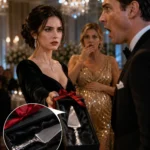
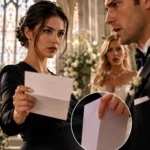
At mediation, Evelyn slid the sealed envelope across the table.
Nathaniel did not touch it.
His attorney whispered to him.
Nathaniel smiled at me.
That old smile.
The one that used to undo the buttons of my anger.
“No,” he said.
Evelyn’s voice was calm.
“Mr. Blackwood, refusing to review the material does not make it disappear.”
He leaned back.
“I’m done being manipulated.”
I looked at him then.
Really looked.
At the perfect suit.
At the expensive watch.
At the mouth that had kissed my belly and then denied the child inside it.
“You were never manipulated, Nathaniel.”
His eyes narrowed.
“You were loved by someone who didn’t know you were empty.”
That was the last thing I said to him in private.
Until the wedding.
Part 3 – The Bride Wore White, and So Did the Lies
St. Andrew’s Chapel sat beneath a canopy of live oaks, their branches heavy with Spanish moss that moved like old ghosts in the July heat.
The church had hosted Blackwood baptisms, Blackwood funerals, Blackwood weddings, and at least one Blackwood scandal involving a senator’s wife in 1989.
It smelled like lilies, polished wood, and money trying to look like God.
I arrived twelve minutes before the ceremony.
Not early enough to mingle.
Not late enough to look afraid.
My dress was black silk, sleeveless, high-necked, and cut with the kind of restraint that costs more than sequins.
My hair was pinned at the nape of my neck.
My lipstick was the red I wore only when I needed people to remember I had a mouth and might use it.
Evelyn stepped out of the town car behind me in a dove-gray suit.
She carried the leather folder.
A process server named Malcolm waited across the street pretending to check his phone.
He wore a navy blazer and the patient expression of a man paid to ruin brunches.
Evelyn looked at the church doors.
“Ready?”
I smoothed one pearl earring.
I glanced at her.
“Women who say they’re ready for this kind of thing are usually lying.”
I almost smiled.
Then the church doors opened.
A Blackwood cousin I barely remembered froze when she saw me.
Her eyes dropped to my dress.
Then to Evelyn.
Then back to me.
Within thirty seconds, the whispering began.
It moved through the vestibule like smoke.
Claire is here.
She came.
Is that her lawyer?
God, she looks incredible.
Poor thing.
No, not poor thing.
Look at her.
That was the first victory.
Not legal.
Not financial.
Atmospheric.
I did not enter like a discarded wife.
I entered like a verdict.
Nathaniel’s mother stood near the front pew in champagne silk.
Eleanor Blackwood was seventy-three and still terrifying enough to make donors double their pledges.
She turned when the whispers reached her.
For one second, surprise cracked her face.
Then the old polish returned.
“Eleanor.”
She looked at Evelyn.
“Ms. Price.”
Evelyn inclined her head.
“Mrs. Blackwood.”
“How unexpected.”
“Nathaniel invited me.”
“Yes,” Eleanor said.
“I’m sure he did.”
There was warning in her tone.
A plea too, maybe.
But not enough of one.
Eleanor had visited Lily twice.
Once at the hospital, where she stared at the incubator like it contained a lawsuit.
Once on Lily’s first birthday, where she brought a silver rattle engraved with the wrong initials.
I sent it back.
“You look well,” Eleanor said.
“So do you.”
“Is your daughter here?”
Her lips tightened at the phrase your daughter.
Even now.
Even after everything.
Even with the shape of Nathaniel’s face alive in Lily’s.
“Perhaps that is best.”
I leaned closer, close enough that only she could hear.
“It won’t be for long.”
Then the organ began.
Conversation snapped into silence.
I walked to the front pew on the bride’s side because that was where my invitation placed me.