“And the judge?”
“We got ahead of it.”
She opened the black box.
Not the gift box now, but the legal one.
Inside were copies of video transcripts, registry receipts, hotel bills, private security logs, and sworn statements from two household employees.
There were photos of Madison entering Bennett’s suite in Chicago.
There was a transfer from Whitaker Group to a shell vendor that paid for Madison’s apartment in SoHo.
There was proof that Bennett had used marital funds to pay for the Plaza deposit.
There was the paternity test.
There was the prenup.
There was a copy of an email Bennett sent to his father.
Subject: E will fold if we keep Lila close.
I read it twice.
Not because I could not understand.
Because a mother needs to see the monster clearly before she decides how to kill it legally.
“She is not leaving with him,” I said.
“No,” Margot said.
“She is not.”
At three that afternoon, Bennett arrived at Whitaker House with two black SUVs, his father’s security team, and the kind of confidence only inherited money can produce.
I watched from the top of the staircase as he entered the foyer.
He looked tired.
Good.
Celeste came in behind him.
She wore beige cashmere and moral superiority.
Alistair followed, silver-haired and calm, his face carved from old marble and bad decisions.
Madison did not come.
That was wise.
Bennett looked up at me.
“We need to talk like adults.”
I descended slowly.
“We tried that in the bathroom the morning I found your registry.”
His jaw flexed.
“My daughter is upstairs.”
“My daughter is in her room with her nanny and a security officer hired by my trust.”
Alistair stepped forward.
“Evelyn, let’s not make this uglier than it has to be.”
I looked at my father-in-law.
Alistair had once told me that women like me were safest when admired.
I had been twenty-eight then.
I had smiled because I was new to cages.
“You tried to take my child this morning,” I said.
His eyes did not change.
“We tried to protect the family.”
“You tried to protect the balance sheet.”
Celeste lifted her chin.
“Bennett made a mistake.”
“A mistake is ordering the wrong wine.”
I reached the last step.
“Creating a wedding registry with your mistress, announcing her pregnancy at your wife’s home, hiding a paternity report, misusing company funds, and filing for custody before breakfast is not a mistake.”
Bennett’s eyes flashed.
“Do not discuss my child.”
I tilted my head.
“Which one?”
The room snapped quiet.
His father turned slowly toward him.
Celeste went very still.
Bennett’s face betrayed him.
Only for a second.
But a second was enough.
I had spent six years married to that face.
I knew every fracture.
Alistair said, “Bennett.”
Bennett looked at me with hatred then.
Clean hatred.
There was almost relief in it.
“You don’t know what you’re doing.”
“I know exactly what I’m doing.”
“You think a prenup makes you untouchable?”
I stepped closer.
“My daughter does.”
His mouth twisted.
“You always do this.”
“Do what?”
“Act like you’re above emotion.”
That line used to bruise.
Now it amused me.
“I am not above emotion, Bennett.”
I leaned in just enough that only he could hear the rest.
“I am beneath rage, beside grief, and far past begging.”
His eyes darkened.
I stepped back and spoke clearly for the room.
“You have ten minutes to collect personal items from the guest suite.”
“This is my house,” he said.
Margot appeared from the library doorway.
“This house is owned by the Monroe Family Trust and leased to the Whitaker Foundation for seasonal events, a lease which was terminated this morning for breach of morality and misuse provisions.”
Alistair stared at her.
“That is absurd.”
Margot smiled politely.
“It is notarized.”
Celeste looked at me as if seeing me for the first time and hating the view.
“You would throw your husband out of his ancestral home?”
I looked at the portrait above the fireplace.
My grandmother Lydia Monroe stared down in oil paint, wearing emeralds and the expression of a woman who had survived men with better manners than Bennett.
“It was never his,” I said.
PART 4: THE CHURCH WITH NO BRIDE
Bennett did not go quietly.
Men who mistake silence for weakness often panic when silence ends.
His lawyers filed motions faster than gossip blogs could refresh.
His publicist released a statement about private family transitions.
His father called board members and suggested I was emotionally compromised.
Celeste invited three society reporters to lunch and cried about the pain of watching a daughter-in-law become vindictive.
Madison posted a photo of herself in a cream sweater, one hand on her stomach, captioned choosing peace.
The comments did not choose peace.
Women from Iowa, Georgia, Michigan, and New Jersey flooded her page with black gift box emojis.
Someone made a filter.
Someone else started selling shirts that read MAY YOU CUT CLEANLY.
I did not comment.
I had a hearing to attend.
The courtroom in Providence was nothing like the ballroom.
No chandeliers.
No roses.
No quartet.
Just fluorescent lights, polished wood, a judge with tired eyes, and the clean democratic cruelty of everyone having to sit on the same benches.
Bennett arrived in a charcoal suit with Madison beside him.
She wore pale blue.
A strange choice.
Soft.
Maternal.
Almost virginal.
Her hand never left her stomach.
The gesture had become her brand.
Bennett did not look at me when he entered.
He looked at Lila’s empty seat.
She was not there.
She was at home baking blueberry muffins with my mother’s old housekeeper, because children should not watch adults turn love into paperwork.
The custody hearing began at nine.
By nine-ten, Bennett’s attorney was describing me as unstable, retaliatory, and consumed by public humiliation.
By nine-thirty, Margot was playing the gala footage.
Not the viral clip.
The full security recording.
Bennett’s speech.
Madison stepping forward.
The senator’s wife dropping her glass.
Me raising my champagne.
Margot entering.
The room watched Bennett create the scandal he had blamed on me.
The judge looked unimpressed.
By ten, Margot introduced the sealed email.
E will fold if we keep Lila close.
Bennett’s attorney objected.
The judge overruled.
Madison’s face changed when she saw the email.
It was the first time I wondered whether Bennett had lied to her too.
Not enough to pity her.
Enough to understand the architecture of the disaster.
By ten-thirty, Margot introduced the financial records.
Company funds used for Madison’s apartment.
Foundation accounts used for private travel.
Registry deposits coded as vendor hospitality.
A $75,000 payment to a Boston concierge physician labeled donor medical logistics.
By eleven, she introduced the prenatal paternity report.
The courtroom did not gasp.
Courtrooms do not gasp.
They absorb impact through pens, eyebrows, and sudden silence.
Madison did gasp.
It was small.
Private.
Real.
She looked at Bennett.
Not like a smug mistress.
Like a woman realizing she had been brought to war without being told which side she was on.
Bennett stared ahead.
The judge read the report.
Then he looked over his glasses.
“Mr. Whitaker, you were aware before the gala that the unborn child was not biologically yours?”
Bennett’s attorney stood.
“Your Honor, my client’s emotional relationship to the child is not dependent on genetics.”
The judge said, “That was not my question.”
Bennett’s jaw worked.
The word fell like a coin into a grave.
Madison whispered, “You knew?”
Bennett did not answer.
She stood so abruptly her chair scraped the floor.
Her face had gone gray under expensive makeup.
“You knew?”
The judge warned her to sit.
She did.
But something had shifted.
The mistress had walked into court expecting to be protected by the man who ruined me.
Instead, she discovered he had used her pregnancy the way he used everything.
As leverage.
By noon, the judge denied Bennett’s emergency custody request, ordered temporary primary physical custody to remain with me, restricted Bennett’s unsupervised access pending further review, froze disputed accounts, and ordered preservation of all communications relating to Madison, the registry, the paternity test, and the Whitaker Group.
It was not victory.
Not yet.
It was oxygen.
Outside the courthouse, cameras waited behind barricades.
Bennett tried to take my arm.
I looked down at his hand until he removed it.
“Evelyn,” he said.
There was a time when my name in his mouth could undo me.
That version of me felt very far away.
“What?”
“We need to settle this privately.”
“You announced it publicly.”
His nostrils flared.
“You have no idea what my family can do.”
I looked at the cameras.
Then at him.
“I married into your family, Bennett.”
My voice was quiet.
“I know exactly what it can do.”
Madison emerged behind him.
She was alone.
No publicist.
No assistant.
No smug smile.
She looked at me with eyes too bright to be dry for long.
“I didn’t know about the test,” she said.
Bennett turned sharply.
“Madison, get in the car.”
She ignored him.
“I swear to God, I didn’t know he knew.”
I studied her.
The old Evelyn might have felt something immediate and messy.
Jealousy.
Hate.
Triumph.
But standing there on the courthouse steps with winter light cutting across the stone, I felt only exhaustion and a strange, hard clarity.
“You knew about me,” I said.
She swallowed.
“You knew about Lila.”
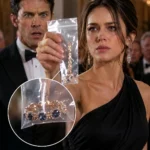
“You accepted my grandmother’s diamond earrings from him.”
Her face burned.
“I didn’t know they were yours.”
That made me laugh softly.
It was not kind.
“Madison, women always know when diamonds have a ghost.”
She looked down.
For the first time, her hand left her stomach.
“I’m sorry,” she whispered.
Bennett grabbed her elbow.
She pulled away.
The cameras caught that too.
By evening, the second video was everywhere.
Mistress learns husband lied about baby.
Except Bennett was not her husband.
And the baby was not his.
And I was no longer interested in correcting strangers for free.
Two weeks later, I learned why Bennett had been desperate enough to lie in public.
The Whitaker Group was not strong.
It was a chandelier with termites.
For years, Bennett and Alistair had used Monroe-backed credit to cover failing luxury developments in Nashville, Austin, and Scottsdale.
They moved money between subsidiaries like men rearranging deck chairs on a sinking yacht.
My trust held the debt.
My trust held the voting rights.
My trust held the trigger clause.
Infidelity alone would have cost Bennett reputation.
Financial misconduct would cost him access.
Custody manipulation would cost him the last sympathetic judge in Rhode Island.
But one detail turned the knife.
The Plaza wedding date on the registry was not for a future wedding.
It was for a vow renewal ceremony staged as a private brand event.