A woman can look dead and still be planning.
Grant appeared in the doorway.
He was wearing yesterday’s shirt.
For a foolish second, I wondered whether Madison had touched the buttons.
Then I stopped being foolish.
“We need to talk,” he said.
“No,” I replied.
His reflection narrowed its eyes at mine.
“Naomi.”
“There are people who need to talk.”
I pinned the final piece of hair.
“You need to listen.”
He gave a short laugh.
“Is that what we’re doing now?”
I stood.
The silk robe had been replaced by a charcoal sheath dress, black stockings, and my grandmother’s emeralds.
There are outfits for mourning.
There are outfits for war.
A wise woman learns the difference.
Grant’s gaze moved over me.
Something like uncertainty flickered across his face.
It disappeared quickly, but I saw it.
Good.
“You’re upset,” he said.
I smiled.
It was small and cold.
“Be careful, Grant.”
“You can’t make this ugly.”
“You made it ugly in a ballroom.”
His mouth tightened.
“Madison is carrying my child.”
“You sound almost sure.”
The room went still.
Grant stared at me.
“What is that supposed to mean?”
“It means your mistress had an interesting spring.”
He stepped closer.
I did not step back.
“Don’t start spreading garbage because you’re hurt.”
“I don’t spread garbage.”
I picked up my phone from the vanity.
“I file it.”
For the first time since I had known him, Grant looked truly awake.
“You had her followed?”
“No,” I said.
“I had you audited.”
He laughed too quickly.
“By whom?”
“Someone smarter than your lawyer.”
Grant’s face flushed.
“You think you can scare me with a private investigator?”
“No.”
I walked past him toward the stairs.
“I can scare you with a clause.”
Eleanor was waiting in the grand salon beneath a chandelier imported from Venice and cleaned by women she never learned to thank.
She sat upright on the ivory sofa with Madison beside her.
Madison had come to my house.
She wore a pale blue maternity dress and held a porcelain cup of tea as if she were the lady of the estate.
Her eyes brightened when she saw me.
That was the mistake arrogant women make.
They confuse another woman’s restraint for permission.
“Naomi,” she said gently.
“Are you feeling better?”
I looked at the cup in her hands.
“That is my mother’s tea set.”
Madison glanced at Eleanor.
Eleanor smiled faintly.
“It belongs to the house.”
“It belongs to me.”
A small silence opened.
Grant entered behind me.
Madison’s hand flew to her stomach.
Reflexive, practiced, theatrical.
Grant noticed, and his expression softened.
It would have hurt if I still wanted tenderness from a man who rationed it like charity.
Eleanor folded her hands.
“We invited Madison because decisions must be made.”
“You invited your son’s pregnant mistress into my living room two days after my miscarriage.”
Eleanor’s eyes went flat.
“Do not use that word.”
“Which one?”
“Mistress.”
Madison looked down, hiding a smile in her tea.
I saw it.
So did Claire, who stood by the French doors pretending not to listen.
“Fine,” I said.
“Would you prefer liability?”
Grant snapped, “Enough.”
I turned to him.
“No, Grant.”
My voice was quiet enough that everyone leaned in.
“That is exactly what you should have said at the gala.”
Madison set the cup down.
Her chin trembled with a softness I almost admired.
“You don’t have to be cruel,” she whispered.
I looked at her stomach.
Then at her face.
“Cruelty is bringing a victory lap to a funeral.”
The tremble vanished.
There she was.
Not fragile.
Not sorry.
A woman with her fingers around my husband’s legacy and her eyes on my staircase.
Madison leaned back.
“Grant loves this baby.”
“He loves ownership.”
“He loves me.”
“Then you should ask why he made you use the service elevator for eight months.”
Her cheeks went pink.
Eleanor rose.
“Naomi, you will not speak to her that way in this house.”
“This house,” I said, “is held in trust by Whitmore-Hale Holdings.”
Grant frowned.
“My grandfather’s trust.”
I opened the black folder Claire had brought me.
“Fifty-one percent transferred to the marital estate three years ago when your father restructured the company after the federal investigation.”
Grant went very still.
Eleanor did not.
Eleanor was older, meaner, and quicker.
“That structure requires a surviving marriage,” she said.
“Correct.”
I flipped a page.
“Unless dissolution is caused by infidelity resulting in pregnancy.”
Madison’s hand froze on her stomach.
Grant looked at his mother.
Eleanor looked at me.
For the first time, I saw a crack in her porcelain.
“That clause is unenforceable,” Grant said.
“Your lawyer thought so too.”
I lifted my eyes.
“Mine disagrees.”
Madison laughed softly.
It was a pretty sound with rot underneath.
“No judge is going to punish a pregnant woman.”
“The judge will not punish you.”
I turned a page.
“The prenup punishes Grant.”
Grant crossed the room and grabbed the folder.
He scanned it, face draining.
I did not stop him.
Some knives are sharper when the victim picks them up.
His eyes reached the paragraph.
There it was, buried in Section 14.7 under Reproductive Misrepresentation and Extramarital Paternity Exposure.
The Pregnant Mistress Clause.
His father had added it after a scandal with a Miami actress, then forgotten to remove it when Grant married me.
Grant had signed without reading.
Men like him rarely read anything they believe they own.
Madison stood too quickly.
“I don’t understand.”
“Of course you don’t,” I said.
“You thought the baby was a shield.”
Eleanor’s voice was low.
I looked at her.
The room held its breath.
“This is not a divorce anymore,” I said.
“It is a forfeiture event.”
Grant tore his gaze from the page.
“You wouldn’t.”
“I already did.”
At that exact moment, the front gates opened.
Two black cars rolled up the driveway.
My attorneys stepped out first.
Then a court-appointed process server.
Then, because Claire was a genius with timing and a grudge, the same gossip columnist who had photographed Madison at the hospital appeared on the public sidewalk beyond the gate.
Madison saw the camera.
Her hand went to her stomach again.
This time it looked less like a crown.
More like a trigger.
Part 3: The Clause No One Read
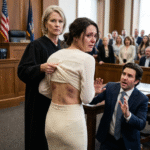
The first hearing took place in a Manhattan courtroom with walnut walls, fluorescent lights, and the quiet smell of expensive fear.
Grant arrived with Eleanor on one side and Madison on the other.
He looked perfect.
Navy suit.
Clean shave.
Wedding band still on his finger because optics matter to men without vows.
Madison wore cream, of course.
She had learned that white made people call her delicate.
Her hair fell in loose waves over one shoulder, and she paused at the courthouse steps long enough for cameras to capture her belly in profile.
Her attorney helped her walk as if the marble itself were dangerous.
I arrived five minutes later in black.
Not widow black.
Verdict black.
The reporters surged.
“Naomi, did you know about the baby?”
“Naomi, are you contesting the pregnancy?”
“Naomi, are you trying to take the Whitmore estate from an unborn child?”
That one made me stop.
I turned toward the reporter.
“I am trying to take it from the man who used one.”
The microphones exploded.
Claire touched my elbow.
“Perfect,” she murmured.
Inside, Grant’s legal team tried to paint me as cold.
It was almost funny.
A woman who cries is unstable.
A woman who does not cry is heartless.
A woman who asks for what a man signed is dangerous.
Grant’s lead attorney, Victor Pell, had silver hair and the theatrical sorrow of a funeral director.
“Your Honor,” he said, “Mrs. Whitmore is attempting to enforce a punitive provision against an unborn child and its mother.”
My attorney, Julian Ross, did not rise immediately.
Julian believed in letting stupidity echo.
Then he stood, buttoned his jacket, and said, “No, Your Honor.”
He placed one page on the lectern.
“Mrs. Whitmore seeks enforcement against Grant Whitmore pursuant to a voluntary contract triggered by his own conduct.”
Judge Carver leaned over her glasses.
“I have reviewed the provision.”
Victor smiled.
“With respect, Your Honor, it is archaic, morally grotesque, and designed to shame pregnancy.”
Julian’s expression did not change.
“The provision was drafted by Whitmore family counsel.”
That landed.
Even the clerk looked up.
Julian continued.
“It was inserted by Grant Whitmore’s father after an extramarital pregnancy threatened corporate succession.”
Eleanor sat motionless.
Her pearls glowed under the courtroom lights like little moons with secrets.
“The clause protects the non-offending spouse from reputational harm, loss of marital assets, and inheritance dilution caused by an affair producing a paternity claim.”
Victor snapped, “Alleged affair.”
Julian looked at Grant.
“The plaintiff will stipulate to Grant Whitmore’s sworn statement that he is the father of Madison Vale’s unborn child.”
Victor’s smile vanished.
Grant’s jaw worked.
He had filed that statement to look noble.
He had declared paternity to protect Madison from being portrayed as a gold digger.
He had done it before asking what the word father might cost.
Judge Carver turned a page.
“The clause requires three conditions.”
Julian nodded.
“Extramarital sexual relationship, pregnancy, and public or legal acknowledgment of paternity by the offending spouse.”
He looked at Grant again.
“All three are satisfied.”
Victor recovered fast.
“This is about cruelty, Your Honor.”
“No,” I said before I could stop myself.
The room went quiet.
Judge Carver looked at me.
“Mrs. Whitmore, your attorney speaks for you.”
“I apologize, Your Honor.”