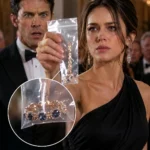
I did not admire her.
But I understood survival when I saw it.
The board voted.
Unanimous rejection of the merger.
Unanimous removal of Grant.
Unanimous referral of Ashford Meridian materials to outside counsel.
By 9:12, it was over.
No shouting.
No champagne.
Just signatures.
That was how empires ended most of the time.
Not with fire.
With paperwork.
Grant remained standing after everyone else left.
Celeste had been escorted out by then, pearls trembling with every step.
Henry and Margaret withdrew to the side office.
Everett stayed near the door.
Grant looked at the city beyond the windows.
For a moment, he seemed younger.
Or maybe simply less decorated.
“You know what the worst part is?” he asked.
I said nothing.
“I did love Lily.”
The words entered me carefully.
I believed them, too.
That was the tragedy of Grant.
He was not empty.
He was divided.
And when forced to choose between love and hunger, he fed the hunger first.
“Then you should have protected her from yourself,” I said.
His eyes closed.
“I thought I could fix everything.”
I picked up the audit folder.
“You thought you could own everything.”
He turned.
“And Everett?”
I frowned.
“What about him?”
Grant’s smile was bitter.
“He’s been waiting, hasn’t he?”
It was such a small, ugly thing to say in such a large ruined room.
I almost pitied how predictable it was.
“Even now,” I said.
“You think the only reason a man would stand beside a woman is because he wants to possess her.”
Grant looked away first.
I walked to the door.
Then I stopped.
There was one thing left.
“Grant.”
I removed my wedding ring.
It was a flawless emerald-cut diamond set between two tapered stones.
He had chosen it because it looked like legacy.
I had worn it through dinners, pregnancies that failed, one that became Lily, hospital nights, holidays, and every polished lie.
I placed it on the boardroom table.
The sound was very soft.
But Grant heard it like a gunshot.
“My attorney will send the divorce papers.”
He stared at the ring.
I looked at him one last time as my husband.
Not with hatred.
Hatred would have kept him close.
I wanted distance.
Clean, permanent distance.
“You came for Lily’s trust,” I said.
“You lost mine.”
Then I walked out.
The next weeks were ugly in the way wealthy divorces are ugly.
Quietly.
Through filings.
Through leaks.
Through people choosing sides over lunches where the wine cost more than most people’s rent.
Grant tried to fight the prenup.
He failed.
Celeste tried to file for grandparent visitation.
The judge denied emergency access and ordered evaluation first.
Ashford Meridian lost two lenders and one reputation.
Rowan Ashford disappeared to Palm Beach until the internet found him anyway.
Madison gave one interview through her attorney.
She said she regretted being used.
She did not apologize to me.
I did not wait for it.
Closure is not a debt other people pay on time.
Sometimes you write it off and protect your peace.
Lily asked about Grant less than I feared and more than I wanted.
Children understand absence before they understand betrayal.
At night, she slept with her stuffed rabbit and asked if Daddy was busy.
I told her the truth in pieces small enough for her hands.
Daddy made some bad choices.
Daddy needs help making better ones.
You are loved.
You are safe.
None of this is your fault.
She accepted the last sentence the way children accept medicine.
Reluctantly.
But she swallowed it.
One evening, a month after the board meeting, Lily found me in my closet holding the black Dior gown from the gala.
“Is that the dress from the night Daddy was on TV?” she asked.
I looked at the dress.
Then at her.
“Did you feel sad?”
I sat on the floor beside her.
The closet lights glowed softly over rows of shoes, silk, wool, armor.
“I felt very sad.”
“Did you cry?”
I smiled.
“Later.”
She climbed into my lap.
I held her carefully, as if she were still connected to wires and monitors.
“Why not there?” she asked.
I kissed her hair.
“Because sometimes people want your tears so they can prove they hurt you.”
She thought about that.
Then she said, “That’s mean.”
“What do you give them instead?”
I looked at the dress again.
Then at my daughter’s bright, serious face.
“Nothing they can use.”
She nodded as if this were a lesson worth keeping.
Maybe it was.
CONCLUSION — THE HOUSE WE BUILT AFTER THE FIRE
Spring came slowly that year.
Not gently.
Slowly.
The trees along Park Avenue bloomed like they had forgiven winter but not forgotten it.
Lily returned to school with a new inhaler plan, a new backpack, and a security detail she thought was just Mr. Paul who liked crossword puzzles in the lobby.
I returned to Ellison Global as interim chair.
The press called it a comeback.
That made me laugh.
Women are always called dramatic when they survive quietly, then miraculous when the world finally notices they are still standing.
I was not coming back.
I had never left.
Grant moved out of our townhouse in April.
The movers arrived before sunrise.
I watched from the upstairs window as they carried out his suits, his golf clubs, his framed awards, and the leather chair he had bought for a study he never used to read in.
There was no grand final conversation.
No rain-soaked apology.
No cinematic collapse on the front steps.
Real endings are often much less theatrical than betrayals.
He sent one text.
I am sorry for what I did to Lily.
Not to me.
To Lily.
That was the only apology I needed him to understand first.
I did not reply immediately.
When I did, I wrote one sentence.
Then spend the rest of your life becoming someone who would never do it again.
I blocked him for the night.
Not forever.
Just long enough to sleep.
Everett stayed my lawyer until the final divorce decree.
Nothing more happened between us.
Not then.
I know that disappoints people who want every broken woman handed a better man by the final chapter.
But I was not a vacancy.
I was a house after a fire.
Before anyone could be invited in, I needed to learn which walls still held.
On the day the divorce was finalized, I took Lily to the Central Park Conservatory Garden.
She wore a yellow coat and ran ahead of me between the hedges.
The sky was bright.
The air smelled like tulips and rain.
My phone buzzed once.
Everett had sent a message.
It is done.
Below that, another line.
Your father would be proud.
I stood beneath an arch of blooming branches and let myself feel it.
Not victory.
Not revenge.
Relief.
A quiet, shaking relief that moved through me like light entering a locked room.
Lily ran back and slipped her hand into mine.
“Mommy, are we okay now?”
I looked down at her.
Her cheeks were pink from the cold.
Her eyes were my father’s shade of blue.
Her trust, her name, her future, all still hers.
I squeezed her hand.
“We’re okay.”
Then she tugged me toward the fountain.
Behind us, the city kept moving.
Headlines faded.
Gossip shifted.
The Ashford name lost its shine and found other rooms to haunt.
Madison had her baby in August, far from cameras.
Rowan eventually signed the papers.
Celeste sold the Greenwich estate two years later.
The chapel windows went to auction.
I almost bought them.
Then I decided some things are more beautiful when they belong to someone else’s ruin.
As for Grant, he saw Lily under supervision until he earned more.
Painfully.
Without access to her trust, her votes, or my forgiveness.
He learned that fatherhood is not a title you use in court.
It is a thousand ordinary choices made when no one is applauding.
Some days, Lily came home happy.
Some days, quiet.
I held space for both.
Children do not heal on adult schedules.
Neither do mothers.
But we healed.
Not perfectly.
Not quickly.
But honestly.
On Lily’s eighth birthday, we held a party in the rooftop garden of our building.
There were fairy lights, vanilla cake, pink lemonade, and a magician who somehow made twenty children scream with joy over a foam rabbit.
Henry Walsh came with a cane and a gift wrapped in silver paper.
Margaret Sloan sent a first-edition copy of The Secret Garden.
Everett stopped by for exactly twenty minutes and stayed for two hours because Lily challenged him to chess on the patio.
He lost.
Badly.
I suspected on purpose.
That night, after everyone left, Lily and I sat barefoot on the terrace under a soft blanket.
The city glittered around us.
She leaned against my shoulder.
“Grandpa Charles gave me the trust, right?”
“He helped protect it for you.”
“Is it money?”
“It is responsibility.”
She wrinkled her nose.
“That sounds like homework.”
“It is a little like homework.”
She looked out at the skyline.
“What do I have to do with it?”
I brushed a crumb of cake from her sleeve.
“Grow up kind.”
She waited.
“And smart.”
She nodded.
“And never let anyone convince you that love means handing them the keys to everything you are.”
She looked up at me.
“Even if they say please?”
“Especially then.”
She rested her head on my arm again.
Below us, Manhattan shimmered like broken glass arranged into something beautiful.
I thought about the hospital room.
The leather folder.
Madison’s white coat.
Celeste’s pearls.
Grant’s hand on the pen.
I thought about how close I had come to signing because I was tired, scared, and desperate for peace.
Then I thought about my father’s letter.
Assume he is acting as a man who has run out of doors and found a child-sized window.
I understood something then.
Protection is not always loud.
Sometimes it is a clause written years before the betrayal.
Sometimes it is a mother reading the last paragraph.
Sometimes it is a woman smiling coldly in a room full of people waiting for her to break.
Lily fell asleep against me before the candles burned out.
I carried her inside and tucked her into bed.
On her nightstand sat the stuffed rabbit from the hospital, worn soft at the ears.
Beside it was the birthday card Grant had mailed.
She had read it twice, then placed it there without comment.
Healing leaves room for complicated things.
I turned off her lamp and stood in the doorway for a while.
My daughter slept peacefully.
No monitors.
No oxygen.
No lawyers.
Just breath.
In and out.
Her own.
I walked downstairs and found the old leather folder in my office safe.
The custody papers were still inside.
I kept them not because I needed the pain.
But because one day, when Lily was old enough, I would show her the document that taught me the difference between peace and surrender.
I would tell her that betrayal often arrives well-dressed.
That greed can speak in the language of family.
That a woman does not have to scream to be dangerous.
And that the most powerful word in any room is sometimes the quietest one.
Then I would show her the final page.
The paragraph Grant thought would make him rich.
The paragraph that made me wake up.
The paragraph that saved her future because I finally understood the truth.
My husband was never trying to leave me for his mistress.
The mistress was the distraction.
The trust was the prize.
And my daughter was never his to spend.
I can reshape this into a shorter “Part 1 in comments” FB/Reels serial version with stronger cliffhangers per section.
Comments 1
Thank you for completing the story