By morning, Grant’s corporate card charges were preserved.
By noon, Ashford Holdings issued notice of potential governance breach.
By sunset, every Whitaker attorney in the Northeast knew one thing.
The quiet wife had counsel.
Part 3 — The Gala Where the Smile Fell Off
Grant did not call me until the next afternoon.
Not because he felt guilty.
Because his lawyer told him to.
I let it ring three times before answering.
“Nora,” he said.
“Grant.”
He hated when I sounded calm.
In marriage, men like Grant build entire systems around the expectation that women will eventually become emotional enough to discredit themselves.
I gave him nothing.
“You took Lily to a hotel,” he said.
“She needs stability.”
“She needed her father at her play.”
Silence.
Then his voice lowered.
“This isn’t good for her.”
“No,” I said.
“It isn’t.”
He exhaled.
“I want to see my daughter.”
“Your attorney has Helena’s number.”
“Our daughter,” he corrected.
I looked through the hotel window at Central Park, green and indifferent below.
“You remembered.”
He said my name again, but softer this time.
For one dangerous second, I heard the man from our wedding.
The man who danced with me under a thousand hanging orchids and whispered that he would spend his life earning me.
Memory is not mercy.
It is evidence of who someone chose not to remain.
“I never wanted to hurt you,” Grant said.
That sentence should be retired from the language.
It is almost always spoken by people who wanted everything except consequences.
“You brought her to dinner,” I said.
“My mother thought it would be better to—”
“Your mother did not impregnate Madison.”
Another silence.
My voice was still quiet.
“You do not get to make this softer by spreading the dirt around.”
His breath sharpened.
“You think you can punish me into loving you?”
There it was.
The old Grant.
The real one.
The one under the tailoring.
I almost thanked him for making it easier.
“I don’t want your love,” I said.
“I want a parenting schedule, full financial disclosure, and Lily’s bluebird costume returned from your car.”
He laughed once.
It sounded ugly.
“You really think you’re in control.”
I looked at my reflection in the glass.
No makeup.
Hair tied back.
Eyes clear.
“I think you should stop talking before you become discoverable.”
I hung up.
Two days later, the Whitakers went public without me.
They did it at the St. Jude Children’s Hospital benefit in Manhattan, which was bold even for them.
The gala was held in a ballroom washed in gold light, with white orchids climbing acrylic columns and ice sculptures shaped like wings.
Every woman wore diamonds.
Every man wore a tuxedo and the expression of someone pretending not to check stock prices.
I had been expected to attend as co-chair.
My name was on the invitation.
My photograph was in the program.
But when I arrived, escorted by Helena and wearing a black velvet gown with no wedding ring, the room shifted.
Not loudly.
Rich rooms rarely move loudly.
They ripple.
Whispers opened like fans.
Grant stood near the stage with Madison at his side.
She wore pale pink this time.
Soft.
Maternal.
A diamond bracelet on her wrist caught the light.
My bracelet.
Not literally.
Worse.
Purchased through a company account while he told me we needed to scale back foundation spending.
Evelyn saw me from across the room.
For one bright second, panic crossed her face.
Then she remembered she was Evelyn Whitaker and turned it into grace.
She glided over in silver silk.
“Nora,” she said.
“You came.”
“My name is on the step-and-repeat.”
Her smile did not reach her eyes.
“This may not be the best environment for Lily’s mother to make a scene.”
I looked around.
“At a charity event for children?”
Her mouth tightened.
“Grant is trying to protect the family.”
“From what?”
“From your anger.”
I leaned closer.
“I am not angry, Evelyn.”
That was a lie.
I was furious.
But anger was only the fire.
Discipline was the blade.
“I am prepared.”
Her pupils changed.
Good.
On stage, the emcee tapped the microphone.
Grant was scheduled to introduce the hospital’s new family wellness initiative, funded by the Whitaker Foundation.
He walked to the podium with Madison beside him.
That was not in the program.
The whispers became a low electrical current.
Helena touched my elbow.
“You ready?”
Then I walked forward anyway.
Grant smiled at the crowd.
He had a donor smile, a boardroom smile, a husband smile, and a predator smile.
That night, he wore all of them at once.
“Ladies and gentlemen,” he began, “thank you for being here in support of families, children, and the future we build together.”
Madison stood slightly behind him, one hand on her stomach.
A photographer moved closer.
This was not a speech.
It was a coronation.
Grant continued.
“The last few months have taught me that family is not always simple, but it is always worth honoring.”
My skin went cold.
He was going to do it.
He was going to introduce her publicly before the divorce.
He was going to force the narrative, wrap betrayal in philanthropy, and make me look like the bitter woman standing in the corner refusing to applaud a baby.
Madison lowered her lashes.
Evelyn watched me.
Richard watched Grant.
I watched the exit doors.
Then Grant said, “Madison and I are grateful for the kindness many of you have already shown as we prepare to welcome a son.”
A son.
The word hit the ballroom like thrown crystal.
Cameras flashed.
Someone gasped.
Helena swore under her breath.
For one half second, grief moved through me so violently I thought I might faint.
Not because I wanted him back.
Because humiliation is physical.
It has hands.
It presses on the chest.
It fills the mouth with metal.
Then I saw Lily in my mind, standing under stage lights in blue feathers, refusing to cry.
My daughter had held her chin up.
I stepped onto the stage.
Grant’s smile froze.
“Nora,” he said into the microphone, making my name part of the performance.
The room held its breath.
I crossed to him slowly.
No rushing.
No grabbing.
No slap.
A slap ends too quickly.
I took the microphone from his hand.
He let me because refusing would look bad.
That was the thing about men like Grant.
They were easiest to beat when witnesses were watching.
“Good evening,” I said.
The ballroom became so quiet the chandeliers seemed loud.
“I was not aware Grant had revised tonight’s program.”
A few nervous laughs fluttered and died.
Madison looked at Grant.
Evelyn’s face turned to marble.
I smiled gently at the donors, the board members, the doctors, the reporters, the women who had judged me before I even opened my mouth.
“As co-chair, I want to return us to the reason we are here.”
“Children.”
Grant’s jaw flexed.
“Children deserve stability, honesty, and adults who do not use them as props in stories they were too cowardly to tell cleanly.”
The room changed.
Some people looked away.
Others leaned in.
Madison’s cheeks reddened.
I turned toward her, but I did not speak to her.
She was not the center.
That would have been a gift.
“Effective this evening,” I said, “the Ashford Family Fund is suspending all joint programming with the Whitaker Foundation pending review of financial irregularities, governance concerns, and misuse of restricted charitable accounts.”
The words landed like a judge’s gavel.
Grant stepped toward me.
I lifted one hand without looking at him.
He stopped.
That photograph ran on three gossip sites by midnight.
My hand raised.
His body halted.
The caption practically wrote itself.
I turned back to the room.
“No hospital program will lose funding.”
I let that sink in before panic could become sympathy for Grant.
“My family fund will cover every child services pledge made tonight, directly, under independent oversight.”
A doctor near the front began clapping.
Then another.
Then a woman from the board.
Then half the ballroom.
Not thunder.
Not yet.
But enough.
Enough to move oxygen back into my lungs.
Madison whispered something to Grant.
He ignored her.
I placed the microphone back on the podium.
Grant leaned close, smiling for the cameras.
“You have no idea what you just did,” he whispered.
I smiled back.
“Yes, I do.”
Then I walked off the stage.
Helena fell into step beside me.
Behind us, the ballroom erupted into the kind of chaos money cannot fully silence.
At the coat check, Madison caught up with me.
She was breathing hard.
Pregnancy had made her face fuller, but fear made her look younger.
“You think this makes you powerful?” she snapped.
I turned.
There she was.
Not the soft mistress.
Not the future mother.
Just a woman cornered by the possibility that the man she stole came with debt.
“I think power is knowing when not to beg,” I said.
Her mouth trembled.
“I love him.”
I believed that too.
That was the saddest part.
“He told me you were cold,” she said.
“He told me you never needed him.”
A laugh escaped me.
Small.
Tired.
“He always confused not needing him with not loving him.”
Her eyes shone.
For one second, the two of us stood in the ruins of Grant’s appetite, and I saw the ugly little truth.
He had lied to both of us.
Different lies.
Same purpose.
To be wanted without being accountable.
Madison looked down at her stomach.
“He chose me.”
The valet brought my coat.
“He chose himself.”
Her face hardened again because shame often reaches for cruelty before it reaches for wisdom.
“At least my baby will have the Whitaker name.”
I stepped closer.
Not enough to threaten.
Enough that she could hear me under the cameras and whispers.
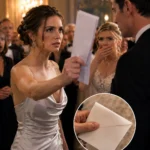
“Madison,” I said, “before you build a nursery around that name, I suggest you wait for the test.”
Her face went still.
Behind her, Grant appeared.
“What test?” he asked.
I took my coat from the valet.
“The one your mother ordered.”
Evelyn’s voice came from behind him.
I turned and saw her standing beneath the ballroom’s gold sconces.
For the first time since I had known her, Evelyn Whitaker looked old.
Not fragile.
Never that.
But old in the way queens look old when they realize the crown is not welded to the skull.
Grant turned to his mother.
“What is she talking about?”
Evelyn did not answer.
Madison’s hand flew to her stomach.
Grant looked at me.
I gave him the smallest smile.
“Goodnight.”
Part 4 — The Courtroom With No White Roses
The first hearing was held in Stamford Superior Court on a gray Monday morning.
There were no chandeliers.
No orchids.
No white roses.
Just fluorescent lights, tired wood benches, a judge with reading glasses, and the gorgeous brutality of procedure.
I wore navy.
Grant wore charcoal.
Madison did not attend, but her name entered the room before the clerk finished calling the matter.