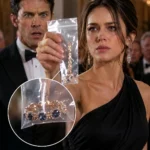
He wore a black Tom Ford tuxedo and the expression of a man who believed God had personally approved his ambition.
Outside, Fifth Avenue had been closed for the arrival of senators, surgeons, venture capitalists, and women whose diamonds required private security.
The Ashfords called it the wedding of the decade.
My mother called it a beautifully decorated warning.
Evelyn Vale had built Vale Biomedical from a rented laboratory in New Jersey.
By the time I was twenty-seven, she owned patents that had changed pediatric medicine and enough voting stock to make old-money families return her calls.
The Ashfords had the name.
My mother had the money keeping that name alive.
At our rehearsal dinner, Grant’s father described the marriage as the perfect union of legacy and innovation.
My mother leaned toward me after the applause.
“Never marry a man who describes love like a merger.”
I laughed because I thought she was being dramatic.
I had not yet learned that mothers sometimes sound dramatic because daughters refuse to hear quiet truth.
Grant was gentle with me then.
He remembered the tea I ordered when I was nervous.
He carried flats in the car after formal events because he knew my feet hurt.
When my mother’s cancer returned, he sat beside me through every consultation.
He held my hand in hospital rooms.
He slept in rigid chairs beneath fluorescent lights.
He told me he loved me when I was too frightened to say anything back.
That was the version of Grant I married.
For years, I believed cruelty had replaced him.
Eventually, I understood cruelty had always lived inside him.
Love had simply made him patient.
My mother died eighteen months after our wedding.
The last time she was fully conscious, snow covered the windows of her private hospital room.
Grant had left to take a call.
My mother asked the nurse to bring her jewelry case.
Inside was the diamond bracelet.
It had belonged to my grandmother, who had worn it while signing the first lease for the factory that eventually became Vale Biomedical.
My mother fastened it around my wrist.
“This is not jewelry,” she whispered.
“It is evidence.”
“Of what?”
“That women existed before men decided what they were worth.”
I tried to smile.
She did not.
“When Rose is born, place it in trust.”
I looked down at my stomach.
I had learned I was pregnant six weeks earlier.
Only Grant and my mother knew.
“What if the baby is a boy?”
“Then choose another name.”
Her mouth softened.
“But it will be a girl.”
She was right.
Rose Evelyn Ashford was born seven months after her grandmother died.
I created the trust before leaving the hospital.
The bracelet became its first asset.
Grant signed an acknowledgment of ownership.
Celeste witnessed it.
For the next four years, the bracelet remained in a biometric safe inside our penthouse.
I wore it only three times.
The first was at Rose’s christening.
The second was when Vale Biomedical received FDA approval for my mother’s final treatment program.
The third was at Grant’s fortieth birthday gala.
Savannah Blake attended that evening in a black dress with an open back.
She had joined the Ashford Foundation as communications director six months earlier.
She was bright, polished, and skilled at making wealthy people feel more generous than they were.
Savannah understood cameras.
She understood angles.
She understood that an affair with a married CEO should never begin in a hotel room when it could begin inside a cause.
At first, I liked her.
She sent flowers when Rose had pneumonia.
She remembered Celeste’s birthday.
She spoke about losing her father young, although I later learned he lived in Arizona and sent her Christmas cards every year.
Savannah made people feel chosen.
Grant had always been addicted to being chosen.
The affair began during a foundation trip to Geneva.
I discovered it because Grant returned home wearing the wrong cuff links.
They were engraved with the initials G and S.
When I asked him about them, he kissed my forehead and said the hotel laundry had mixed up two garment bags.
It was a weak lie.
I accepted it because Rose was asleep upstairs and because I still believed the preservation of a family was more important than the preservation of my dignity.
Three months later, I found a hotel receipt inside his tuxedo pocket.
One room.
Two breakfasts.
A bottle of Bordeaux Savannah had once ordered at dinner.
I said nothing.
Silence became my disguise.
Grant mistook it for surrender.
While he became careless, I became exact.
I copied credit card statements.
I preserved text messages from our shared tablet.
I photographed the scratches on Savannah’s red suitcase when it appeared in the background of Grant’s video call from London.
I reviewed the prenuptial agreement my mother had insisted upon.
I reopened Rose’s trust documents.
I met Adrian Cole in a quiet conference room overlooking Bryant Park and asked him one question.
“How do I leave without letting him destroy my daughter’s future?”
Adrian closed the door.
“First,” he said, “you stop thinking like his wife.”
That sentence saved me.
For six weeks, I watched Grant prepare to replace me.
He transferred expenses from our household accounts.
He requested new valuations of the penthouse, the Hamptons property, and my inherited art.
He asked our nanny whether I drank during the afternoon.
He persuaded Rose’s preschool director to document every late pickup, including days when Grant had changed the driver’s schedule without telling me.
He was not merely having an affair.
He was building a case.
Grant wanted custody of Rose.
At first, I believed it was vanity.
Then Adrian found a sealed amendment in my mother’s estate archive.
Rose’s trust did not own only the bracelet.
It owned a forty-million-dollar convertible note issued by Ashford Medical Holdings.
My mother had saved Grant’s family company from bankruptcy ten years earlier.
The debt could convert into thirty-eight percent of the company’s voting shares if the CEO committed fraud, misused charitable funds, interfered with trust property, or caused material reputational damage.
Grant knew about the note.
He did not know my mother had assigned it to Rose.
If he obtained control over Rose’s financial guardianship, he intended to petition for influence over the trust.
If he could portray me as unstable, he could remove me as trustee.
Then he could suppress the conversion.
That was why he needed our daughter.
Not because he read her bedtime stories.
Not because he knew she hated peas and loved thunderstorms.
Not because she waited every Friday for a father who usually sent an assistant.
He needed her signature through a guardian.
The bracelet was never the real prize.
It was bait.
Two weeks before the gala, Grant asked me to meet him in the library of our penthouse.
He did not sit.
“I think we should separate,” he said.
The windows behind him reflected Manhattan lights.
He had chosen the room where my mother’s portrait hung above the fireplace.
“How long have you been thinking that?”
“A while.”
“Does Savannah agree?”
His expression barely shifted.
“This is not about her.”
“It rarely is when men are speaking to their wives.”
He exhaled.
“I’m trying to be civilized.”
Grant placed a folder on the desk.
Inside was a settlement proposal.
Two million dollars.
A confidentiality agreement.
No claim against Ashford Medical Holdings.
Joint legal custody of Rose, with Grant designated as primary financial guardian.
I read every page.
He watched my face, waiting for tears.
I gave him none.
“This is generous,” he said.
“Your definition of generosity has changed.”
“You haven’t worked in years.”
“I suspended my career to raise our daughter and manage your foundation events.”
“That was your choice.”
I closed the folder.
“It was our agreement.”
His eyes turned cold.
“Do not make this difficult, Eleanor.”
“You mean expensive.”
“I mean ugly.”
I stood.
He was taller than I was, and he had used physical distance as intimidation for years.
That night, I stepped close enough to make him move first.
“How ugly?”
He smiled.
“You should ask yourself what a judge will believe.”
The answer arrived the following morning.
A private laboratory sent me a copy of a paternity report requested by Grant’s attorney.
The report claimed Grant was not Rose’s biological father.
For one minute, I could not breathe.
Not because I doubted the truth.
Grant was the only possible father.
I could not breathe because I understood what he was willing to do.
He planned to call me adulterous.
He planned to question Rose’s identity.
He planned to use a forged test to destroy both of us.
I called Adrian.
He studied the report for less than an hour.
“The laboratory number is valid,” he said.
“The report is not.”
“How can you tell?”
“The document was created four days before the sample was received.”
Grant had been so confident no one would challenge him that he had forgotten digital files remember their birthdays.
I did not confront him.
I kissed Rose goodnight.
I moved the original trust documents to Adrian’s office.
I filed a confidential police report after discovering the bracelet missing.
Then I attended the gala in a black velvet gown and watched my husband build the stage for his own destruction.
When Savannah raised her paddle, she believed she was buying my mother’s bracelet.
Grant believed he was buying my silence.
Neither of them understood that my mother had written consequences into every page.
PART THREE
THE CHILD THEY TRIED TO ERASE
Grant filed for emergency custody the morning after the gala.
By noon, every major gossip site carried photographs of me standing beneath the chandeliers.
The headlines called me jealous, unstable, calculating, and heartbroken.
Savannah’s publicist released a statement describing her as an innocent expectant mother caught inside a private marital dispute.
Grant’s attorneys claimed the bracelet had been donated in good faith.
Celeste told a society columnist that grief had made me irrational.
I read none of the articles.
Adrian’s team printed them for evidence.
The emergency custody hearing took place inside a limestone courthouse in Lower Manhattan.
Rain darkened the steps.
Reporters crowded behind metal barricades.
Grant arrived through the front entrance with Savannah on his arm.
She wore cream wool and carried a structured handbag over her stomach.
He wore a navy suit and the solemn expression of a devoted father facing an unwell wife.
I entered ten minutes later.
I wore charcoal gray.
No diamonds.
No visible anger.
Rose remained with my sister in Connecticut.
I would not let my daughter become a photograph beneath a headline.