Savannah had already retained her own attorney.
She had also begun cooperating with investigators.
Grant crossed the room.
Harold stepped between the brothers.
“This is not the place.”
“This is exactly the place.”
Grant pointed toward Miles.
“He authorized the transfers.”
“You approved them,” Miles replied.
“For the foundation.”
“You told me to use whatever account would clear fastest.”
“You said the baby was mine.”
“I never said that.”
Grant lunged.
Two security officers entered before he reached his brother.
Miles adjusted his jacket.
His calmness was almost as cruel as Savannah’s smile had been at the gala.
“She told me you couldn’t give her what she needed,” he said.
Grant went still.
Miles continued.
“I assumed she meant attention.”
The board removed both brothers before lunch.
Grant was terminated as chief executive officer for cause.
Miles resigned before the vote to remove him.
Harold became interim chief executive.
I accepted a temporary board seat on behalf of Rose’s trust.
The room felt colder after Grant left.
I looked at the chair where he had sat.
For years, I had believed his power came from intelligence.
It did not.
It came from people cleaning the floor before anyone noticed what he spilled.
My mother had understood that.
She had not tried to predict every betrayal.
She had designed a structure where betrayal became expensive.
The conversion gave Rose’s trust thirty-eight percent of the voting shares.
The infidelity clause in my prenuptial agreement transferred an additional fourteen percent from Grant’s marital holding company to me.
Together, Rose and I controlled fifty-two percent.
The Ashford empire had not been stolen from Grant.
It had passed through contracts he had signed and promises he had broken.
That afternoon, Celeste arrived at my temporary apartment without calling.
Security stopped her in the lobby.
I agreed to meet her in the residents’ library.
She entered wearing black gloves and a camel coat.
Her posture remained perfect.
Her eyes did not.
“You will reverse the conversion,” she said.
“The mansion was never meant to become collateral.”
“Your husband signed the note.”
“He was desperate.”
“So was my mother when he begged her to save the company.”
Celeste removed her gloves one finger at a time.
“Grant is Rose’s father.”
“He remembered that after the court proved it.”
“You are punishing all of us because your marriage failed.”
“My marriage did not fail.”
I set down my tea.
“It reached its intended conclusion.”
Her mouth tightened.
“You enjoyed the gala.”
The accusation surprised me.
“You enjoyed humiliating him.”
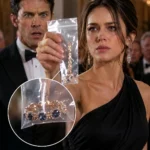
I thought about the bracelet beneath the spotlight.
“I hated every second.”
“Then why did you do it publicly?”
“Because he committed the act publicly.”
“You could have protected the family.”
I looked at her.
“I protected the youngest member.”
Celeste’s composure cracked.
“The mansion is my home.”
“It secures a debt owed to Rose’s trust.”
“You would remove me?”
“Your son tried to remove my daughter from her own name.”
“That report was a mistake.”
“It was a weapon.”
“She will never understand any of this.”
“She will someday.”
I leaned forward.
“And when she does, I want to tell her that her mother did not trade her future for an invitation to Christmas dinner.”
Celeste stared at me.
For the first time, she looked old.
Not fragile.
Not innocent.
Merely old.
“What do you want?” she asked.
“The truth under oath.”
“About what?”
“The bracelet.”
Her eyes moved toward the window.
The answer was already there.
“You knew Grant took it.”
“I knew he planned to donate something meaningful.”
“You gave him the safe code.”
Celeste said nothing.
“You had the code because you helped choose the safe when we moved into the penthouse.”
“He said you had approved it.”
“And you believed him?”
“He is my son.”
“That is not an answer.”
She looked at me then.
“I believed what allowed me to continue respecting him.”
It was the most honest thing Celeste had ever said.
“You will testify,” I said.
“If you do, Adrian will recommend delaying enforcement against the mansion until the litigation ends.”
Her lips parted.
“You are bargaining with my home.”
“I learned from your family.”
Celeste stood.
“I will not betray my son.”
I rose with her.
“You already did.”
She looked confused.
“You taught him love meant protection from consequences.”
The library doors opened.
Her driver waited in the lobby.
Celeste put on her gloves.
At the doorway, she paused.
“Your mother was not kind.”
I almost smiled.
“She was careful.”
Celeste testified three weeks later.
She admitted giving Grant the safe code.
She admitted knowing about Savannah before the gala.
She admitted advising Grant to describe me as emotionally unstable.
She admitted that the foundation’s public relations office had prepared statements before the bracelet was auctioned.
The humiliation had not been spontaneous.
It had been a campaign.
Grant had intended to provoke me publicly, document my reaction, and use the footage in custody court.
The plan required me to cry.
It required me to shout.
It required me to become the woman he had described before I entered the room.
I had denied him the performance.
That was why my silence frightened him more than anger ever could.
Savannah testified next.
She arrived without Grant.
Her hair was pulled into a severe knot.
The silver dresses, soft photographs, and perfect smiles were gone.
She looked younger without victory on her face.
Her attorney had negotiated limited immunity in exchange for evidence concerning the charitable accounts and forged laboratory report.
Savannah admitted Grant asked her to bid on the bracelet.
She admitted receiving my warning text.
She admitted using a corporate letter of credit.
She admitted she had known the bracelet belonged to Rose.
“Why did you proceed?” Adrian asked during the deposition.
Savannah looked at me across the conference table.
“Grant said Eleanor would never fight publicly.”
“Why?”
“He said she cared too much about appearing dignified.”
Adrian waited.
Savannah lowered her eyes.
“He said dignity made her predictable.”
Savannah’s fingers tightened.
“I thought he had already won.”
“Won what?” Adrian asked.
“The divorce.”
“No divorce had been filed.”
“He said the marriage was functionally over.”
“Were you living with him?”
“Sometimes.”
“While he remained married?”
“Did you believe your child was his?”
Savannah hesitated.
“I believed it was possible.”
“Did you tell him there were other possible fathers?”
“Why not?”
She looked toward the window.
“Because Grant does not share things he believes belong to him.”
The room fell silent.
For one brief second, I saw the truth beneath Savannah’s cruelty.
She had believed she was using Grant.
Grant had believed he owned her.
They had mistaken mutual exploitation for love.
I felt no sympathy.
But I understood the shape of the trap.
Before leaving, Savannah stopped beside me.
“I didn’t think he would come after Rose.”
“You helped him.”
“I didn’t know about the fake report until later.”
“But you knew about the bracelet.”
Her face tightened.
“He told me you didn’t deserve it.”
“My mother did not leave it to me.”
“I know.”
“That made it easier?”
She looked toward the door.
“It made it worse.”
I studied the woman who had sat beside my husband beneath the chandeliers.
She had wanted me to collapse.
Instead, she was the one standing without a family, without a job, and without the future Grant had promised.
“You looked happy when you raised the paddle,” I said.
“I was.”
Savannah’s honesty was almost elegant.
“For thirty seconds, everyone in that room believed I had won.”
She walked away.
I understood then why public humiliation was so seductive.
It offered the illusion that witnesses could turn cruelty into truth.
They could not.
A room full of applause had not made the bracelet Savannah’s.
A thousand headlines had not made me unstable.
Grant’s confidence had not made his evidence real.
Ownership was written elsewhere.
So was truth.
PART FIVE
THE VERDICT BENEATH THE MARBLE SAINTS
The final hearing began ten months after the gala.
By then, the ballroom photographs had become famous.
One image showed Savannah holding her paddle.
Another showed me standing alone in black velvet.
A third showed Grant at the microphone, his expression halfway between contempt and panic.
People online called it the Million-Dollar Mistress Auction.
They made videos about the bracelet.
They argued about marriages they had never witnessed.
They guessed which diamonds were real.
No one knew about the inscription.
That still belonged to Rose.
The courthouse was crowded on the morning of the verdict.
Grant arrived alone.
Savannah had filed a separate action seeking child support from Miles.
Miles had moved to Switzerland before federal investigators restricted his travel.
Celeste entered through a side door.
She no longer lived at the mansion.
Enforcement of the debt had been delayed during the litigation, but she moved voluntarily after the board voted to convert the property into a corporate asset.
She rented a townhouse in Greenwich and told friends the city had become exhausting.
I suspected shame was more exhausting than the city.
Inside the courtroom, Judge Ellison reviewed the issues one by one.
The paternity report had been fraudulent.
The bracelet had been removed without authorization.
The attempted auction constituted conversion of trust property.
The charitable letter of credit had been improperly issued.
Grant had committed marital waste.
The infidelity clause was enforceable.
The voting-share transfer was valid.
The custody evidence demonstrated a pattern of manipulation, false allegations, and willingness to damage Rose’s identity for financial advantage.
Grant’s attorneys argued he had acted under emotional pressure.
Judge Ellison did not appear moved.
“Pressure does not create documents,” she said.
“It does not alter metadata, authorize wire transfers, or remove property from a biometric safe.”
Grant stared straight ahead.
The judge awarded me sole legal custody of Rose.
Grant received supervised visitation twice each month, contingent upon therapy and compliance with all court orders.
He lost the penthouse.
He lost his claims to my inherited assets.
He lost the fourteen percent of company shares secured by the prenuptial agreement.
He was ordered to reimburse Rose’s trust for legal expenses, security costs, appraisal fees, and losses associated with the attempted transfer.
The district attorney’s investigation remained open.
The civil judgment did not protect him from criminal charges.
The bracelet was returned to Rose’s trust.
Grant looked at me for the first time when the judge said those words.
I wondered whether he remembered my mother’s hospital room.
I wondered whether he remembered signing the trust acknowledgment.
I wondered whether he remembered any moment that did not involve winning.
After the hearing, his attorney asked Adrian for five minutes alone with me.