“Your father’s plane was sabotaged.”
I stopped.
Graham walked toward me.
“Your mother discovered it three years after the crash.”
“Who sabotaged it?”
I faced him.
“Your father planned to remove Victor from Blue Lantern. Victor had been moving money into unauthorized investments.”
“Do you have proof?”
“Eleanor had proof.”
“Where?”
“She gave it to me for protection.”
“You mean you stole it.”
“She trusted me more than you think.”
“My mother built a decoy amendment to expose you.”
“She also knew you were too emotional to survive the truth about your father.”
The old insult.
Too emotional.
Too fragile.
Too female to be trusted with the facts of my own life.
“Play the recording,” I said.
“First, we make an agreement.”
“You have not heard the terms.”
“I do not negotiate with men who drug me.”
His jaw tightened.
“I was trying to help you sleep.”
“You instructed a physician to diagnose the symptoms you created.”
“You were collapsing under pressure.”
“So you increased it?”
“I kept this company alive while you wandered through boardrooms pretending compassion was leadership.”
His voice rose.
“Do you know how many deals I closed while you memorized employees’ children? How many investors I convinced to overlook your sentimentality?”
I looked at him.
“You hate me.”
“I hate waste.”
“No. You hate that I possessed what you believed you deserved.”
“I earned Sterling Crown.”
“You were paid to manage it.”
“I built its value.”
“You stole its reserves.”
“For restructuring.”
“You funded your mistress from a scholarship account.”
His face hardened.
“Sloane was part of the acquisition strategy.”
“She thought you loved her.”
“People believe what they need to believe.”
“And what did I believe?”
For the first time, he hesitated.
I stepped closer.
“What did you make me believe, Graham?”
“That you needed me.”
The honesty was almost beautiful.
I nodded slowly.
“There you are.”
“What does that mean?”
“That may be the first true thing you have said in twelve years.”
He turned toward the writing desk.
“You want truth? Your mother knew Victor killed your father. She also knew exposing him would destabilize Blue Lantern. So she buried it.”
He removed a small recorder from the hidden drawer.
I knew immediately it was different from the one we had found.
Older.
Silver.
My mother’s initials engraved on the back.
“Play it,” I said.
“Sign the settlement.”
He placed a document on the desk.
I scanned the first page.
He wanted the fraud evidence sealed, the divorce resolved privately, and all criminal referrals withdrawn where legally possible.
In exchange, he would surrender claims to the marital estate and provide the recording.
“You are asking me to help conceal crimes.”
“I am asking you to protect your family’s name.”
“My family’s name survived you.”
“Will it survive murder?”
I looked at the recorder.
“Play ten seconds.”
“Then you have nothing.”
I turned again.
He pressed play.
My mother’s voice filled the salon.
“Evelyn, if you ever hear this, it means Graham has broken his promise to me.”
Graham stopped the recording.
The world became very quiet.
She had named him.
She had given it to him willingly.
“What promise?” I asked.
“Sign first.”
“You forged my name, stole my money, drugged me, and tried to have me declared incompetent. There is no contract on earth that makes your promise valuable.”
“Then leave.”
I walked toward the door.
Behind me, Graham said, “Victor did not sabotage the plane.”
I stopped again.
He smiled without warmth.
“Your mother did.”
The words entered me slowly.
“Your father planned to dissolve Blue Lantern and sell Sterling Crown. He had gambling debts. He had pledged family assets to cover them. Eleanor discovered he intended to leave both of you with nothing.”
“You are lying.”
“She ordered the maintenance chief to delay the plane.”
“Delay?”
“She wanted to prevent departure until lawyers could freeze the assets. The mechanic tampered with a fuel sensor. He made a mistake. The plane crashed.”
My hands went numb.
“Who was the mechanic?”
Graham watched me.
“Thomas Bell’s father.”
Thomas.
The operations manager who detached the Aurelia.
The man whose family had served ours for decades.
“Your mother paid the Bell family for years.”
“Because his father died in the crash investigation.”
“Because he kept her secret.”
My heartbeat pounded against the transmitter beneath my bracelet.
“Play the recording.”
“Sign.”
He lifted the recorder.
“Then it burns.”
A lighter appeared in his other hand.
The investigators would enter if I used the emergency phrase.
But I needed the confession preserved.
I needed him to continue.
“You would destroy evidence of my father’s death?”
“I would destroy a copy.”
So there were others.
“Where is the original?”
“You are finally asking the right questions.”
A sound came from the forward corridor.
Soft.
Metal against wood.
Graham’s eyes flicked toward the door.
He knew.
“You brought someone.”
He moved quickly.
The lighter fell.
His hand closed around my wrist.
Pain shot up my arm as he twisted the bracelet.
“Who is listening?”
He tore the bracelet free and threw it against the wall.
Then he reached inside my coat and found the microphone.
“You never learn.”
He ripped the device away.
The emergency signal cut.
The lights went out.
Darkness swallowed the salon.
Graham cursed.
A second later, the carriage jolted.
Not hard.
Just enough to disturb his balance.
I pulled free.
Emergency lamps illuminated in deep blue along the floor.
The salon transformed into a tunnel of shadow and silver.
The door opened.
Adrian entered.
Behind him stood federal investigators and Thomas Bell.
Graham looked from Thomas to me.
“You.”
Thomas’s face was pale.
“My father did not sabotage that plane,” he said.
“Your family has taken Sterling money for fifteen years.”
“Compensation from the aircraft manufacturer.”
“Your father confessed to Eleanor.”
“No,” Thomas said. “He recorded Victor Mercer confessing.”
Graham’s smile vanished.
Thomas held up a sealed evidence bag.
Inside was a reel of magnetic tape.
“My father found Victor in the hangar the night before the crash. Victor had paid another mechanic to alter the fuel gauge. My father confronted him and carried a recorder because he had already suspected financial theft.”
“Where did you get that?” Graham demanded.
“Eleanor Sterling gave it to my father’s attorney. The original has remained in escrow.”
I looked at Thomas.
“My mother knew?”
“Why did she not expose Victor?”
“She tried. Victor threatened to implicate your father in the Blue Lantern fraud and collapse the railway. Federal investigators advised her to remain silent while they built a larger case. Then the lead agent died. The investigation stalled.”
“And Graham’s recording?”
Thomas looked toward the silver device.
“Edited.”
Adrian retrieved it from the desk.
Graham backed toward the observation window.
“You cannot prove I edited anything.”
“We do not need to,” Adrian said. “You just admitted there are other copies.”
I saw calculation return.
He would claim coercion.
Misunderstanding.
Marital conflict.
He had escaped consequences through language his entire life.
Then Sloane stepped from the corridor.
“What is she doing here?”
She held her phone in both hands.
“Livestreaming.”
His face drained.
A red number glowed on her screen.
Two point four million viewers.
She had begun the stream when Graham played my mother’s recording.
The country had heard him demand a settlement in exchange for evidence.
They had heard him threaten to burn it.
They had heard him grab me.
They had heard Thomas identify the tape.
Sloane’s voice shook.
“You taught me that people believe what they see.”
Graham lunged for the phone.
Investigators seized him.
This time, they placed his hands behind his back.
The click of the cuffs was quiet.
Smaller than I expected.
Graham turned his head toward me.
“You planned this.”
“Not all of it.”
“You used Sloane.”
“I asked her to tell the truth.”
“You used Thomas.”
“I asked him to bring evidence.”
“You used Adrian.”
I looked at the man standing beside me.
“No,” I said. “That is the difference between us. They chose.”
Graham’s breathing became ragged.
“You think they love you?”
“I think they are free to.”
The investigators led him toward the door.
At the threshold, he stopped.
I had heard my name in his voice thousands of times.
Tenderly, in the beginning.
Impatiently, later.
Clinically, when he wanted me to doubt myself.
Now it contained something I had never heard before.
Need.
“Do not let them take me out through the terminal,” he said.
News cameras waited beyond the platform.
Employees had gathered behind the security barriers.
He knew what awaited him.
“You publicly placed another woman in my life,” I said. “You can publicly leave it.”
They took him through the terminal.
Sloane ended the livestream.
Her hands trembled.
Thomas sat heavily in one of the velvet chairs.
Adrian crossed the salon and stood in front of me.
“Are you hurt?”
“My wrist.”
He touched it gently, his anger visible in the careful set of his mouth.
“A doctor should examine it.”
Outside, camera flashes burst beyond the rain-streaked windows.
Sloane folded my mother’s blanket and held it out to me.
“I should never have touched this.”
I took it.
“Will that ever be enough?”
She flinched.
I continued, “But it may become the beginning of something better than enough.”
She looked at me through tears.
“Accountability.”
Thomas stared at the floor.
“My father carried that secret until he died.”
“He should not have had to.”
“Your mother paid for my education.”
“She believed your family had paid a greater price.”
He looked up.
“Was she right?”
The answer surprised him.
Perhaps he expected a wealthy woman to defend another wealthy woman’s silence.
But love did not make my mother innocent.
Fear did not make her choices harmless.
She had protected the railway while families lived beneath the weight of secrets she could afford to bury.
Repair required more than admiring her strategy.
It required naming her failures.
I looked around the Aurelia.
The carriage had carried presidents, stars, diplomats, refugees, liars, lovers, and thieves.
Now it carried the truth.
Not clean truth.
Not beautiful truth.
The kind that arrived covered in fingerprints.
# CHAPTER FIVE — THE LAST PARTY OF GRAHAM VALE
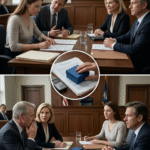
Six months later, Graham Vale stood trial in federal court.
The charges included wire fraud, conspiracy, identity theft, fraudulent conveyance, witness tampering, unlawful administration of controlled substances, and obstruction.
Victor Mercer faced related charges.
Preston Cole pleaded guilty.
Dr. Latham surrendered his medical license before his own trial began.
Two Sterling Crown directors entered cooperation agreements.
Sloane testified for three days.
The tabloids analyzed her clothes, her tears, and every glance she directed toward Graham.
But the jury cared about documents.
Messages.
Transfers.
Video.
The biometric mold.
The offshore account.
The sedatives.
The livestream from the Aurelia.
Graham’s attorneys argued that he had acted to save Sterling Crown from an unstable heiress.
Then Naomi explained the company had been solvent before he moved two hundred million dollars out of its reserves.
The defense argued that our marriage had been privately open.
Then prosecutors showed his messages instructing Sloane to provoke me publicly for the incapacity petition.
They argued that Dr. Latham’s treatment was legitimate.
Then the laboratory presented the disguised bottles.
They suggested my mother had transferred Blue Lantern to Graham.
Then the vault video played.
The jurors watched Eleanor Sterling smile faintly and say:
One juror looked directly at Graham.
The verdict came after nine hours.
Guilty on every major count.
He was sentenced the following month.
I attended.
Not because I wanted to see him punished.
Because I had spent too many years absent from the rooms where men decided my life.
Before the judge entered, Graham turned toward me.
Gray had appeared at his temples. His suit hung loosely. Without executives, assistants, drivers, and cameras arranged to flatter him, he looked ordinary.
That may have been the final cruelty of truth.
The monster was never larger than life.
He had simply been protected from consequence.
“I did love you,” he said.
A court officer told him to face forward.
He ignored the instruction.
“In the beginning,” he continued, “I loved you.”
I studied him.
Perhaps he believed it.
Perhaps, in his private language, possession and love had always meant the same thing.
“You loved being needed,” I said.
“And you never needed me.”
“I did.”
He looked almost relieved.
“For a time,” I said. “Then you made sure I believed I always would.”
The judge entered.
Graham faced forward.
I never spoke to him again.
Victor Mercer’s case revealed the truth about my father’s death.
He had arranged the sabotage to prevent my father from exposing Blue Lantern theft.
The mechanic Victor bribed altered the wrong component, causing the fatal failure. Thomas Bell’s father discovered the conspiracy afterward and preserved the confession.
My mother had cooperated quietly with investigators, but when the case stalled, she chose to protect the trust rather than expose everything publicly.
Her choice saved Sterling Crown.
It also allowed Victor to remain powerful enough to target me years later.
Legacy, I learned, was rarely clean.
Families like mine built museums around their virtues and locked their sins beneath the floor.
I opened the floor.
Sterling Crown established an independent restitution fund for employees and investors harmed by Blue Lantern’s concealed history.
We released the archived evidence surrounding my father’s crash.
Thomas Bell became director of railway safety and ethics.
Naomi joined the board.
The compromised directors were replaced by engineers, labor representatives, finance experts, and two descendants of workers who had helped build the original line.
For the first time in Sterling Crown history, employees received a permanent voting stake.
Business magazines called the move radical.
My mother might have called it dangerous.
I called it overdue.
Sloane disappeared from social media for nearly a year.
When she returned, she did not relaunch her beauty brand.
She established a legal-defense fund for women coerced into financial crimes by partners or family members.
Some people called it image repair.
Perhaps part of it was.
Good actions did not erase old harm.
But imperfect motives could still produce useful work.
We never became friends.
That would have been too simple.
Once a year, she sent a donation to the Eleanor Sterling Scholarship Fund without attaching her name.
I knew because Naomi traced everything.
The Aurelia underwent restoration.
Every black rose was removed.
Every altered panel was repaired.
Sloane’s photographs were destroyed.
My grandmother’s portrait returned to the observation salon.
My mother’s blanket was cleaned by hand and placed in a glass case beside a small plaque.
The plaque did not describe the scandal.
It read:
**Luxury is not what we possess. It is what we refuse to purchase with another person’s dignity.**
The carriage reopened as part of the Sterling Scholars Journey, carrying scholarship recipients across the country to meet engineers, artists, scientists, historians, and community leaders.
The first journey departed one year after the birthday party.
Thirty-two students boarded at Hudson Crown Terminal.
The same students whose tuition had been delayed.
Caleb Harris arrived with his father, a broad-shouldered mechanic wearing his best suit. They stood beneath the terminal clock taking photographs until Caleb’s father began crying.
I pretended not to notice until he pulled me into a hug.
“Your mother would be proud,” he said.
I looked toward the Aurelia.
“I hope she would learn something.”
He laughed.
“That too.”
Adrian waited near the rear platform.
He no longer worked as general counsel. After the trials ended, he returned to his private firm.
We had spent the year learning how to stand beside each other without turning gratitude into obligation.
There were dinners.
Walks.
Arguments about governance.
One disastrous weekend in Maine during which it rained constantly and Adrian attempted to cook lobster without instructions.
There had been no dramatic declaration.
No diamond.
No orchestra.
Only choices.
Small, repeated, freely made.
As the students boarded, he handed me a paper cup.
“Coffee,” he said.
“Is it safe?”
He looked offended.
“I watched the barista make it.”
“You interrogated her?”
“Politely.”
I took the cup.
The platform announcement echoed beneath the glass roof.
Adrian glanced toward the train.
“Are you riding to Chicago?”
“Only as far as Albany.”
“I could ride that far.”
“You have court tomorrow.”
“I could return tonight.”
“That sounds inconvenient.”
“I have survived inconvenience before.”
I smiled.
He studied me for a moment.
“You look different here.”
“I am wearing the same suit I wore at the board meeting.”
“That is not what I mean.”
I looked through the windows of the Aurelia.
Students laughed beneath the amber lamps. A young woman touched the velvet seats with reverence. Caleb showed his father the restored engineering diagrams mounted near the dining salon.
A year earlier, I had believed the carriage represented my inheritance.
Now I understood it was only a container.
The true inheritance was responsibility.
And responsibility did not require loneliness.
“I feel different,” I said.
“Better?”
Something warmed in his eyes.
The conductor called final boarding.
I climbed onto the rear platform.
Adrian remained below.
“You are not coming?” I asked.
“You did not invite me.”
After everything, he still waited.
Not because he lacked courage.
Because he respected the door.
“Come with me.”
He boarded.
The Aurelia began to move.
Hudson Crown Terminal slid behind us, its lights stretching across the evening glass.
In the observation salon, Adrian and I sat beneath my grandmother’s portrait.
No photographers.
No board members.
No strategic flowers.
He placed his hand on the velvet seat between us.
The same way he had placed it beside mine in his office.
Near.
Not touching.
Waiting.
I closed the distance.
His fingers folded gently around mine.
For a while, we watched Manhattan recede.
“I used to think love was someone refusing to leave,” I said.
“And now?”
“I think sometimes it is someone waiting to be asked to stay.”
He lifted my hand and pressed his lips lightly against my knuckles.
The gesture was old-fashioned.
Almost absurdly elegant.
My heart did not race.
It settled.
That was how I knew.
I leaned toward him.
Our first kiss was quiet.
No champagne.
No audience counting the cost of the room.
Only warm light, moving rails, and the soft pressure of a man who understood that tenderness was not ownership.
When we parted, Adrian rested his forehead against mine.
“Was that all right?” he asked.
I laughed softly.
“You sound relieved.”
“I am an attorney. Clear consent is calming.”
Outside, the Hudson River reflected the last blue light of evening.
I thought of my mother’s vault.
My father’s secrets.
Sloane’s livestream.
Graham’s final expression when the handcuffs closed.
For years, I had believed survival would feel like triumph.
It did not.
It felt like space.
A room no one had entered without permission.
A future no one else had drafted.
The train carried us north as darkness gathered over the river.
At Albany, I stepped onto the platform beside Adrian.
The scholarship students leaned from the Aurelia’s windows to wave.
Caleb shouted, “See you in Chicago, Ms. Sterling!”
“Make the engineers nervous,” I called back.
His father laughed.
The conductor raised his lantern.
The train moved forward.
Adrian and I stood together beneath the station lights until the final carriage disappeared around the curve.
He touched the silver rose at my collar.
“Do you ever wish you had stopped Graham earlier?”
I considered the question.
“I wish I had trusted myself earlier.”
“That is not the same thing.”
“Do you regret the years?”
I looked down the empty track.
Regret was too simple.
I mourned the woman I had been.
I honored the woman who survived her.
And I felt tenderness for the woman still becoming.
“I regret every day I mistook silence for peace,” I said. “But I do not regret learning the difference.”
Adrian offered his arm.
We walked through the station without security, cameras, or a waiting car.
Just two people beneath a high ceiling, moving at the same pace.
Later, strangers would continue telling the story as a fantasy of revenge.
They would say an heiress discovered an affair and stopped a luxury train.
They would post Sloane’s photographs beside images of Graham entering court.
They would repeat my mother’s words about men who failed to read past the page that rewarded them.
But the most important part was never the money Graham lost.
It was not the company I recovered, the hidden empire I inherited, or the courtroom verdict.
It was the moment I understood that humiliation only becomes identity when we accept the betrayer’s version of events.
Graham had wanted the world to see a discarded wife.
Instead, they saw an owner reclaim her property.
He wanted my grief to prove I was unstable.
Instead, his plan proved he was criminal.
He wanted another woman to live my life.
But my life had never been the blanket, the velvet seats, the townhouse, or the Sterling name.
My life was the authority to choose what happened next.
And on the night Graham believed he had finally taken everything from me, I made one telephone call.
The guests raised their champagne.
Sloane smiled for the cameras.
Graham waited for the train to carry them into the life he thought he had stolen.
The engine moved.
The music stopped.
And the carriage was detached while their guests were still taking photographs.