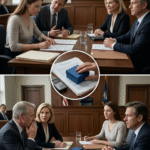
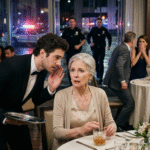
“He didn’t file,” I said. “He contacted schools, drafted a Manhattan lease, and authorized you to present yourself as Emma’s domestic caregiver.”
Several women in the room visibly recoiled.
Sloane’s expression changed.
Not guilt.
Calculation.
“You told me Claire agreed Emma would live with us half the time.”
“I thought we could work it out.”
“You told me everything was settled.”
“Nothing was settled.”
Her voice cracked.
“What about the apartment?”
“I haven’t signed it.”
“You said you had.”
“I said I was handling it.”
Sloane stared at him as if seeing the same stranger I had seen one week earlier.
“You lied to me.”
The sentence was almost laughable.
Instead, it was sad.
She had believed herself exempt from the character he had already revealed.
Daniel reached for her.
She pulled away.
The guests shifted toward the exits.
The showcase was over.
The brides left with their families, carrying reimbursement letters instead of venue brochures.
The photographers packed their equipment.
The models upstairs changed out of wedding gowns no one would see.
The florist demanded payment before removing the arrangements.
The reporter from Hudson Bride asked Naomi for a formal statement.
Sloane remained near the platform as her future disappeared around her.
Daniel came toward me.
Naomi looked at me.
I nodded, allowing him to speak.
He stopped several feet away.
“I never meant for this to happen.”
“What did you mean to happen?”
His eyes filled.
He looked older than he had that morning.
“I thought the business would work. I thought once the revenue came in, you would see it made sense.”
“And the affair?”
He looked down.
“I was lost.”
“No. You were certain. You were certain I would remain quiet. You were certain the deed was a technicality. You were certain Emma could be moved into your new life after you built it in secret.”
“I made mistakes.”
“A mistake is forgetting an anniversary. You formed a company.”
He flinched.
“I still love you.”
Behind him, Sloane laughed once.
It was a broken sound.
“You told me you hadn’t loved her in years,” she said.
I looked at the two of them.
A week earlier, they had stood beneath my grandmother’s chandeliers, united by the certainty that I would accept whatever they decided.
Now they stood several feet apart, each horrified by the lies that had once felt romantic.
Daniel stepped closer.
“Claire, I know I don’t deserve forgiveness.”
“Then don’t ask for it.”
“I can fix this.”
“We can go to counseling.”
“For Emma.”
“Do not use her to make your regret sound noble.”
His face crumpled.
“I don’t want to lose my family.”
“You were willing to replace it when you believed replacement would be easy.”
“I was wrong.”
“I’ll end it with Sloane.”
I felt no triumph.
Only exhaustion.
“You are still speaking as though the prize is your decision,” I said. “It isn’t.”
“What do you want me to do?”
“Tell the truth to the board. Cooperate with the audit. Repay what you took. Respect the custody order. And leave Rosemere tonight.”
He looked around the carriage house.
At the flowers.
At the abandoned runway.
At the sign bearing Sloane’s company name.
Then he looked at me.
“Is there any chance?”
I thought of our first apartment.
Emma’s birth.
The Christmas mornings.
The hospital chair.
The lies.
The hotels.
The email about moving our daughter.
The recording in which he called my dignity weakness.
“No,” I said.
He nodded once.
Tears slipped down his face.
I did not comfort him.
Regret deserved to be felt by the person who created it.
Sloane disappeared before the last guest left.
She abandoned the diamond bracelet on a table beside the champagne tower.
Daniel stood alone beneath the paper butterflies.
I walked to the main doors and opened them.
Cold night air entered the carriage house.
One by one, the candles went out.
Chapter 5: The House That Kept My Name
The divorce took ten months.
Daniel fought during the first three.
Then the evidence became too expensive to argue with.
The forensic audit confirmed that he had diverted company funds, falsified expense descriptions, and attempted to conceal his financial relationship with White Ember. Outside counsel negotiated repayment terms that prevented criminal referral from becoming the company’s primary objective, though the bank conducted its own review of the false collateral application.
Daniel resigned from Mercer Ellison Development.
The board removed his name from the company six months later.
It became Ellison Development Group.
Marcus remained chief executive.
I accepted the role of board chair, not because I wanted Daniel’s office, but because I had spent too many years believing quiet support was the same as leadership.
Sloane’s company filed for bankruptcy.
Two vendors sued over unpaid invoices.
The three brides recovered every dollar.
Madison held her June wedding at a vineyard near Millbrook. She sent me a photograph afterward.
She and her husband stood beneath strings of warm lights, laughing in the rain.
On the back, she wrote:
Thank you for protecting a day that had nothing to do with the people who tried to ruin it.
I kept the photograph in my desk.
Sloane gave one interview after the showcase.
She described herself as another victim of Daniel’s deception.
Some of that was true.
Not all of it.
The recording proved she knew my name was on the deed. The emails proved she encouraged Daniel to act before I could object. The invoices proved she participated in hiding the source of the money.
She had been deceived about the depth of his power.
She had not been deceived about my existence.
The difference mattered.
Daniel moved into a rented apartment in White Plains.
He sold his sports car, his watches, and the Manhattan club membership he had once considered essential to his identity.
Under the divorce settlement, he reimbursed the marital estate for the funds spent on Sloane and waived any claim to Rosemere, the carriage house, my inherited shares, and the trust.
The court awarded us joint legal custody with primary residential custody to me.
Daniel received regular parenting time.
I did not try to remove him from Emma’s life.
He had failed as my husband.
That did not give me permission to make Emma responsible for punishing him.
But boundaries were written clearly.
No changes to her school without mutual consent.
No romantic partner presented as a parent.
No travel outside the state without notice.
Family counseling for the first year.
At the beginning, Emma resisted seeing him.
She was angry in the quiet, stubborn way children often become angry when they love someone who has embarrassed them.
I never told her to forgive him.
I told her she was allowed to feel everything.
Daniel apologized to her without excuses.
For once, he did not call betrayal a transition.
He called it betrayal.
That was the beginning of whatever relationship they would build next.
It was not mine to manage beyond keeping her safe.
Three weeks after the divorce became final, Daniel came to Rosemere alone.
The maple trees were turning red.
I found him standing outside the carriage house with his hands in his coat pockets.
“You shouldn’t be here without calling,” I said.
He held out a small box.
Inside was my grandmother’s silver riding crop.
The one Sloane had decorated with a satin ribbon.
“I had it restored,” he said.
I took the box.
He looked toward the carriage house.
The White Ember signs were gone.
The paper butterflies had been removed.
The original lanterns had been rehung.
Through the windows, afternoon light fell across the old stone floor.
“You were right about this place,” he said.
A sad smile touched his mouth.
“You always hated when I said that.”
“I hated how long it took you to say it.”
He nodded.
“I thought if I became successful enough, I’d stop feeling like everything came from your family.”
“I never asked you to feel small.”
“No. You didn’t. I did that myself.”
He looked older now.
Not ruined.
Human.
The loss of power had not transformed him into a better man overnight. But it had removed the stage on which he had performed certainty.
“I resented Rosemere,” he said. “Every room reminded me that you came from something I couldn’t build.”
“So you tried to control it.”
“And me.”
His eyes lowered.
“And when Sloane admired you, you believed admiration was love.”
“I wanted to.”
The wind moved through the maples.
For several moments, neither of us spoke.
“I’m sorry,” he said. “Not because I lost the company. Not because Sloane left. I’m sorry because I trained myself to see your loyalty as something guaranteed.”
I held the box against my coat.
“Loyalty is given. It is never guaranteed.”
“I understand that now.”
“I hope you do.”
“I think part of me will always believe there was a version of our life I could have saved.”
“There was.”
His face tightened.
“But you would have had to save it before you needed to be forgiven.”
A tear gathered in one eye, but he did not look away.
“Are you happy?” he asked.
The question surprised me.
I looked at Rosemere.
At the windows of the house.
At the carriage house.
At the road beyond the gate.
“I’m becoming peaceful,” I said. “That is better.”
He left without asking again for another chance.
I watched his car disappear between the stone pillars.
Then I carried my grandmother’s riding crop inside.
The following spring, we reopened the carriage house.
Not as a luxury bridal empire.
Not as a monument to revenge.
As the Ellison House for Creative Women.
The lower floor became an event space available to local nonprofit organizations, small businesses, and community arts programs. The upper rooms became studios for women building companies after divorce, widowhood, bankruptcy, caregiving, or years spent supporting someone else’s career.
Naomi helped establish the legal fellowship.
Marcus funded the first business grant through Ellison Development Group.
Mateo supervised the restoration and refused to let anyone replace the old beams.
Mrs. Whitcomb donated my grandmother’s letters, which we displayed in the archive room Sloane had planned to demolish.
One letter became the heart of the building.
My grandmother had written it to my mother in 1987.
A home should not teach a woman to remain trapped. It should remind her that she has somewhere to stand.
We framed those words above the entrance.
Emma chose the flowers for opening day.
Not white roses.
Wildflowers.
Blue cornflowers, yellow ranunculus, pink sweet peas, and branches of flowering quince. She said the building had looked too perfect before.
“It needed to feel alive,” she told me.
She was right.
On the morning we opened, sunlight filled the carriage house.
There were no influencers posing beneath the chandeliers.
No reporters waiting for a woman to break.
No husband touching another woman while his daughter watched.
There were artists carrying canvases, lawyers offering free consultations, accountants teaching financial literacy, and small-business owners exchanging cards over coffee.
Madison came with her husband.
They brought their wedding photograph in a silver frame.
Daniel did not attend.
He sent a handwritten note to Emma congratulating her on the flowers.
She read it, folded it, and placed it in her pocket.
Healing did not arrive as one grand victory.
It arrived in smaller choices.
A daughter learning she did not have to hate her father in order to love her mother.
A woman discovering that composure was not the absence of pain.
A house becoming useful without surrendering its history.
A name surviving the man who tried to spend it.
That afternoon, when the final guests had gone, Emma and I sat on the carriage house steps with our shoes off.
The lawn rolled green toward the pond.
She rested her head on my shoulder.
“Are people going to get married here someday?” she asked.
“Maybe.”
“Would you let them?”
I looked through the open doors.
The chandeliers glowed softly above the stone floor. My grandmother’s riding crop hung in its proper place. Her letter remained framed at the entrance.
“Yes,” I said. “But only if they understand what the building means.”
“What does it mean?”
I took her hand.
“That love should never require someone to disappear.”
Emma thought about that.
Then she smiled.
Behind us, the carriage house stood exactly where it had stood for more than a century.
Daniel had believed my dignity would keep me silent.
Sloane had believed possession began when a woman acted confident enough.
They had mistaken patience for surrender, history for weakness, and marriage for permanent permission.
The lease disappeared.
The money was recovered.
The brides were protected.
The man who had underestimated me finally understood what he had lost.
And the building he tried to give away became a place where women learned to own their futures.
As for White Ember Bridal, every booking was canceled before the first bride arrived.