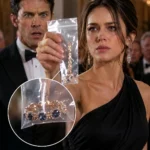
Eleanor stared at the screen.
For the first time all evening, she looked old.
I tilted the phone slightly so everyone could see.
“You announced the second baby before dessert,” I said.
“That was ambitious.”
Part 2 — What Was Folded Behind the Registration
Four nights earlier, I had not been looking for proof.
That was the thing people never understood about betrayal.
You rarely find it because you go hunting.
You find it because someone arrogant becomes lazy.
Grant’s Bentley had a flat tire on the Merritt Parkway, and his driver had taken my Range Rover instead.
By six, the Bentley was in our garage, polished and silent, smelling faintly of leather and his cedar cologne.
At eight, Grant called from Manhattan and said he would not be home.
Board dinner.
Important investors.
Do not wait up.
I did not wait up.
I walked into the garage with a folder of insurance forms because the registration renewal had been mailed to the wrong office.
Marriage turns women into archivists of men’s carelessness.
I opened the glovebox.
The registration was not there.
There were sunglasses, a tire pressure gauge, three valet tickets, and an envelope wedged behind the owner’s manual.
Cream paper.
No return address.
My name was not on it, so I should have closed the glovebox.
That was the old Olivia.
The old Olivia had respected locked doors inside her own marriage.
The new Olivia had spent too many nights listening to Grant shower after coming home smelling like hotel soap.
I pulled out the envelope.
Inside was a photograph.
Not digital.
Printed.
Tucked into a folded hospital bracelet like a relic.
Madison lay in a maternity bed with her hair brushed and her mascara perfect.
Grant stood beside her holding a baby.
He looked tired.
Proud.
Soft in a way he had not looked at me in years.
On the back, in Madison’s rounded handwriting, were five words.
For Daddy G.
First Harlow heir.
I sat in the Bentley until the garage lights clicked off around me.
The darkness did not frighten me.
The photo did not even surprise me as much as I wanted it to.
It confirmed something my body had known before my mind had agreed to say it.
There had been late meetings.
There had been sudden showers.
There had been a Madison Reed who went from junior event consultant to executive brand liaison in eighteen months.
There had been hotel suites booked under holding companies.
There had been Grant’s new habit of keeping his phone facedown, always within reach, like a gun.
Still, a child was different.
A child meant planning.
A child meant appointments, names, money, lies.
A child meant everyone who knew had watched me sit at family tables while they discussed legacy as if my grief were the only obstacle.
I turned the bracelet over in my hand.
Born April 19, 2024.
Lenox Hill Hospital.
At that exact time, Grant had told me he was in Chicago negotiating the Lakeshore acquisition.
I remembered because he had sent flowers to the house with a card that read, We’ll try again when I’m back.
We’ll try again.
As if trying had been our shared failure.
As if I had not injected hormones into my stomach while he complained about stress.
As if I had not lain under fluorescent lights while doctors discussed egg quality, uterine lining, and age with the gentle brutality of science.
As if he had not let me believe my body was the locked door.
I did not cry in the Bentley.
Crying would have fogged the windows.
Instead, I photographed everything.
The printed photo.
The bracelet.
The handwriting on the back.
The envelope.
The position of the envelope inside the glovebox.
Then I placed it all exactly where I had found it.
That is the difference between pain and strategy.
Pain wants to throw the evidence.
Strategy puts it back.
At 9:12 p.m., I called Lena Ortiz.
Lena had been my roommate at Columbia Law before I married into marble.
She had become one of the most feared divorce attorneys in New York by developing the rare ability to smile like a saint while cutting men open with subpoenas.
She answered on the second ring.
“Tell me you finally found something.”
“I found a baby.”
Silence.
Then her voice sharpened.
“Whose?”
“That is the expensive question.”
By midnight, I was in Lena’s office on Madison Avenue, drinking burnt coffee while she examined the photographs on her tablet.
Outside her windows, Manhattan glittered like it had never broken a woman’s heart in its life.
Lena zoomed in on Grant’s wedding ring.
Then on the bracelet.
Then on the reflection in the window.
“This is good,” she said.
“It feels disgusting.”
“Good evidence often does.”
She leaned back.
“Do you still have access to joint accounts?”
“Company card statements?”
“Calendars?”
“Fertility records?”
I looked up.
Her expression softened, but only slightly.
“Olivia, we need everything.”
I knew what she meant.
The private humiliation had to become public paper.
That is how wealthy men are beaten.
Not by screaming.
By PDFs.
For three days, my life became quiet excavation.
I did not confront Grant.
I did not ask where he had been.
I did not touch Madison’s Instagram, though she posted a photo of white roses with the caption, Some blessings arrive after patience.
I made breakfast.
I attended a foundation meeting.
I kissed Grant’s cheek when he left for work.
His skin was cold.
Mine was colder.
Lena’s investigators found the apartment first.
A two-bedroom on East Seventy-Second, paid through a Harlow Meridian vendor account labeled “regional hospitality staging.”
They found a nanny payroll routed through a consulting firm.
They found medical insurance reimbursements buried under executive wellness expenses.
They found a trust inquiry sent to the Harlow family office asking whether a nonmarital male child could qualify under “bloodline continuity provisions.”
That phrase made Lena laugh for five full seconds.
Not because it was funny.
Because it was exactly the kind of arrogance judges hated.
Then came the prenup.
Grant had waved it around at dinner because he believed a contract was a cage.
He had forgotten who reviewed it before I signed.
Me.
The Harlow prenup was brutal on the surface.
No alimony beyond two million.
No claim to premarital trusts.
No right to the Greenwich house.
No right to the Aspen house, the Nantucket house, or the ridiculous Park Avenue apartment Eleanor called “a pied-à-terre” even though it had six bathrooms.
But contracts written by old-money lawyers often had secret doors.
Mine had two.
The first was an infidelity clause Eleanor had insisted on to protect Grant from me.
If either spouse engaged in adultery resulting in pregnancy, childbirth, reputational damage, concealed expenditures, or fraudulent use of marital or corporate funds, the cap dissolved.
The guilty party paid legal fees, forensic costs, and equitable damages.
Eleanor had wanted the clause because she assumed I would be the temptation.
Women like her always believed middle-class girls married up with one eye on the gardener.
The second door was better.
A morality provision buried in the Harlow Meridian family trust.
Grant’s grandmother, Margaret Harlow, had written it after watching her own husband install three mistresses in company apartments and call it business.
Margaret had been dead for twelve years, but her anger remained very well drafted.
If a controlling Harlow heir attempted to replace a lawful spouse with a nonmarital partner while still married, or presented a nonmarital child as an heir for trust advantage before legal dissolution, his voting rights could be suspended pending review.
If corporate money was used to conceal the affair, the board could remove him as chief executive.
If the lawful spouse held vested company shares, she could vote them without family restriction.
That last part mattered.
Grant had forgotten my shares because he never thought of my work as ownership.
Five years earlier, when Harlow Meridian was bleeding money after the Miami resort lawsuit, I had negotiated the lender standstill, restructured the debt, and saved the company from selling three historic properties.
Margaret’s trust rewarded rescue work.
The board issued me restricted Class A shares.
Eleanor called it symbolic.
Grant called it paperwork.
I called it vesting.
As of the previous Monday, the shares were mine.
Seventeen percent.
Enough to matter.
Enough to terrify them if they ever bothered to count.
On the third night, Lena called me back to her office.
She had a sealed envelope on her desk.
“What is that?” I asked.
“Your husband’s fertility records.”
My stomach tightened.
“How?”
“Subpoena draft first, voluntary production second, and a very nervous clinic administrator third.”
“Lena.”
“I did not break the law,” she said.
“I just stood close to it and smiled.”
I opened the file.
The words were clinical.
Precise.
Merciless.
Non-obstructive azoospermia.
Repeated confirmation.
Natural conception highly improbable.
Recommendation for donor sperm or advanced reproductive intervention.
Date of diagnosis.
Three months before Grant and I began fertility treatments.
I read it once.
Then again.
Then a third time because betrayal sometimes needs repetition before the brain agrees to be wounded.
Grant had known.
He had known his body was the reason we could not conceive naturally.
He had let me sit through Eleanor’s pity.
He had let doctors medicate me.
He had let me apologize after every negative test.
He had let me bury my hope month after month and never once said, It is me.
Lena watched my face.
I did not cry.
That was the first time she looked frightened for him.
“Olivia,” she said quietly.
“You do not have to be graceful about this.”
I closed the file.
“Yes,” I said.
“I do.”
Because grace was not forgiveness.
Grace was control.
The dinner invitation arrived the next morning.