Suits.
Watches.
The first edition Hemingway my mother had given me because he liked the way it looked in his office.
Then one rainy Thursday, he came for June.
Not permanently.
Not yet.
He arrived with a new car seat in the back of his black Range Rover and a smile polished for security cameras.
June ran to him because she was four and did not understand betrayal unless it raised its voice.
Cade crouched, kissed her forehead, and called her princess.
Then he looked at me over her shoulder.
“Savannah wants to take her to Magnolia Plantation this weekend.”
My face did not change.
“Savannah isn’t her parent.”
“She’s going to be in her life.”
“Not this weekend.”
He stood slowly.
“You know, judges don’t like mothers who alienate children.”
There it was.
Not anger.
Not grief.
A threat spoken softly in a marble foyer while our daughter showed her stuffed rabbit the rain.
I folded my hands in front of me.
“Judges also don’t like fathers who introduce affair partners before temporary custody orders.”
His smile thinned.
“You’ve been talking to Lydia.”
“I never stopped.”
He stepped closer.
Cade was handsome in the way expensive things are handsome, all clean lines and cold surfaces.
Once, I had mistaken that for strength.
“Listen to me, Ellie,” he said.
“You can either make this dignified, or you can make it painful.”
I looked past him to June, who was pressing her rabbit’s face against the window.
“It’s already painful.”
“Then stop making it worse.”
I almost laughed.
That was what he hated most, I think.
Not tears.
Not accusations.
He hated the possibility that I could see him clearly and survive it.
When he left without June, he slammed the door hard enough to shake the chandelier.
Two days later, I opened my jewelry safe and found the velvet pearl box empty.
For a moment, the world narrowed to the black hollow where my mother’s necklace should have been.
No scream came.
No sob.
Only a coldness so complete it felt like my bones had turned to glass.
I touched the empty indentation in the velvet.
Then I called Lydia.
She did not sound surprised.
“Do you have proof he accessed the safe?”
“I have cameras in the upstairs hall.”
“Good.”
“He knows about the cameras.”
“He knows about the visible cameras,” she said.
My mother had installed a second system after a housekeeper stole antique silver in 2009.
Cade had called it paranoid.
Lydia called it Exhibit C.
The footage showed him entering my dressing room at 11:42 p.m. the night he came back for his tuxedo studs.
It showed him using the emergency key from the linen closet.
It showed him standing at my safe for six minutes.
It did not show the combination, because Cade blocked the keypad with his shoulder, but it showed the velvet box in his hand when he left.
I watched the clip once.
Only once.
His face as he opened the box was the face of a boy finding something breakable.
Not precious.
Breakable.
Lydia asked if I wanted to file an emergency motion immediately.
I looked at the frozen image of my husband stealing my dead mother’s pearls and heard my mother’s voice in the hospital room.
Let them carry it into the light.
“No,” I said.
There was a pause.
“Eleanor.”
“Where is he taking them?”
Another pause.
Then paper shifted on Lydia’s desk.
“There is a wedding scheduled Saturday at St. Augustine’s.”
My breath stayed even.
“A wedding.”
“A blessing ceremony, technically,” Lydia said.
“The divorce is not final until Monday, so the church cannot call it a legal wedding.”
I closed my eyes.
Of course.
Cade had found a loophole pretty enough for photographs.
A blessing ceremony for Cade Mercer and Savannah Lyle, followed by a reception at the Mercer mansion, with white roses, champagne towers, and a string quartet playing beneath the oaks.
Not legal.
Just cruel.
Just public enough to brand me as the past before a judge had signed my name out of his.
“Is Vivian hosting?” I asked.
“Yes.”
“And Savannah will wear the pearls.”
“She would be foolish.”
“She will wear them.”
Because Savannah did not want jewelry.
She wanted proof.
She wanted Charleston to see my mother’s pearls against her skin and understand that Cade had not simply left me.
He had taken the blessing of my bloodline and gifted it to her.
Women like Savannah do not just steal husbands.
They redecorate the crime scene.
Saturday arrived bright and sharp, with a blue sky so clean it felt insulting.
I dressed carefully.
Black silk.
Low heels.
Diamond studs.
No wedding ring.
My hair was pulled back at the nape of my neck the way my mother wore hers in board meetings.
June stood on my bed in a cream cardigan, watching me fasten my earrings.
“Are we going to church?” she asked.
“For a little while.”
“Is Daddy there?”
“Is Miss Savannah there?”
I turned.
June did not say it with anger.
She said it like children say the names of storms they have learned from adults.
She looked down at her rabbit.
“Do I have to hug her?”
“No, baby.”
Her shoulders dropped with relief so small it broke my heart.
“You never have to hug anyone who makes your stomach feel tight.”
She nodded seriously, absorbing the lesson as if it were math.
At St. Augustine’s, the parking lot glittered with luxury cars and old money discomfort.
People saw me and forgot how to move naturally.
A woman in a lavender suit touched her pearls as if mine might be contagious.
A man from Cade’s investment board looked at my dress and then at June and then at the church doors, calculating which side of history had better cocktails.
I walked through them all.
Slowly.
Not because I wanted drama.
Because women like my mother taught me that speed is what guilty people use to escape rooms.
The chapel smelled of lilies, candle wax, and expensive lies.
White roses climbed the altar in heavy arrangements.
Gold programs rested on every pew.
At the front, Cade stood in a black tuxedo with his brothers beside him.
He looked happy until he saw me.
Only for a second.
Then his face corrected itself.
Savannah stood at the doors to the side vestibule, waiting for her music.
She wore ivory lace, not white, because even her audacity needed plausible deniability.
Her hair was swept up.
Her smile was soft and smug.
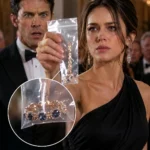
And around her throat, glowing beneath the chapel lights, were my mother’s pearls.
For one breath, I was back in the hospital room.
My mother’s fingers.
Her lipstick.
Her voice telling me not to beg.
Then Savannah saw me.
Her hand rose to the necklace.
She smiled wider.
It was not a nervous smile.
It was a woman pressing a knife in deeper to see whether it would draw sound.
I gave her none.
June’s hand tightened in mine.
“Mommy,” she whispered.
“I know.”
“Those are Grandma’s.”
“Why is she wearing them?”
The question drifted one pew forward.
Then another.
People turned.
Cade’s mother stiffened in the front row, feathers trembling on her hat.
Cade stepped down from the altar, his face tight.
“Ellie,” he said under his breath when he reached me.
“You need to leave.”
I looked at the pearls.
“They look smaller on her.”
His eyes flashed.
“Do not do this here.”
“You did.”
The organist began to play before he could answer.
Savannah started down the aisle on her father’s arm, every step deliberate, every camera phone rising like a jury.
Cade leaned toward me.
“You’re embarrassing yourself.”
I smiled then.
Not warmly.
Not kindly.
A small, calm smile.
“No, Cade.”
Savannah reached the altar.
The minister cleared his throat.
The church settled.
Cade took Savannah’s hands and turned his back on me as if that were enough to erase me.
Lydia Vance rose from the third pew.
She wore charcoal gray, red glasses, and the expression of a woman about to ruin a very expensive afternoon.
“Reverend,” she said.
Her voice carried perfectly.
“I apologize for the interruption.”
Cade went pale.
Savannah’s fingers flew to the pearls.
Lydia stepped into the aisle and opened her folder.
“My name is Lydia Vance, counsel for Eleanor Whitaker Mercer.”
A sound moved through the chapel.
Not a gasp.
Something better.
Recognition.
Lydia looked at the minister, then at Savannah.
“The bride is wearing protected property.”
Part 3 — The Chapel Where the Music Died
No one moved at first.
Even the candles seemed to hold still.
Savannah gave a soft laugh, the kind women practice for moments when they need an audience to think they are too innocent to understand the accusation.
“I’m sorry,” she said.
“These were a gift.”
Her voice floated through the chapel, sweet as poisoned tea.
Cade recovered faster.
“This is harassment,” he said.
He stepped in front of Savannah, but not far enough to hide the pearls.
That was Cade always.
Protective enough to look noble.
Selfish enough to keep the useful evidence visible.
Lydia did not raise her voice.
“That necklace is listed as separate inherited property under Schedule B of the Mercer-Whitaker Prenuptial Agreement, amended and acknowledged on March 12 of last year.”
Vivian Mercer stood.
Her pearls were smaller, whiter, and suddenly much less interesting.
“This is a church.”
“Yes,” Lydia said.
“That is why I waited until everyone was listening.”
A murmur cracked open the room.
Cade’s father, Hollis Mercer, stared at his son with the flat horror of a man seeing a financial liability in human form.
Savannah’s father removed his hand from her arm.
The minister looked as if he wished the rapture would begin immediately.
Cade pointed toward the doors.
“Get out.”
I stepped forward before Lydia could answer.
My heels sounded clean against the stone aisle.
Every head turned.
I did not look at them.
I looked only at my husband.
Technically, he was still my husband for forty-one more hours.
That mattered now.
“You had no right to take them,” I said.
His jaw worked.
“You left them in my house.”
“Our house.”
“I gave you everything.”
“You gave me a daughter and a masterclass in disgust.”
Savannah’s eyes sharpened.
“Eleanor, this is sad.”
I finally looked at her.
She had painted herself into softness.
Ivory lace.
Blush cheeks.
My mother’s pearls.
A woman performing innocence while wearing stolen grief.