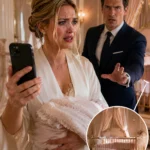
Madison placed one hand lightly over her stomach.
Not flat.
Protective.
Possessive.
The room did not breathe.
“Excuse me?” Eleanor said.
I kept my eyes on Grant.
“Room 172. St. Bartholomew. White roses. Visitor badge under your real name. Careless, even for a man who thinks security cameras are for other people.”
Madison’s lips parted.
Not in fear.
In satisfaction.
She had wanted this.
She had come to my table hoping I would bleed in front of everyone.
Grant’s voice was low.
“Olivia, stop.”
Eleanor stood.
“You will not humiliate my son in his own home.”
I turned to her.
“Your son humiliated himself in a hospital hallway.”
Madison’s eyes glittered.
Then she made her mistake.
“He was there because he cares,” she said.
The table went silent.
I smiled at her.
It was not kind.
“How comforting.”
Grant closed his eyes for one second.
When he opened them, the husband was gone.
Only the heir remained.
“We’ll discuss this privately,” he said.
“No, Grant.”
I placed the wristband on the table beside the bread plate.
“We’re done with private.”
Part 2: The Dinner Where the Mistress Smiled
Madison did not cry.
That almost impressed me.
She sat in my dining room, beneath my mother’s chandelier, with her hands folded beside the soup, and watched the Everly family rearrange itself around her scandal.
Eleanor was the first to recover.
She always was.
“Staff out,” she said sharply.
Every server in the room vanished within ten seconds.
The heavy doors closed, and the silence left behind felt expensive.
Grant remained seated.
His jaw was tight, but his eyes were alert.
He was calculating damage.
Men like Grant did not panic until numbers were involved.
Madison looked at him with a softness that made my skin crawl.
“Grant,” she whispered.
He did not answer.
I knew that look.
I had worn it once.
Years ago, before I learned that loving Grant Everly was like warming your hands over a beautiful fire built to burn your house down.
Eleanor placed both palms on the table.
“Olivia, you are emotional.”
“No, Eleanor. I am informed.”
“You are jealous.”
“I am married.”
“You are making assumptions.”
“I am holding hospital documentation.”
She looked at the wristband as if it had been left there by a servant.
Then she turned to Madison.
“Is there something we need to know?”
Madison lowered her lashes.
For a second, she looked almost young.
She was twenty-nine, maybe thirty, all pale hair and polished restraint.
The kind of woman magazines call effortless after six hours of effort.
“I never wanted to hurt anyone,” she said.
That sentence is always a confession wearing perfume.
I leaned back.
“Start again without the lie.”
Her face flushed.
“That’s enough.”
“Sit down,” I said.
He stared at me.
The room felt suddenly smaller.
I had spoken to him like a stranger, and everyone heard it.
Even Madison.
Especially Madison.
Grant did not sit.
“I made mistakes,” he said.
It was so corporate I nearly laughed.
“I’m sure the baby appreciates being filed under mistakes.”
Eleanor went still.
“Baby?”
Madison touched her stomach again, but this time her hand trembled.
Not from fear.
From anticipation.
She wanted the word spoken aloud.
She wanted the room to change shape around it.
“Yes,” Madison said softly.
“I gave birth three days ago.”
Eleanor gripped the back of her chair.
“A child?”
“A son.”
Grant looked at the ceiling.
The oldest ghost in old-money families.
Not love.
Not loyalty.
I thought of Hazel upstairs, probably coloring quietly while adults below her measured human worth in chromosomes and inheritance.
My hands were steady.
I had never been prouder of them.
Eleanor sank back into her chair.
“Grant.”
He said nothing.
Madison looked at me now.
The mask slipped just enough.
“I’m sorry you found out this way.”
“No, you’re not.”
Her mouth curved.
Barely.
“You’re right.”
Eleanor gasped.
Grant turned on her.
But Madison had waited too long for this stage.
She had rehearsed her lines in hospital beds, hotel suites, and stolen afternoons.
She was not about to leave quietly.
“He told me the marriage was over,” she said.
The room tilted, but I did not.
“They always do.”
“He said you had an arrangement.”
“Did he also say the house was cold and his wife didn’t understand him?”
Her cheeks reddened.
“Yes,” I said.
“They use the same script because women like you keep applauding.”
Grant took one step toward me.
“Do not talk to her like that.”
I looked at his shoes on the Aubusson rug my father had gifted us when we married.
“Careful, Grant.”
His eyes narrowed.
I had used his word against him.
Madison leaned forward.
“Whatever you think of me, my son is innocent.”
“I agree.”
That surprised her.
I let the silence stretch.
“Which is why the first person who should have protected him was his father.”
Grant flinched.
Small.
Real.
Good.
Eleanor’s face had turned from outrage to strategy.
“A paternity test will settle the matter.”
Madison’s smile returned.
“We already did one.”
My blood went cold.
Grant’s head snapped toward her.
She had not told him she would say that.
Now this was becoming interesting.
She reached into her white clutch and removed a folded envelope.
The paper was thick, official, and sealed in plastic.
She placed it on the table with ceremonial care.
“Non-invasive prenatal paternity testing,” she said.
“Certified lab. Ninety-nine point nine percent probability.”
Eleanor looked at Grant as if he had just placed a crown on the wrong head.
My husband did not move.
Madison slid the envelope toward me.
I did not touch it.
She wanted me to.
She wanted my fingerprints on my humiliation.
“Congratulations,” I said.
“I hope the lab was cleaner than the affair.”
Her smile sharpened.
“My son’s name is Henry Ashford Everly.”
For the first time that night, I felt something break through my calm.
Not rage.
Not grief.
A clean, stunned disbelief.
Ashford.
She had given her child my maiden name.
Grant looked sick.
Eleanor looked delighted despite herself.
Madison looked like a woman who had placed a bomb under the table and was waiting for applause.
“You named another woman’s child after my family?” I asked.
Grant said, “Olivia—”
I raised one hand.
He stopped.
Madison lifted her chin.
“Grant said Ashford carries weight.”
“It does.”
My voice was soft now.
That made everyone more afraid.
“Ashford also carries lawyers.”
Eleanor smiled thinly.
“You signed a prenup.”
“Yes.”
Grant looked at me.
Something flickered there.
He knew the prenup better than anyone.
He had insisted on it.
He had believed it protected him.
But Grant had always read contracts like a man looking for locks.
I read them like a woman looking for doors.
“I signed a prenup,” I said.
“And you signed an infidelity clause tied to custody, voting shares, and the marital residence.”
Madison’s smile faltered.
Eleanor’s eyes cut to Grant.
“What is she talking about?”
Grant’s face had gone very still.
The clause was not romantic.
It was not dramatic.
It was my father’s condition.
Before he walked me down the aisle in St. Patrick’s Cathedral, he made Grant sign a private marital conduct rider.
The rider had three triggers.
A documented affair.
A pregnancy outside the marriage.
Or public conduct that harmed the Ashford Foundation.
If any trigger occurred, Grant lost claim to the Greenwich house, surrendered his proxy vote over my Ashford-Med holdings, and agreed to primary custody terms in my favor if a court found moral or reputational harm to Hazel.
At twenty-six, I had hated my father for it.
At thirty-seven, I wanted to lay flowers on his grave.
Grant finally spoke.
“You can’t enforce that.”
“Then why do you look like I can?”
Eleanor whispered, “Grant, what did you sign?”
He ignored her.
“Olivia, this is not the place.”
I looked around the dining room.
The chandelier.
The silver.
The portraits.
The mistress in winter white.
The mother-in-law protecting bloodlines like scripture.
“No,” I said.
“This is exactly the place.”
Madison stood abruptly.
Her chair scraped against the floor.
“I will not have my son treated like a legal problem.”
“Then stop using him as a legal weapon.”
Her eyes flashed.
“You think being calm makes you superior?”
“It makes me dangerous.”
The doors opened before anyone could speak.
Hazel stood there in pink pajamas, clutching her paper star.
Her nanny hovered behind her, pale and helpless.
“I heard yelling,” Hazel said.
The room died.
Grant’s face changed.
For one second, the father appeared.
Then Hazel saw Madison.
She saw the woman’s hand on her stomach.
She saw the envelope on the table.
She saw me standing alone.
Children understand betrayal before they understand language.
“Mommy?” she whispered.
I crossed the room and knelt before her.
“Everything is okay.”
She looked past me at Grant.
“Daddy?”
Grant took a step.
Hazel stepped back.
That was the sound of his punishment beginning.
Not in court.
Not in headlines.
In the tiny retreat of his daughter’s bare feet on marble.
I lifted Hazel into my arms.
She was getting too big to carry, but that night she wrapped herself around me like she was three again.
I turned toward the table.
“Dinner is over.”
Eleanor’s voice cut through the room.
“You are not taking my granddaughter upstairs while this family is in crisis.”
I looked at her over Hazel’s shoulder.
“This family has been in crisis for years. Tonight you were simply invited to notice.”
Then I carried my daughter up the staircase while Grant stood below us, rich, handsome, powerful, and suddenly very small.
Part 3: The Prenup Was Not the Trap
By morning, the house had divided itself into territories.
Grant slept in the east wing.
I stayed with Hazel in her room until sunrise.
Madison left sometime after midnight in a black town car Eleanor had ordered, which told me everything I needed to know about where the Everly matriarch had placed her first bet.
A son had appeared.
A new heir.
A new weapon.
I expected Grant to knock on my door.
He did not.
He sent a text at 7:08 a.m.
We need to control this before it becomes public.
Not apologize.
Not explain.
Not ask about Hazel.
Control.
I looked at the message while Hazel slept curled around her stuffed rabbit.
Then I took a screenshot and sent it to my attorney.
Her name was Beatrice Cole, and she had the kind of reputation that made guilty men remember appointments in full detail.
By 9:30 a.m., I was in her Manhattan office overlooking Bryant Park, wearing black wool, a low bun, and sunglasses I did not need.
Beatrice was seventy-one, silver-haired, and terrifying in Chanel.
She had represented actresses, senators’ wives, and one woman whose husband tried to hide a vineyard inside a Delaware trust.
She kissed both my cheeks and said, “Finally.”
That was all.
Finally.
As if she had been waiting years for Grant to become careless enough to be useful.
I placed the wristband, the screenshots, the dinner summary, and Madison’s lab envelope on her conference table.
Beatrice put on reading glasses.
“I assume you did not touch the envelope.”
“I am not new.”
She smiled.
“No, darling. You are your father’s daughter.”
The mention of my father softened something in me.
Charles Ashford had been cold in many ways, but he had loved me with the paranoia of a man who knew what powerful families did to women.
He had not trusted Grant.
He had trusted paper.
Beatrice read the paternity document.