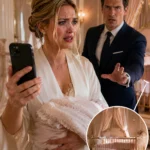
“Don’t make a scene.”
“I never make scenes.”
Cecelia smiled.
“That is debatable.”
“No, Cecelia.”
I let the pause stretch.
“I document them.”
Her eyes hardened.
The dinner began at eight.
At eight-ten, Cecelia took the stage.
She spoke about legacy, generosity, and the sacred obligation to protect the future.
Grant sat at Table 1 with Sabrina’s hand on his sleeve.
I sat at Table 19 with a venture capitalist, a museum curator, and Margot Whitmore, who had moved her name card herself and dared anyone to object.
“You look lethal,” Margot murmured.
“You look amused.”
“I am.”
“Because Mother has no idea who sponsored tonight’s media coverage.”
She lifted her champagne.
“Calder House Media.”
I felt a laugh rise and swallowed it.
Of course.
Life rarely offers justice, but sometimes it offers lighting.
After Cecelia spoke, Grant took the stage.
He was handsome under the lights.
That had always been part of the danger.
He looked like a man born to be believed.
He thanked sponsors.
He thanked donors.
Then he paused.
His eyes found Sabrina.
My stomach tightened.
“I also want to acknowledge someone very special tonight,” he said.
The room leaned in.
Sabrina lowered her eyes.
Cecelia’s smile widened.
Grant continued, “This foundation is about the future, and my family is deeply blessed to be looking toward a future filled with new life.”
A murmur moved through the tables.
Sabrina placed a hand on her stomach.
The room understood before he finished.
I watched the woman beside me whisper, “Oh my God.”
Grant smiled.
It was the warmest smile I had seen from him in months.
“And though life can be complicated,” he said, “love asks us to be brave.”
The mistress announcement dressed as moral courage.
The betrayal baptized in charity language.
Applause began slowly.
Not everyone joined.
But enough did.
Enough for humiliation to become public.
Sabrina stood.
Cecelia embraced her.
Cameras flashed.
Grant helped Sabrina step onto the stage.
My husband kissed another pregnant woman’s temple in front of four hundred people while our daughter was six weeks old at home.
I did not move.
I did not cry.
I did not lower my gaze.
I let every camera catch my face.
Calm.
Still.
Unruined.
Grant looked toward me as if expecting devastation.
Instead, I lifted my water glass.
Not in a toast.
In acknowledgment.
Proceed.
That unsettled him.
The room had barely quieted when a man in a dark suit approached the stage from the side aisle.
He handed Grant an envelope.
Grant frowned.
The man leaned in and whispered something.
Grant’s face changed.
Cecelia’s did too.
Vivian Cross had promised me timing.
I had not known she meant theater.
Grant opened the envelope.
His eyes moved across the first page.
Sabrina touched his arm.
“What is it?” she whispered, too close to the microphone.
Half the room heard.
Vivian stood near the entrance in a midnight-blue suit.
She did not smile.
She only nodded once at me.
The court order required Grant Whitmore, Sabrina Vale, and upon birth, Sabrina’s child, to submit to paternity-related proceedings concerning inheritance claims, marital asset concealment, and fraudulent trust manipulation.
It was not the full war.
It was the opening shot.
Grant looked at me.
This time, the panic was not hidden.
The room smelled of champagne and bloodless violence.
Cecelia stepped to the microphone.
“There seems to be a private matter that requires—”
Margot stood at our table and said clearly, “A private matter announced onstage?”
A sound moved through the room.
Not laughter exactly.
Something sharper.
Grant left the stage.
Sabrina followed, one hand gripping his sleeve.
Cecelia remained under the lights, pale with fury.
Every eye turned.
I walked to the exit without rushing.
Vivian met me near the marble stairs.
“Well?” she asked.
I glanced back at the ballroom.
“They wanted public.”
Vivian’s mouth curved faintly.
“They have public.”
By morning, Boston society had done what it does best.
It pretended to be shocked by a scandal it had been feeding for months.
The headlines were restrained.
The comment sections were not.
Foundation Heir’s Gala Announcement Interrupted by Court Filing.
Whitmore Family Trust Faces Paternity Dispute.
Wife of Grant Whitmore Seeks Review of Marital Asset Transfers.
Nobody wrote the sentence plainly.
So the internet did.
He bought his mistress a gold crib while his newborn daughter slept in a borrowed bassinet.
That line spread faster than any official statement.
Someone leaked the nursery photos.
Not me.
I suspected Margot.
I never asked.
By noon, the image of the gold crib had been shared across Facebook, TikTok, and every local gossip account with a ring-light setup and a moral opinion.
Women were furious.
Mothers were volcanic.
Men in comment sections announced that there must be more to the story, which was the first sign that they knew exactly what the story was.
Sabrina turned off her comments.
Grant released a statement asking for privacy.
Cecelia called me at 1:16 p.m.
I answered because I wanted to hear the fear up close.
“You have humiliated this family,” she said.
I stood by Lily’s crib, watching my daughter sleep in sunlight.
“I have made the humiliation visible.”
“You think you have won?”
“I think your son is about to learn the difference between reputation and evidence.”
“You will regret this.”
“I regret marrying into a family that considered my child a rounding error.”
“She is a Whitmore.”
“She is mine.”
Cecelia’s voice lowered.
“If you drag Grant through court, custody will become unpleasant.”
Another mistake.
I put the call on speaker.
Vivian sat across from me at the small writing desk, pen already moving.
“Please continue,” I said.
Cecelia went silent.
Then she hung up.
Vivian looked up.
“Threatening custody in response to legal action.”
“Useful?”
“Very.”
That week became a blur of attorneys, sealed filings, emergency hearings, and headlines.
Grant moved into a hotel.
Sabrina moved into Cecelia’s guest house in Brookline.
The gold nursery remained locked on the third floor until Vivian obtained permission to inventory it.
When the appraiser walked into the room, he actually whispered, “Jesus.”
The total was $142,000.
I thought of the borrowed bassinet.
I thought of Cecelia’s voice.
Newborn girls do not need luxury.
They needed safety.
They needed reverence.
They needed mothers who did not mistake endurance for virtue.
At the first hearing, Grant’s attorney tried to paint me as unstable.
Postpartum.
Emotional.
Vindictive.
The judge was a woman in her sixties with silver hair, reading glasses, and the expression of someone who had seen too many arrogant men arrive wearing the wrong confidence.
She looked over the documents.
Then she looked at Grant’s attorney.
“Counsel, are you suggesting that a woman six weeks postpartum discovering her husband’s apparent diversion of marital funds to prepare a nursery for another pregnant woman should respond with gratitude?”
The courtroom went very still.
Vivian did not smile.
I did not either.
But inside me, something exhaled.
Grant sat two tables away.
He looked thinner.
Angrier.
Not sorry.
Men like Grant often mistake consequences for cruelty.
Sabrina did not attend.
Her attorney claimed medical stress.
The judge ordered financial disclosures.
She ordered preservation of communications.
She ordered Grant not to remove Lily from my care without written agreement.
Then Vivian stood.
“Your Honor, we also request temporary exclusive use of the marital residence for Mrs. Whitmore and the minor child.”
Grant’s head snapped up.
His attorney objected immediately.
Vivian waited.
Then she presented the photographs.
Lily’s borrowed bassinet.
The stained mattress.
The unfinished room.
The gold nursery upstairs.
The words welcome home, little prince.
Then the ultrasound photo.
The courtroom changed.
Not loudly.
Morally.
The judge looked at Grant.
“Mr. Whitmore, did you write this?”
Grant’s face was stone.
“And the child referenced is not the child born to your wife?”
His jaw clenched.
“Is that child born yet?”
The judge removed her glasses.
“Then I am deeply concerned by the priorities reflected here.”
Grant looked away.
It was the closest thing to shame I had seen from him.
But it was not enough.
The order was granted.
Grant had forty-eight hours to remove his personal belongings.
The house on Chestnut Street, the house where I had been treated like a guest, became mine and Lily’s temporary home.
When I returned from court, Marta was waiting at the door.
She held Lily in her arms.
“Welcome home, Mrs. Whitmore,” she said.
I looked at the brass knocker, the black shutters, the polished lie of the place.
“For now,” I said.
Part 5: The Test That Broke the Throne
Sabrina gave birth in April at a private hospital in Manhattan.
Not Boston.
Not St. Catherine’s.
Not anywhere local enough for reporters to camp politely outside with coffee and long lenses.
She named the baby Theodore Grant Whitmore Vale.
Theodore, because old families love names that sound like buildings.
Grant flew to New York the day she went into labor.
He did not ask about Lily before he left.
I knew because all communication had to go through the court-monitored parenting app, and the app was silent.
For fourteen hours, he was only a man waiting for a son.
For fourteen hours, he believed the gold crib still meant something.
Then the paternity test came back.
I was in my lawyer’s office when Vivian received it.
She read the result once.
Then again.
Then she placed the paper on the desk between us.
Probability of paternity: 0.00%.
Grant Whitmore was not the father.
I thought I would feel triumph.
I did not.
I felt something quieter and stranger.
A final door closing in a house I had already left.
“Who is?” I asked.
Vivian folded her hands.
“That is not established in this document.”
But we both knew.
Bennett Caldwell’s name had been circling the case like a shark beneath dark water.
Three days later, Bennett’s attorney contacted Vivian.
By then, Sabrina had stopped posting.
Cecelia had stopped calling.
Grant had not.
He called through the app first.
Then through attorneys.
Then through mutual friends.
Then one night, he came to the townhouse and stood behind the iron gate in the rain.
Marta saw him on the camera and came to find me.
“Mrs. Whitmore,” she said quietly.
“He is outside.”
I was in Lily’s room, folding tiny cotton onesies.
The room was finished now.
Not extravagant.
Beautiful.
White oak crib.
Soft green walls.
A rocking chair by the window.
A framed photograph of my mother holding me as a baby.
No gold.
No throne.
No prince.
Just a room made for a child, not a strategy.
I went downstairs.
Grant stood outside in the rain without an umbrella.
That was new.
Grant had always believed weather was something staff handled.
I opened the door but not the gate.
He looked terrible.
His hair was wet, his coat soaked, his face pale beneath the gaslamp.
“Elena,” he said.
“I need to see Lily.”
“She’s asleep.”
“She’s my daughter.”
The word hung between us.
He flinched as if I had struck him with it.
“I know I failed,” he said.
“That is a small word for what you did.”
“I was under pressure.”
“You keep saying that as if pressure impregnated your mistress, furnished a secret nursery, and ignored your newborn child.”
He gripped the bars of the gate.
“I thought Sabrina’s baby was mine.”
His eyes lifted.
“You hoped Sabrina’s baby was useful.”
Rain ran down his face.
For a moment, he looked almost young.
Not innocent.
Just stripped.
“You don’t understand what my mother did to me,” he said.
I thought of Cecelia’s pearls.
Her careful voice.
Her need for male heirs and obedient women.
Maybe she had made him cruel.
Maybe she had only rewarded what was already there.
Either way, Lily would not inherit the damage.
“You are almost forty years old,” I said.
“Your mother is no longer an excuse.”
He closed his eyes.
“I lost everything.”
I looked at him through the gate.
“You lost the fantasy that everything belonged to you.”
He swallowed.
“I want to make it right.”
“You cannot unbuild a palace.”
“You cannot unknow that when your daughter was born, you saw a problem.”
His voice broke.
“I was wrong.”
“I can change.”
“Maybe.”
He looked hopeful.
It almost made me sad for him.
“But not inside my life,” I said.
The hope died.
He nodded once, slowly, as if the movement hurt.
Then he reached into his coat and pulled out a small velvet box.
I almost laughed.
Because men really do reach for jewelry when words fail.
“I bought this for Lily,” he said.
I did not open the gate.
“She does not need guilt diamonds.”
“It’s not guilt.”
“Then give it to her through your attorney.”
His hand dropped.
The rain kept falling.
Behind me, the house was warm and lit.
Before me stood the man I had loved, or thought I had loved, reduced to a silhouette behind black iron.
There was a time I would have opened the gate just to stop his suffering.