Olivia continued.
“And that role has made me think deeply about what it means to protect a child’s future, especially when family circumstances are complicated.”
My mother looked toward me.
So did my father.
The room shifted.
People sensed blood beneath the flowers.
Olivia lowered her voice.
“My sister Mara is brilliant,” she said. “No one denies that. But brilliance can become isolation. Independence can become control. And sometimes the people who love us most have to step in before a child is affected by adult resentment.”
A hush fell.
June babbled softly against my shoulder.
My face did not move.
Olivia looked directly at me now.
“So tonight, with love, our family is choosing transparency. We are inviting Mara to join us in signing a family support agreement that will allow me to help guide June’s charitable trust and public legacy as her godmother and guardian liaison.”
The screen changed.
A scanned image of the guardianship agreement appeared behind her.
My name was visible.
June’s name was visible.
A low murmur passed through the ballroom.
My mother clasped her hands as if praying.
My father looked solemn.
Olivia smiled gently, beautifully, murderously.
“Mara,” she said into the microphone, “we love you. Please don’t make this harder than it needs to be.”
Public humiliation wrapped in concern.
A ballroom full of donors, board members, relatives, clergy, bankers, and friends had just been invited to watch me be labeled unstable if I refused to sign away authority over my own child.
I could feel everyone looking.
Some with pity.
Some with curiosity.
Some with the sick little hunger people get when private pain becomes public entertainment.
June patted my necklace.
I kissed her hand.
Then I gave her to Tessa.
My mother’s eyes sharpened with satisfaction. She thought I was surrendering.
I walked toward the podium.
Not fast.
Not slow.
Every step sounded clear against the polished floor.
Olivia stepped aside with a gracious smile, leaving the microphone for me as if she were merciful.
Up close, I could see the pulse beating at her throat.
She was excited.
She thought she had won.
I adjusted the microphone.
The room became very still.
“Olivia,” I said calmly, “when was the last time you held June?”
Her smile flickered.
“When was the last time you held my daughter?”
A few people shifted.
Olivia laughed lightly. “This isn’t the time for—”
“You told this room you became her godmother. You called yourself her guardian liaison. You said this was about love. So I’m asking a simple question. When was the last time you held her?”
Olivia’s eyes hardened.
My mother stood halfway from her chair. “Mara.”
“Sit down, Mother.”
The words were not loud.
That was why they worked.
My mother sat.
Olivia leaned toward the microphone. “I held her at the baptism.”
“No,” I said. “You stood beside her.”
Color rose in her cheeks.
I turned to the room.
“Last week, at Saint Catherine’s, my daughter cried during her baptism because my family moved me to the end of the pew and placed Olivia beside the priest for photographs.”
Whispers.
I held up the first document.
“This is the original baptism record, submitted six weeks before the ceremony. It lists me as June’s mother and Tessa Mercer as her godmother.”
The screen behind me changed.
Adrienne had taken control from the AV booth.
The original document appeared.
Clear.
Certified.
Unmistakable.
I held up the second page.
“This is the altered form submitted the day before the baptism. It attempted to replace Tessa with Olivia. It also included a signature that was not mine.”
The screen changed again.
The forged signature appeared beside my real one.
A sound moved through the ballroom.
Not quite a gasp.
Not quite a verdict.
Olivia took one step toward me.
“You don’t know that I—”
Father Callahan stood.
“I do.”
The room turned.
He walked forward, hands folded.
“I am Father Michael Callahan of Saint Catherine’s Parish,” he said. “I officiated June Whitmore’s baptism. The altered document was not accepted. Olivia Whitmore is not listed as the child’s godmother on church records.”
Olivia’s mouth opened.
Nothing came out.
Father Callahan looked at her, then at the room.
“I corrected the matter during the ceremony because the child’s mother had been physically moved away from the font.”
Silence.
Real silence this time.
The kind that makes chandeliers seem too loud.
I turned back to the microphone.
“Tonight, my sister again represented herself as my daughter’s godmother. She is not.”
My mother rose, trembling with fury.
“This is enough.”
“No,” Adrienne said from the side of the stage.
She walked forward with the legal case in one hand.
“This has barely begun.”
My father’s face changed.
He recognized her.
People like my father always recognized attorneys before they recognized consequences.
Adrienne introduced herself, then placed a stack of documents on the podium.
“The guardianship agreement displayed tonight was neither drafted by Ms. Mara Whitmore nor approved by her counsel. It contains language granting Olivia Whitmore authority over June Whitmore’s financial accounts, medical representation, charitable identity, and trust administration under vague claims of emotional instability.”
A board member near the front said, “Is that true?”
My father said quickly, “It’s standard family planning language.”
“It is not,” Adrienne said.
Paragraph five appeared enlarged.
Emotionally incapacitated.
Unstable.
Unavailable.
Unable to act in the child’s best interests.
People read it.
My mother’s friends lowered their eyes.
Olivia’s hand tightened around the podium edge.
Adrienne continued, “On Tuesday, First Lake Trust received an inquiry from Olivia Whitmore’s assistant attempting to change administrative access to June Whitmore’s education trust using this unsigned agreement.”
Matthew Klein stood.
“As senior account manager, I can confirm no access was granted,” he said. “The inquiry was flagged and documented.”
Email timestamps.
Account request.
Olivia’s assistant’s name.
Attached document.
A woman in the second row whispered, “Oh my God.”
Olivia’s composure cracked.
“This is ridiculous,” she snapped. “It was an inquiry. It wasn’t theft.”
“No,” I said. “It was preparation.”
I looked at my parents.
“You planned to use tonight to pressure me into signing. In front of donors. In front of family. In front of the people whose approval you value more than my daughter’s safety.”
My father’s lips thinned.
“Mara, you are twisting a private concern into public theater.”
“At an event where my child’s face is on a screen without my consent?”
He said nothing.
I nodded to Adrienne.
This time, the family group chat appeared.
Whitmore Family First.
The room read in silence.
Mara won’t dare make one in front of donors.
If she refuses to sign after the announcement, she’ll look unstable.
The guardianship language is only leverage.
Once the foundation board sees me with June, they’ll stop asking why Mara controls Grandma’s shares.
Olivia made a sound like a wounded animal.
My mother covered her mouth.
My father stared at the screen as if betrayal was not the message, but the fact that someone had saved it.
Cousin Paige stood near the back, pale but steady.
I looked at her briefly.
She nodded once.
That small nod meant more than most apologies I had received in my life.
Olivia lunged toward the laptop near the AV table.
Tessa stepped in front of it.
“Try it,” she said.
Olivia stopped.
For the first time all evening, she looked ugly.
Not because her makeup had smudged.
Because entitlement without applause has nowhere to hide.
“You did this because you hate me,” Olivia spat.
“No. I did this because you tried to use my daughter.”
My mother began to cry.
“Mara, please,” she whispered. “This is your sister.”
I felt something old move inside me.
A reflex.
The old training.
Comfort your mother.
Soften your voice.
Protect Olivia.
Make the room easier for everyone else.
I let the feeling pass through me.
Then I let it die.
“Yes,” I said. “She is my sister. That has never stopped her from taking what belonged to me.”
Olivia laughed bitterly. “What belonged to you? You mean Grandma’s money?”
“No,” I said. “I mean credit. Peace. Safety. The right to be believed. The right to stand beside my own child without being moved for a better photograph.”
The room was so silent I could hear someone’s champagne glass tremble against a saucer.
My father stepped forward.
“Mara, enough. You’ve made your point.”
“I haven’t.”
His face darkened.
“I am still your father.”
I looked at him for a long moment.
Then I nodded.
“You are.”
Now the documents were financial.
Mortgage payoff: Hawthorne House.
Property tax payments.
Wire transfers to Whitmore Development.
Payroll rescue loan.
Hospital payment: Richard Whitmore cardiac surgery.
Treatment payments: Evelyn Whitmore.
Tuition payments: Olivia Whitmore.
My voice stayed calm.
“For years, this family has publicly described me as selfish, cold, and dependent on my grandmother’s trust. Here are the records of what that trust and my personal income actually paid for.”
My father went gray.
My mother sank slowly into her chair.
Olivia shook her head.
“No,” she whispered.
“Yes,” I said.
The screen highlighted Olivia’s tuition wires.
“Your graduate degree.”
Then my father’s hospital balance.
“Dad’s surgery.”
Then the company payroll rescue.
“Whitmore Development’s employees.”
Then the mortgage release.
“Hawthorne House.”
My mother’s voice broke. “Mara…”
I did not look at her.
Not yet.
I continued.
“The home my parents still present as theirs was transferred into my grandmother’s trust before her death. My parents have lifetime occupancy, under conditions they have repeatedly violated.”
Adrienne placed the deed and trust certificate on the screen.
“Ms. Mara Whitmore is the controlling beneficiary of the trust that owns Hawthorne House and the majority voting interest in Whitmore Development,” Adrienne said. “She has also personally prevented foreclosure, payroll default, and tax delinquency on multiple occasions.”
A board member stood.
“Richard, is this accurate?”
My father’s mouth worked.
No sound came.
That was answer enough.
The room shifted away from him.
It was subtle. Social. Devastating.
All the people who had applauded his speech about legacy now saw the ledger beneath it.
Olivia looked around, desperate.
“She’s punishing us,” she said. “Can’t you see that? She saved all this to ruin me.”
I turned to her.
“You ruined yourself when you thought my silence meant you owned the truth.”
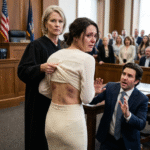
She slapped me.
The sound cracked through the ballroom.
June cried out from Tessa’s arms.
Every person froze.
My cheek stung.
My sister stood in front of me, breathing hard, hand still raised slightly, eyes wild with panic and rage.
For thirty-four years, Olivia had been protected from consequences.
In that moment, she looked around for someone to protect her again.
My mother stood halfway.
Then stopped.
My father stared at the floor.
No one moved.
No one rushed to Olivia.
No one comforted her.
No one told me not to embarrass her.
The golden child had struck her sister in a ballroom full of donors, clergy, attorneys, bankers, and board members because documents told the truth.
And for the first time in her life, there was nowhere to hide.
I touched my cheek once.
Then lowered my hand.
“Thank you,” I said quietly.
Olivia blinked. “What?”
“For giving everyone something no one can call paperwork.”
Adrienne closed her legal case.
“Ms. Whitmore,” she said to Olivia, “you should retain counsel.”
Olivia looked at our parents.
“Mom?”
My mother was crying silently.
“Dad?”
My father still did not move.
Olivia’s face collapsed.
Not into remorse.
Into disbelief.
The room watched her understand that love and protection had never been the same thing.
I turned back to the microphone one final time.
“As of tonight, Olivia Whitmore has no role in my daughter’s life, legal or otherwise. My parents will communicate with me only through counsel regarding the trust, the company, or Hawthorne House. The Whitmore Legacy Foundation may no longer use June’s image, name, baptism, or identity in any fundraising material.”
My mother whispered, “You can’t cut us off.”
I looked at her then.
Really looked.
At the woman who had dressed my pain in words like dramatic, difficult, jealous, cold.
At the mother who had moved me away from my daughter because Olivia looked better in photos.
“I’m not cutting you off,” I said. “I’m ending your access.”
Her face crumpled.
“Mara, please. I’m your mother.”
I nodded.
“Yes. And I am June’s.”
That was the line that broke her.
Not because it was cruel.
Because it was clean.
There was no accusation in it.
No begging.
No performance.
Only a boundary she could not decorate.
I stepped down from the podium and walked to Tessa.
June reached for me, sobbing.
I took her into my arms.
The second I held her, she quieted against my chest.
Again.
Everyone saw it again.
Olivia stood under the screen with her forged signature behind her, her mascara streaked, her hand trembling from the slap everyone had witnessed.
My father looked suddenly old.
My mother looked suddenly small.