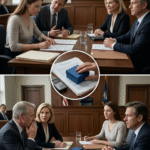
I looked at the crown on Sloane’s head.
It had been used every December for a game with children in the oncology ward.
They called it the Courage Crown.
Each child wore it after finishing a treatment cycle.
Lily had never worn it.
But hundreds of children had.
And Sloane had put it on while mocking grief.
I said, “Take off the crown.”
She touched it automatically.
Then remembered she was on camera.
Her chin lifted.
“You don’t own dignity, Evelyn.”
“I own the trademark, the building, the endowment structure, and the chair authority.”
Someone behind me coughed.
Maybe it was a laugh.
Sloane’s eyes flicked to Mason.
He said nothing.
Because he knew enough now.
Not all.
But enough.
I leaned closer to the camera.
“The crown belongs to the children served by this foundation.”
My voice did not shake.
“Not to consultants.”
Sloane’s face flushed.
“I’m carrying Mason’s child.”
The boardroom shifted.
Caroline closed her eyes.
Mason looked like a man watching a lit match fall into gasoline.
Not kindly.
“We’ll come back to that.”
Sloane went still.
A woman knows when another woman has proof.
Even if she does not know what kind.
Mason snapped, “Evelyn.”
I ignored him.
“Security will escort both of you from foundation property.”
Sloane gave the camera a dazzling, desperate smile.
“See? This is what he meant. She can’t handle being replaced.”
I looked at her for a long moment.
Really looked.
Under the hair, the makeup, the glitter, the borrowed crown, she was shaking.
Not with guilt.
With rage that the fantasy had become procedural.
“Sloane,” I said softly, “a mistress can replace a wife in a bed.”
Her smile collapsed.
“She cannot replace a founder in a trust agreement.”
Mason’s phone rang again.
He looked down.
Whatever name appeared there frightened him.
The building’s head of security, probably.
Or the bank.
Or maybe Beatrice’s office.
He turned away from the camera.
Sloane grabbed his sleeve.
“Do something.”
He looked at her then.
And for the first time, I saw him realize what she had cost him.
Not because he loved me.
Not because he regretted hurting me.
Because men like Mason can survive sin.
They panic at paperwork.
The ballroom doors opened behind them.
Two security officers entered in black suits.
The livestream caught it all.
The gold chairs.
The champagne wall.
The mistress in the crown.
The husband who had adjusted the camera for his own downfall.
Sloane backed away.
“This is assault,” she said.
“It’s trespass,” Beatrice said from beside me.
Her voice carried into my microphone like a judge entering the room.
Sloane ripped off the crown and threw it onto the table.
It bounced once and rolled against a centerpiece of white roses.
For some reason, that small sound hurt more than the affair.
Mason reached for it.
Not for Sloane.
Not for me.
For the symbol.
He always did love symbols after someone else paid for them.
I looked into the livestream one last time.
Then I said the line that would be quoted on every gossip page by morning.
“Queens don’t need Wi-Fi to remove peasants.”
The screen froze for half a second.
Then Sloane ended the livestream.
But the internet had already saved her crown.
Part 5: The Woman Who Owned The Ending
By midnight, every major gossip account had the clip.
By dawn, morning shows had blurred the charity documents and sharpened the scandal.
By 9 a.m., Mason’s lawyers had called Beatrice six times.
By 10 a.m., Sloane had posted a Notes app statement claiming she was a victim of a powerful wife’s jealousy.
By 10:07 a.m., Beatrice emailed her attorney a preservation notice.
The statement vanished before lunch.
I spent that day at Hart House.
Not hiding.
Working.
Children still needed surgery grants.
Mothers still needed hotel rooms near hospitals.
Nurses still needed funding for overnight staff.
A scandal feels enormous to the people inside it.
Need remains larger.
At noon, Dr. Helen Park came to my office.
She ran one of our neonatal programs and had once handed me Lily wrapped in a blanket so small it looked made for a doll.
She stood by my window and said, “You don’t have to come to the gala.”
I looked up from a donor letter.
“Yes, I do.”
“I won’t let them make this place a crime scene forever.”
Helen nodded.
She understood.
Grief does not make you fragile.
It makes you very aware of what cannot be wasted.
Three days later, Mason came to the penthouse.
Or tried to.
The doorman called upstairs.
“Mrs. Hart Whitaker, Mr. Whitaker is in the lobby.”
I looked at the skyline beyond my breakfast table.
Snow had begun to fall over Central Park.
“Tell him the property access list has changed.”
A pause.
Then the doorman said, “He says it’s his home.”
Fifteen minutes later, my phone rang.
Mason again.
This time, I answered.
His voice was rough.
“Evelyn, please.”
That word should have hurt.
Instead, it sounded like jewelry dropped into a drain.
“Why are you calling?”
“I made a mistake.”
“No, Mason. You made a plan.”
Silence.
Then he sighed.
“I was unhappy.”
I poured tea into a porcelain cup my mother had given me.
“You were funded.”
“That’s cruel.”
“Accurate often is.”
He went quiet.
I could hear traffic behind him.
Maybe he was outside the building, snow settling on his coat, learning that lobbies also have boundaries.
“Sloane lied,” he said.
I almost laughed.
“About which part?”
“The baby.”
Not the apology.
The self-defense.
“She said it was mine.”
“And?”
He swallowed.
“I had a vasectomy after Lily.”
My hand tightened around the teacup.
For a moment, the room narrowed.
Not because of Sloane.
Because of me.
After Lily died, I had wanted another child one day.
Not immediately.
Not as a replacement.
Never that.
But someday.
Mason told me he could not bear the thought of losing another baby.
He said we should wait.
He said we would talk when healing felt possible.
He never told me he had made the decision permanent.
He had taken my future into a clinic and signed it away.
I set the cup down carefully.
“You had a vasectomy.”
His silence answered.
“When?”
“Six months after Lily.”
The snow fell harder.
I thought of every year after that.
Every doctor appointment.
Every quiet month of disappointment.
Every time Caroline looked at my body like a failed investment.
Every time Mason held me and said, “Maybe God is protecting us.”
Some betrayals are not affairs.
Some are rooms you were locked out of inside your own life.
“I see,” I said.
“Evelyn, I was grieving.”
“No.”
My voice was quiet.
“You were deciding.”
He began to cry then.
In a way that might have moved me once.
It did not move me now.
“I didn’t want to lose you,” he said.
“You were afraid another child would make you feel small.”
“That’s not fair.”
“You have no idea what fairness sounds like.”
I ended the call.
Then I sat alone in the dining room while snow covered the city in expensive silence.
I did not cry.
Not because I was strong.
Because some pain is too large to exit quickly.
It has to move out in furniture.
The paternity test arrived two weeks later through Sloane’s former assistant, who decided prison sounded worse than unemployment.
The father was not Mason.
It was an event producer named Kyle Decker, married, minor, and stupid enough to text photos from foundation storage closets.
Sloane had not been carrying a Whitaker heir.
She had been carrying a storyline.
Mason had believed it because arrogance makes men easy to scam.
Caroline found out through lawyers.
She called me that night.
For the first time in ten years, she did not begin with advice.
She said, “I am sorry.”
I looked at the Christmas tree in my living room.
It was decorated in silver stars.
One had Lily’s name.
“Are you sorry he hurt me,” I asked, “or sorry he embarrassed the family?”
A long silence.
Then Caroline said, “Both.”
It was the most honest thing she had ever said to me.
I accepted it for what it was.
Not enough.
But real.
The divorce took seven months.
Not because it was complicated.
Because Mason kept confusing consequences with negotiations.
He wanted the Greenwich house.
It belonged to the Hart Trust.
He wanted the penthouse.
Hart Trust.
He wanted half of my shares in a medical technology company I had invested in before marriage.
Separate property.
He wanted continued influence at the foundation.
Barred by board resolution.
He wanted his reputation.
No court could return that.
At the temporary hearing, he wore a charcoal suit and the wounded expression of a man who had practiced humility in a mirror.