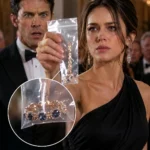
“Bedroom cleared. Medications left behind. Wheelchair too.”
Of course, Emma thought. A woman did not need a wheelchair once the performance ended.
Dante’s phone rang. He listened without speaking. Then his gaze moved to Emma.
“What?” she asked.
“That was my attorney. Marla Bell left Chicago this morning on a flight to Phoenix under another name.”
“She has been moving money through Bell & Bloom for years.”
Emma gripped the back of a chair. “She sent me to you.”
“Because Vivian told her to.”
“Likely.”
“Why?”
Dante’s eyes darkened. “To see if I recognized you. Or to make sure someone else did.”
Before Emma could answer, the restaurant’s front windows shattered.
Glass flew inward with a terrible crystalline roar. Emma ducked. Paulie shoved her behind the bar. Dante pulled a gun from beneath his jacket.
Three men entered through the broken doorway.
They wore ordinary coats, ordinary shoes, ordinary faces. That was what frightened Emma most. Evil, she was learning, did not always arrive with scars. Sometimes it looked like someone’s neighbor.
“Dante,” the largest man called. “Salvi wants the woman.”
“Salvi can come ask me himself.”
“He says you always were sentimental.”
Dante fired once. The shot struck the wall beside the man’s head. Not to kill. To promise.
The men scattered.
Paulie pushed Emma toward the kitchen. “Move.”
She ran.
Behind her, gunfire cracked. Pots clanged. Someone cursed. Emma stumbled through the kitchen, past the flour bins and hanging pans, into the pantry where sacks of sugar stood stacked like pale bricks.
Paulie followed, bleeding from his upper arm.
“There’s a door,” he said, pointing. “Alley. Go.”
“What about Dante?”
“He can handle himself.”
“My name is Clara,” she snapped, then startled herself.
Paulie stared. Then, despite the blood on his sleeve, smiled faintly.
“Good to know. Now go, Clara.”
But the alley door opened before she reached it.
A woman stepped in.
Not in robe or slippers now. She wore a tailored camel coat, leather gloves, and a silk scarf at her throat. Her silver hair was swept into a neat chignon. She looked elegant, composed, and entirely unafraid.
Behind her stood Marla Bell with a pistol.
Emma’s stomach turned.
“Hello, sweetheart,” Vivian said.
The word sweetheart had never sounded more poisonous.
Paulie raised his gun, but Marla pressed hers against Emma’s ribs.
“Drop it,” Marla said.
Paulie looked at Emma. Emma shook her head, barely.
He lowered the gun.
Vivian stepped close and touched Emma’s cheek where she had slapped her the night before.
“My brave girl,” she murmured. “You always did need a little push.”
“Did you arrange all of this?” Emma whispered.
“I arranged survival.”
“You arranged bullets.”
“Bullets clarify loyalties.”
Dante was dragged into the kitchen moments later, blood at his temple, hands bound behind him. He looked first at Emma, and the fury in his face softened into something like apology.
“I’m sorry,” he said.
Vivian laughed. “How touching. He apologizes for failing to save you from the woman who raised you.”
Dante’s gaze stayed on Emma. “I’m sorry I didn’t find you sooner.”
The words entered her like light through a crack.
Vivian’s smile vanished.
“Enough,” she said.
She ordered them into the cellar beneath the restaurant. It was old, low-ceilinged, lined with wine racks and crates. The air smelled of dust, cork, and damp brick. Dante was tied to a support post. Paulie, wounded but alive, was forced into a corner. Emma stood beside a table beneath a bare bulb.
Vivian placed the lockbox there.
“Where is the ledger?” she asked.
Emma laughed softly, though she felt close to breaking. “You don’t have it.”
“I had a child to hide. A life to build. Men to outmaneuver. Forgive me if one inconvenient book slipped through my fingers.”
Dante lifted his head. “You set the Whitcomb fire.”
Vivian turned to him. “Your father did.”
“He was a bastard. He was not clever enough for you.”
A flicker of pleasure crossed her face before she hid it.
Dante saw Emma see it.
Vivian opened the lockbox and removed the baby bracelet. “Your father thought charity made him noble. He did not understand charity is the finest cover in the world. Who questions money collected for children? Who audits tears?”
Emma’s stomach clenched.
“Judge Whitcomb questioned it,” Dante said.
“And paid for his curiosity,” Vivian replied.
Emma whispered, “You killed my parents.”
Vivian’s eyes moved to her. “I gave the order. There is a difference.”
No one spoke.
The bare bulb hummed overhead.
Emma felt the old Emma inside her—the obedient daughter, the apologetic woman, the one who carried trays and bills and guilt—begin to die with a quietness that was almost merciful.
“Why keep me?” she asked.
Vivian’s face softened in a way that might have fooled someone else. “At first? Insurance. Then habit. Then affection, of a sort.”
“Affection?”
“You were a sweet child.”
“You made me afraid of the world.”
“I made you controllable. There is a difference.”
The words should have destroyed her. Instead they clarified everything.
Every missed dance. Every refused invitation. Every man turned away by a mother’s headache, a mother’s spell, a mother’s sudden collapse. Every dollar Emma earned disappearing into emergencies that were not emergencies. Every year shrinking into the next.
**Her loneliness had not been an accident. It had been a design.**
Dante strained against the rope until blood appeared at his wrist.
“Emma,” he said.
She opened her eyes.
Vivian turned sharply. “Do not say her name like that.”
Dante smiled then, despite the blood. “Which name?”
Vivian’s face hardened.
Emma looked at him. In that moment, she understood he was not asking her to be rescued.
He was asking her to choose who she was.
“Emma was the name you gave a prisoner,” she said to Vivian. “Clara was the name you buried.”
Vivian watched her carefully.
Emma lifted her chin. “I’ll take both. You don’t get either.”
Marla shifted behind her, distracted by the words.
It was enough.
Emma drove her elbow backward into Marla’s stomach, exactly as Mrs. Zielinski from the bakery had once taught her after a customer followed Emma to the alley forty years ago. Marla gasped. The gun clattered to the floor.
Paulie moved despite his wound. Dante surged against the ropes. Emma grabbed a wine bottle from the rack and swung with all the strength of a woman who had kneaded dough, lifted laundry, hauled groceries, pushed wheelchairs, and carried invisible burdens for half a century.
The bottle shattered against Marla’s shoulder.
Chaos exploded.
Dante freed one hand, then the other. Vivian ran for the stairs. Paulie tackled Marla. Emma followed Vivian, not because she had a plan, but because the idea of that woman walking away again was unbearable.
She caught her at the top of the cellar stairs.
Vivian turned with a small silver knife in her hand.
“You ungrateful little fool,” she hissed.
Emma stopped.
For fifty-seven years, those words would have brought her to her knees.
Now they sounded almost tired.
“No,” Emma said. “I am done being grateful for captivity.”
Vivian lunged.
Dante appeared behind Emma and caught Vivian’s wrist. The knife fell. Paulie came up behind them, breathing hard, and secured her hands.
Vivian did not scream. She did not cry. She looked at Emma with pure astonishment, as though a chair had stood up and struck her.
Dante turned to Emma. “Are you hurt?”
She shook her head.
The cellar, the broken glass, the blood, the years, all pressed around her. Her hands began to tremble.
Dante stepped closer, then stopped.
“May I?” he asked.
Those two words broke her.
Emma crossed the space between them.
He held her as if the world had become fragile.
When he lowered his head, he waited. Even then. Even after gunfire and betrayal and blood. He waited.
Emma lifted her face.
Their kiss was soft at first, almost a question. Then it deepened—not with the hunger Vivian had warned her against, not with desperation, but with recognition. Emma felt no lightning, no foolish music, none of the things young women were promised in novels.
She felt something better.
She felt herself return to her own body.
**At fifty-seven years old, beside a shattered wine rack and the ruins of every lie she had ever been told, Emma Reynolds received her first kiss and discovered she had not been too late for anything.**
## Part Five: The Woman No Longer Buried
The police did not arrest Vivian that night.
That was the second lesson Emma learned about evil: it always had friends with clean fingernails.
Two detectives arrived, spoke politely to Dante, impolitely to Paulie, and almost reverently to Vivian. Marla Bell cried and claimed confusion. The men who had attacked the restaurant vanished into the city as if Chicago itself had swallowed them.
Vivian sat in a chair with a blanket around her shoulders, transformed once again into a frail old woman.
“My daughter is unwell,” she told the detectives. “She has always been suggestible. Mr. Moretti has taken advantage of her.”
Emma laughed.
Everyone turned.
It was not a pleasant laugh. It was not loud. But it carried.
One detective, a ruddy man with tired eyes, asked, “Something funny, ma’am?”
“Yes,” Emma said. “My whole life, apparently.”
Dante’s attorney arrived with two federal agents before dawn. That changed the temperature of the room. Men who had swaggered began checking their phones. Vivian’s blanket slipped from one shoulder. Her eyes found Emma’s.
A warning lived there.
Emma was surprised to discover she no longer cared.
Over the next forty-eight hours, the truth unfolded in pieces. Not cleanly. Truth rarely arrives clean. It came through bank records, old charity ledgers, forged medical documents, property transfers, and photographs hidden in walls. It came through Paulie’s testimony, Dante’s years of private investigations, and the lockbox Vivian had been arrogant enough to keep.
But the most important piece came from Emma.
Not because she had known it mattered.
Because for thirty-nine years, Emma had kept notebooks.
She had begun them at eighteen, when her mother first complained that Emma forgot things. Emma wrote down medication schedules, phone messages, grocery lists, names of repairmen, amounts paid, scraps of conversation. Later, when Vivian’s “spells” worsened, Emma wrote down the strange calls her mother received late at night. She wrote initials because she was told to forget names. She wrote dollar amounts because money frightened her. She wrote dates because dates made life feel orderly.
Box after box of notebooks sat in the attic beneath Christmas tins and old curtains.
Emma had thought they were evidence of her inadequacy.
They were, in fact, the ledger everyone had been looking for.
**The secret that powerful men had hunted for half a century had been written in the careful handwriting of a lonely woman who believed she was merely trying to be a better daughter.**
When Dante realized it, he sat down at Emma’s kitchen table and covered his face with both hands.
Emma stood beside him, uncertain.
“Is it enough?” she asked.
He looked up. His eyes were wet.
“It is everything.”
The federal agents took the boxes. Vivian’s friends began to fall. An alderman resigned for “health reasons.” A retired hospital administrator shot himself in a vacation home in Wisconsin. Marla Bell accepted a deal before her lipstick had time to fade. Men who had spent their lives hiding behind charity boards and memorial funds discovered that memory, when kept by the overlooked, could become a blade.