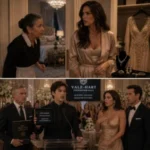
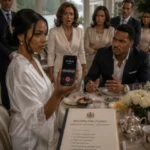
“What does that mean?”
I met his eyes.
It was strange, looking at him then.
He was still handsome in the way weak men can be handsome when money does the tailoring.
Dark hair.
Sharp jaw.
A tuxedo cut in Milan.
But I could see the boy inside him, the one who needed applause to feel real.
“It means congratulations should wait for documentation,” I said.
His face hardened.
“You are not doing this tonight.”
I leaned closer.
“You did this tonight.”
For a second, the old Grant appeared.
The one who knew when I was right.
Then Serena touched his arm, and he remembered the audience.
“You are bitter,” he said.
A few people looked away.
That was the line men use when they want to make a woman’s accuracy sound like an illness.
I nodded slowly.
“No, Grant.”
“I am prepared.”
His nostrils flared.
The photographer lifted his camera again.
I turned toward him.
“Are you on the approved press list?”
He froze.
Grant’s mouth opened.
I raised my hand slightly, and two Caldwell House security men moved from the far wall.
The photographer lowered the camera.
Serena’s expression flickered with naked panic.
Eleanor looked at the guards, then at me.
That was the second thing that ruined their plan.
They had forgotten who employed the staff.
“Vivienne,” Grant said quietly.
“This is embarrassing.”
I smiled.
“For you, I imagine it is just beginning.”
I walked out before they could stop me.
Not because I was fleeing.
Because battles look cleaner when you choose the room.
June followed me through the side corridor into the west library, where the noise of the gala softened behind mahogany doors and first editions watched from shelves like old judges.
Marcus Bell was already there.
So was my assistant, Anika Ross, with a laptop open on the partners’ table.
On the screen were six camera feeds from the ballroom.
Caldwell House had security disclosures at every entrance.
Every guest had signed media and safety releases.
Every word Grant said beneath that chandelier had been captured by three cameras, two microphones, and one very stupid unauthorized photographer.
June removed her glasses.
“Well,” she said.
“That was dramatic.”
“Did you get the announcement?”
“Clearly.”
“Did he say the child was his?”
“Did he present Serena as an official partner of the foundation?”
“By implication, yes.”
“Did she touch her stomach for the camera?”
Marcus snorted.
“Like she was selling the naming rights.”
I looked at the screen.
Grant had his hand on Serena’s waist again.
Eleanor was speaking to them with clipped movements.
Owen Caldwell stood behind them, pale and sweating.
I noticed that.
Owen did not sweat.
Owen was a man of tax shelters and cold hands, a man who could tell a waiter the champagne was warm with the calm of a surgeon identifying a tumor.
Yet there he was, wiping his upper lip with a napkin.
“Zoom camera two,” I said.
Anika did.
Owen’s eyes were not on Grant.
They were on Serena.
Not with judgment.
With terror.
Something clicked into place.
Not the whole truth.
Enough.
June saw my face.
“What?”
I pointed.
“Pull Owen’s communications with the foundation.”
June’s eyebrow lifted.
“Legally, we already have corporate access.”
“Then use it.”
The door opened before she could answer.
Grant came in without knocking, because he had never learned the difference between entry and permission.
Serena followed him.
Eleanor came last.
The three of them looked like a family portrait painted after the war had already been lost.
Grant shut the door.
“What the hell do you think you are doing?”
I sat in the leather chair behind the desk.
It had been Grant’s father’s chair once.
Now it was mine.
“I am hosting,” I said.
Serena laughed sharply.
“You are insane.”
I looked at her.
“Careful.”
Grant slammed his palm onto the desk.
“Do not threaten her.”
“I did not.”
“You humiliated me.”
That made me laugh.
Not loudly.
Just enough.
“You announced your pregnant mistress in my ballroom.”
He leaned forward.
“Our ballroom.”
“My ballroom.”
The room went still.
Eleanor’s eyes narrowed.
Grant stared at me like I had spoken in another language.
“What are you talking about?”
I opened the center drawer and took out a copy of the deed.
Not the original.
I am not reckless.
I placed it on the desk, turned it around, and slid it toward him.
Grant looked down.
His expression changed slowly.
Confusion first.
Then disbelief.
Then rage.
“Caldwell House is held by Hartwood Preservation Trust,” I said.
“The transfer was executed three years ago when you needed the liquidity to satisfy the tax liens your mother swore did not exist.”
Eleanor’s hand went to her pearls.
“You said that was temporary,” she whispered to Grant.
Grant ignored her.
“You tricked me.”
“You signed.”
“I was under pressure.”
“You were under audit.”
Serena looked from him to the paper.
“You told me this was yours.”
“It is mine,” Grant snapped.
“It is where you live because I allowed it.”
The words did not come from anger.
That was why they landed.
Grant’s face reddened.
“You think a deed makes you powerful?”
“The deed is sentimental.”
June set a second folder on the desk.
“This is power.”
Grant did not touch it.
He knew enough to fear folders now.
June opened it for him.
Inside were copies of the Caldwell Rowe Holdings restructuring documents, the foundation conflict policies, the postnuptial agreement, the executive morality clause, and the buy-sell trigger he had signed after the St. Bartholomew procurement scandal.
The scandal I had buried for him.
The scandal Serena knew nothing about.
June spoke in her courtroom voice.
“Mr. Caldwell, your public admission tonight appears to trigger Section 14 of the marital postnuptial agreement, Section 9 of the foundation ethics charter, and the reputational harm provision in the Caldwell Rowe voting trust.”
Serena frowned.
I answered.
“It means the performance you staged for my breakdown became evidence.”
Grant looked at June.
“This is marital intimidation.”
June smiled pleasantly.
“No, this is contract enforcement.”
Eleanor sat down.
She did not ask permission.
For the first time all night, she looked old.
Grant turned on me.
“You planned this.”
I shook my head.
“I planned for you.”
Serena stepped forward.
“I am carrying a Caldwell child.”
I looked at her stomach.
“Again.”
Her face twisted.
“You jealous, bitter—”
“Enough,” Grant said, but he was not defending me.
He was calculating.
I opened my clutch.
The room became very quiet.
Serena saw the envelope first.
The color drained from her face so quickly it was almost artistic.
Grant followed her gaze.
“What is that?”
“A sealed report,” I said.
“From the lab Serena authorized.”
Serena backed up half a step.
“No.”
I tilted my head.
“I signed under pressure.”
“You signed because you wanted access to a trust.”
Grant turned to her.
“You signed what?”
She said nothing.
That was answer enough.
I placed the envelope on the desk between us.
I did not open it.
Not then.
That was the difference between Serena and me.
She needed an audience for every wound.
I needed the right judge.
PART 4 — THE BABY, THE BOARDROOM, AND THE NAME ON THE DEED
By morning, the gala photographs were everywhere.
Not the ones Serena wanted.
The unauthorized photographer had been escorted out before he could leave with his memory cards, but not before he tried to upload three images from the service hallway.
The first showed Grant with his hand on Serena’s stomach.
The second showed the room turning toward me.
The third showed me smiling.
That was the one that went viral.
Not because people understood it.
Because they did not.
Society blogs called it “the coldest reaction in Connecticut.”
A luxury gossip account posted, “Wife smiles as billionaire husband announces mistress pregnancy.”
Someone on Facebook wrote, “That is not a broken woman, that is a woman with paperwork.”
By breakfast, the comments had done what comments do best.
They turned cruelty into a courtroom with no rules.
Some called me heartless.
Some called Serena brave.
Some called Grant disgusting.
One woman wrote, “I have seen that smile before. My aunt wore it right before she took the lake house.”
I liked that one.
At nine o’clock, I arrived at Caldwell Rowe Tower in Manhattan.
The building stood on Park Avenue, all glass and arrogance, with my husband’s last name carved into black stone in the lobby.
Grant had always loved walking through that lobby.
He thought the name meant ownership.
Names are cheap.
Control is expensive.
I wore a white suit.
Not bridal white.
Not innocent white.
The white of clean paper before ink ruins a man’s life.
June walked beside me with a briefcase in one hand and the sealed DNA envelope in the other.