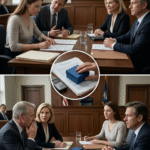
Sienna’s attorney, newly present and deeply unhappy, requested that her name be removed from filings where possible.
The judge looked at her.
“Ms. Hart participated in the event.”
Sienna’s mouth trembled.
“Yes, Your Honor.”
Outside the courthouse, rain fell in clean silver lines.
Reporters waited near the steps.
Not national reporters.
Worse.
Local society reporters with long memories and private group chats.
Pierce tried to walk past me.
Then he stopped.
His voice was low.
“You’ve made your point.”
I looked at the man I had loved.
He looked tired, wet, furious, and suddenly very small against the courthouse columns.
“No,” I said. “The court made orders. The board made findings. The trust made ownership clear. I simply stopped translating your behavior into excuses.”
He glanced toward Sienna, who stood under the awning alone.
“She’s pregnant,” he said.
There was something desperate in the way he said it now.
Not triumphant.
Not tender.
Desperate.
“Yes,” I said.
“It’s my child.”
I held his gaze.
“Then I hope you become a better father to that child than you tried to be in that recording.”
His face twisted.
For one second, I thought he might apologize.
Instead, he said, “You were never warm.”
The final insult men give when they lose access to the fire.
I almost smiled.
“No, Pierce. I was warm. You just kept standing in the doorway with the door open.”
I walked down the steps before he could answer.
The next week, Evelyn was hauled into the yard.
The repainting took three days.
I watched from the dock while workers sanded Sienna’s name off the stern.
Layer by layer, the navy paint disappeared.
Underneath, faint as a bruise, the old letters emerged.
Evelyn.
Not perfect.
Not untouched.
But still there.
Jonah stood beside me with two coffees.
“Your mother would’ve enjoyed this part,” he said.
“My mother would have pretended not to.”
He smiled.
“She was a terrible pretender.”
I laughed then.
A real laugh.
It surprised me.
Pain does that sometimes.
It becomes so familiar you mistake its absence for danger.
Sienna disappeared from Newport for a while.
Her followers debated whether she had been manipulated, arrogant, unlucky, or all three.
She issued a statement about healing privately.
Then she issued another through her lawyer confirming that she had believed Pierce had authority over the vessel.
She did not mention the white dress.
Pierce moved into a hotel suite downtown.
Not a Calder property.
The board insisted.
The forensic audit widened.
Foundation donors were notified.
The hospital quietly removed him from the campaign committee.
Clayton Calder sent me a handwritten note.
It contained eleven words.
I am sorry I mistook your silence for consent.
I did not forgive him.
But I kept the note.
Some apologies are not doors.
They are receipts.
Nora asked about the boat two weeks later.
We were eating blueberry pancakes in the kitchen, her hair still messy from sleep.
“Is Evelyn fixed?” she asked.
“Did Daddy break her?”
I set down my fork.
“He helped hurt something that mattered.”
She considered this with the grave seriousness of a child deciding whether the moon can be trusted.
“But you fixed it?”
“We are fixing it.”
She nodded.
“Can we sail when it’s done?”
“Can Daddy come?”
That was the question that pulled air from the room.
Children do not stop loving people on a legal schedule.
I reached across the table and touched her hand.
“Someday, maybe. When it is healthy and safe.”
She looked at her pancakes.
“Was it not safe?”
I chose every word carefully.
“Sometimes people make choices that show they need help before they can be trusted with fragile things.”
She looked up.
“Like boats?”
“And hearts?”
My throat tightened.
“Yes, baby. Like hearts.”
The first sail after the repainting happened on a clear August morning.
No photographers.
No champagne tower.
No white roses.
Just Nora, Jonah, my grandmother, and me.
My grandmother was ninety-one and still wore lipstick to the marina like the wind had standards.
She touched the restored name on the stern.
“Your mother would approve.”
I looked at the letters.
Clean navy paint.
Gold trim.
The name sat where it belonged, not because time had reversed, but because someone had done the work of restoration.
Nora climbed aboard with her stuffed whale tucked under one arm.
“Permission to board?” she asked Jonah.
“Permission granted, Captain Nora,” he said.
She beamed.
My grandmother settled into the cockpit with a cashmere blanket over her knees.
I took the helm.
For a moment, my hands remembered my mother’s hands.
The way she stood.
The way she watched the horizon.
The way she loved without loosening her grip on herself.
We left the slip slowly.
Hawthorne Harbor opened around us.
The lighthouse flashed.
The water glittered.
Behind us, the club looked smaller than I remembered.
Maybe places shrink when they stop holding your fear.
Out past the breakwater, the wind caught the sail.
Nora laughed so hard she had to grab my sweater.
My grandmother closed her eyes and tilted her face toward the sun.
I breathed in salt and varnish and something I had almost forgotten.
Peace.
Not happiness yet.
Happiness was too bright a word for that morning.
This was steadier.
A quiet returning.
A woman coming back into her own name.
## Warm Conclusion — What The Sea Gave Back
Divorce did not make me victorious overnight.
Courtrooms do not heal you.
Paperwork does not hold you when your daughter cries.
Power does not erase the sound of a champagne bottle breaking against your mother’s memory.
But it gives you a floor.
It gives you a place to stand while the shaking passes.
Pierce eventually settled.
Not because he became generous.
Because discovery is a brutal teacher.
He gave up all claims to Hawthorne Harbor, Evelyn, my trust income, and any Whitmore-held shares.
He accepted restricted visitation until he completed counseling and parenting review.
He resigned from Calder & Rowe before the board could remove him permanently.
Margot stayed on as CEO.
She was better at it.
Women usually are when they have spent years doing the work while men practice the speeches.
Sienna had her baby in December.
The tabloids tried to pull me into the story again.
I refused.
Her child had not painted over my mother’s name.
Her child had not forged documents.
Her child had not stood on my dock and mistaken cruelty for romance.
I sent no gift.
I sent no statement.
Silence is not always bitterness.
Sometimes it is a boundary with excellent posture.
Months later, Pierce wrote me an email.
Not a legal one.
A personal one.
He said he had been wrong.
He said he had confused admiration with ownership.
He said he had loved what my family built but resented that it was not his.
He said he missed the life we had.
I read it once.
Then I archived it.
Some women want the apology.
Some want the man to crawl.
Some want the mistress ruined, the family begging, the world watching.
I understand every version of that hunger.
But by then, I wanted something quieter.
I wanted Nora to grow up knowing that dignity is not passivity.
I wanted my mother’s name to stay visible.
I wanted a harbor where no woman in my family ever had to ask permission to belong.
The next summer, Nora and I hosted a small sailing day for girls from the hospital cardiac program my mother founded.
No press.
No donors posing with checks.
Just children in life jackets, eating strawberries from paper cups, learning the difference between windward and leeward.
One little girl asked why the boat was named Evelyn.
Nora answered before I could.
“Because that was my grandma’s name,” she said. “And because some names are too important to paint over.”
I turned away before anyone could see my eyes.
Out on the water, the girls screamed with joy as the sail filled.
The harbor shone around us, bright and blue and alive.
For the first time in a long time, I did not think of Pierce when I looked at the dock.
I did not think of Sienna’s white dress.
I did not think of champagne, cameras, or the way the crowd went silent when I arrived.
I thought of my mother.
I thought of my daughter.
I thought of every woman who has ever stood very still while someone tried to rewrite her life in public.
And I hoped she would remember this.
You do not have to scream to be heard.
You do not have to beg to be chosen.
You do not have to burn the whole world down to prove the match was in your hand.
Sometimes you only have to know what is yours.
Sometimes you only have to let them pose long enough for the evidence to focus.
And sometimes, when a mistress names the boat, the wife owns the harbor.