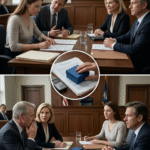
Across the table, forensic accountant David Lin opened a laptop.
“We found the apartment,” he said.
I looked at him.
“What apartment?”
“A three-bedroom condominium on East Sixty-Third.”
“Grant owns an apartment?”
“Technically, Carlisle Whitmore Hospitality Assets owns it.”
He rotated the screen.
The condominium had been purchased fourteen months earlier for $4.8 million.
It was classified internally as an executive residence for visiting partners.
No visiting partner had ever stayed there.
The access logs showed Grant entering forty-seven times.
Sloane had entered sixty-three.
Furniture, art, wine, linens, and monthly floral deliveries had been charged to the company.
There was even an invoice for black silk sheets.
“Who approved the purchase?” I asked.
“Who certified the business use?”
“Sloane.”
Margaret placed both hands on the table.
“That gives us misuse of company assets, self-dealing, false reporting, and an undisclosed relationship between the chief executive and a direct subordinate.”
David clicked to another file.
“There’s more.”
There was always more.
Men who believed their wives were stupid rarely bothered being careful.
Grant had used the corporate jet for twelve private trips with Sloane.
He had charged a weekend in Napa as a brand development summit.
He had purchased her a diamond bracelet through the hotel group’s interior design subsidiary.
He had paid her consulting company nearly nine hundred thousand dollars for projects that produced no reports, deliverables, or measurable work.
The money mattered.
But not as much as the dates.
One payment had been authorized from a hospital room while my mother was dying.
I stared at the signature.
Grant had sat beside me that night.
He had held my coat while I washed my mother’s face.
He had kissed my forehead and told me he would handle everything at the office.
At 9:42 p.m., while I was holding my mother’s hand, he had approved a quarter-million-dollar payment to his mistress.
For the first time since seeing the photograph, my composure slipped.
Not outwardly.
Only enough that my fingers stopped moving.
Margaret noticed.
She always noticed.
“We can pause,” she said.
My voice remained steady, but the room had gone distant.
I remembered the hospital’s blue nighttime light.
The machines.
My mother’s thin wrist beneath the blanket.
Grant standing at the window, typing on his phone.
I had thought he was answering board messages so I could remain beside her.
He had been paying Sloane.
Perhaps messaging her.
Perhaps promising that soon, after my mother died, I would be easier to leave.
“Keep going,” I said.
David hesitated, then opened another document.
Two months after my mother’s funeral, Grant had asked our family office to prepare a restructuring proposal.
Under the proposal, my voting shares would be transferred into a joint marital entity.
Grant would become managing partner.
I remembered the documents.
He had placed them on my desk during the week I was barely sleeping.
He had said the restructuring would protect Clara if anything happened to us.
I had signed the preliminary acknowledgment.
But I had never signed the final transfer.
Grant apparently believed I had.
“Did he file this?” I asked.
“He tried,” Margaret said.
“The trust rejected it because it lacked your notarized consent.”
“Did he know it was rejected?”
“His attorney knew.”
“Which attorney?”
Margaret looked at me.
“Daniel Cross.”
Grant’s private counsel.
And Sloane’s older brother.
The room became very quiet.
Not merely an affair.
A plan.
PART TWO — THE WIFE THEY THOUGHT WAS DECORATIVE
I met Grant when I was twenty-six at a winter benefit inside the New York Public Library.
He had looked like every promise my grandmother warned me not to believe.
Tall, composed, educated at Yale, with dark hair and the kind of smile that made older women trust him and younger men imitate him.
He knew how to cross a ballroom without appearing eager.
He knew which hand to offer a widow.
He knew the difference between inherited confidence and vulgar ambition.
Most importantly, he knew how to look at a wealthy woman as though her money were the least interesting thing about her.
I fell in love with that look.
We married eighteen months later at Saint James Church in Manhattan.
White roses climbed the stone columns.
A quartet played while five hundred guests watched me walk toward a man who had already learned how to make possession look like devotion.
At the reception, my grandmother Arabella took my hand.
She was eighty-two, dressed in midnight blue, and still terrifying enough to silence bankers.
“Marriage does not require blindness,” she told me.
“I know.”
“No, darling.”
Her fingers tightened around mine.
“You know romance.”
Then she slipped a small silver key into my palm.
“What is this?”
“The difference between being loved and being protected.”
The key opened a private deposit box at Carlisle Trust.
Inside were the original voting agreements for Carlisle Whitmore Holdings, the deeds to four family properties, and a sealed letter appointing me successor trustee upon her death or incapacity.
I did not tell Grant.
Not because I distrusted him then.
Because my grandmother had made secrecy a condition.
“A man reveals himself differently when he believes power is sleeping,” she had said.
For thirteen years, I let Grant believe it was.
I hosted dinners.
I chaired the foundation.
I remembered the names of investors’ children and the allergies of foreign ministers.
I stood beside him during openings in Chicago, Miami, London, and Los Angeles.
When reporters called him the architect of Carlisle Whitmore’s renaissance, I smiled.
When magazines photographed our home, I discussed art and gardens instead of debt structures and voting rights.
When Grant interrupted me at board dinners, I allowed it.
When he explained my own hotels to me, I listened.
It kept him comfortable.
Comfort made people careless.
By the time my grandmother died, I controlled fifty-two percent of the voting shares through the Carlisle Heritage Trust.
Grant personally owned six percent.
The Whitmore family owned eleven.
The remaining shares belonged to institutional investors and senior executives.
Grant was powerful because I had permitted him to exercise my family’s voting proxy.
That permission could be withdrawn at any time.
Margaret had prepared the revocation at 7:30 on the morning of Sloane’s post.
At four that afternoon, I signed it.
“Once this is delivered, he loses proxy authority immediately,” Margaret said.
“Will he be notified?”
“The board secretary will notify him before close of business.”
I signed the final page.
My handwriting did not shake.
“What happens to the Halcyon acquisition?”
“You hold veto authority under the trust.”
“Veto it.”
“It will cost him credibility.”
“That is not my concern.”
“It may affect the share price.”
“Delay the vote until after the internal audit is announced.”
Margaret studied me.
“You’ve done this before.”
“You sound as though you have.”
“I learned from my grandmother.”
At 4:51, Grant called.
I declined the call.
At 4:52, he called again.
At 4:53, his name appeared a third time.
I let it ring until voicemail.
At 4:54, he texted.
What the hell did you do?
I placed the phone facedown.
Margaret handed me another document.
“This is the executive conduct agreement Grant signed when the board renewed his contract three years ago.”
I read the highlighted section.
The chief executive could be terminated for cause if he concealed a relationship with a subordinate, misused corporate property, submitted false expense classifications, or engaged in conduct creating material reputational harm.
Termination for cause triggered forfeiture of unvested shares, repayment of performance bonuses, loss of severance, and removal from all company residences.
“Who drafted this?” I asked.
“You did.”
The memory returned.
Three years earlier, after another executive had been accused of harassing a junior employee, I had insisted on stronger protections.
Grant had called the provisions excessive.
Then he had signed without reading closely because he believed rules were written for other men.
“What about the anniversary grant?” I asked.
Margaret opened the trust schedule.
On our fifteenth wedding anniversary, Grant was due to receive an additional eight percent in nonvoting beneficial shares.
The transfer was worth more than ninety million dollars.
Our anniversary was six weeks away.
The grant required continuous service, fiduciary compliance, and no termination for cause.
“So he loses it,” I said.
“If the board confirms the violations before the vesting date.”
“He was planning to leave me after the gala.”
“That appears likely.”
“He thought the shares had already vested.”
“He may have believed marriage itself guaranteed them.”
I looked out at the city.
Somewhere below, thousands of people were finishing ordinary workdays.
They were buying groceries, missing trains, calling parents, and returning home to lives no magazine would ever photograph.
I envied them.
Not because they were free from betrayal.
Because betrayal in my world came with publicists, trustees, and photographers waiting outside church.
My phone vibrated.
This time it was Celeste Whitmore.
Grant’s mother did not call three times.
She summoned once.
I answered.
“Evelyn,” she said.
Her voice was low and controlled.
“Celeste.”
“We need to speak.”
“Then speak.”
“This is not appropriate for the telephone.”
“I’m busy.”
“My son has just informed me that you revoked his voting authority.”
“That is correct.”
“Over a woman?”
“Over concealed financial misconduct.”
She inhaled.
“Grant says this can be resolved privately.”
“Grant’s mistress tagged the company.”
“You know what I mean.”
I did.
Privately meant the wife absorbed the humiliation while the family preserved the man.
Privately meant the mistress received an apartment and silence agreement.
Privately meant I appeared at the gala wearing diamonds, touched Grant’s sleeve, and allowed investors to believe the photograph had been a misunderstanding.
Privately meant Clara learned that powerful men could make women swallow anything if the tablecloth was expensive enough.
“Come to Saint James tomorrow morning,” Celeste said.
“Why?”
“Because your marriage vows were made there.”
“My marriage vows were broken in my bedroom.”
“Do not be crude.”
I almost smiled.
“Your son was wearing my robe.”
“Grant has behaved disgracefully.”
That was as close as Celeste came to condemning him.
“But destroying the company will not restore your dignity.”
“I am not destroying the company.”
“Then return his proxy.”
“You are emotional.”
“I am reviewing financial evidence.”
“Do you understand what people will say?”
“They will say you used your family’s power to punish a husband for falling in love.”
“People may say anything they like.”
“Evelyn, listen to me.”
Celeste’s voice softened.
It was the voice she had used after my mother’s funeral, when she held my face between her hands and called me her daughter.
“Men like Grant are not easy,” she said.
“Men like Grant are never easy.”
“But they are rare.”
I looked at the photograph still open on David’s laptop.
My husband in my robe.
My fireplace behind him.
My mistress-shaped replacement holding the camera.
“No,” I said.
“Men like Grant are common.”
I ended the call.
That evening, I returned to the penthouse with two security officers.
Grant had left.
His suits were gone from the dressing room.
So were four watches, his passport, and the leather box containing his grandfather’s cuff links.
On my pillow, he had placed his wedding ring.
Beside it was a note.
You forced this.
I read it once.
Then I photographed it and placed it in an evidence envelope.
At nine, Clara called from Boston.
Her face appeared on my screen beneath a ceiling painted with glow-in-the-dark stars.
She had been sleeping in my niece’s room.
“Mom?”
“Hi, darling.”
“Is Dad with you?”
She looked away.
Clara had Grant’s dark hair and my habit of noticing what people tried to hide.
“Everyone saw the picture,” she said.
“Phoebe said it might be fake.”
“It isn’t.”
Her eyes filled, but she refused to cry.
That was not strength.
It was inheritance.
“Is that your robe?”
“Why was he wearing it?”
I could have lied.
Parents tell themselves lies protect children, when often they protect the parent from having to speak clearly.
“Your father made a selfish decision,” I said.
“More than one.”
“Does he love her?”
“Does he love us?”
The question broke something no photograph could reach.