“You said the board couldn’t touch you.”
His silence answered.
“You said Evelyn had no operational authority.”
More silence.
“You said the company would be yours after your anniversary.”
Across the room, Celeste Whitmore closed her eyes.
Sloane understood too late that she had just confirmed motive in front of the board, the press, and half of Manhattan’s financial class.
Grant stepped away from the podium.
“Turn off the phones,” he ordered security.
No one moved.
The head of hotel security answered calmly.
“Our instructions come from the property owner.”
Sloane’s voice became smaller.
“You told me you owned this hotel.”
“He worked here.”
The room erupted.
Not loudly.
Elite people rarely gasp as dramatically as films suggest.
They whisper.
They lower their eyes.
They send messages beneath tables.
They revise loyalty in real time.
Grant came down from the stage.
He stopped in front of me while cameras recorded from every angle.
“This is not over,” he said.
I looked toward the ballroom doors.
“It is documented.”
Two security officers approached.
Grant’s face became red.
“You are removing me from my own gala?”
I reached for my champagne glass.
Behind him, the family crest glowed above the stage.
“My name is on the building.”
PART FOUR — THE CONTRACT BENEATH THE MARRIAGE
By sunrise, the photograph of Grant in my robe had been replaced online by a different image.
Grant being escorted from the Carlisle Regent.
Sloane followed three steps behind him, her red gown bright beneath the hotel’s gold canopy.
He did not hold the door for her.
He did not wait while she descended the steps.
He entered one car.
She was left on the sidewalk searching for another.
The internet noticed.
By noon, the board announced Grant’s formal suspension.
By evening, Sloane was placed on administrative leave.
The following morning, three federal-style black vehicles appeared outside the East Sixty-Third condominium, though the investigators who stepped out belonged to a private forensic firm and the hotel group’s outside counsel.
Grant called me seventeen times.
Sloane called twice.
Daniel Cross called once before Margaret reminded him that all communication must pass through counsel.
I answered none of them.
I went to Boston and collected Clara.
She sat beside me in the back of the car while headlines moved across her phone.
“Dad says you’re trying to ruin him,” she said.
“He texted you?”
“Six times.”
“May I see?”
She handed me the phone.
Grant’s messages were warm, wounded, and carefully manipulative.
Your mother is angry, but none of this changes how much I love you.
Adults sometimes weaponize business when they are hurt.
I hope you remember who was always home for breakfast.
The last message was worse.
One day you will understand that your mother chose revenge over family.
I took a breath.
“Would you like me to block him?”
Clara looked out the window.
“Would you like me to answer him?”
“What would you like?”
“I want him to stop making me choose.”
I gave the phone back.
“You never have to choose between your parents.”
“He says I do.”
“Then he is wrong.”
She leaned her head against the glass.
“Are you ruining him?”
“What are you doing?”
“Stopping him from using things that do not belong to him.”
“Like the house?”
“The company?”
“You?”
I looked at her.
Clara’s eyes remained on the passing highway.
“Yes,” I said.
“Like me.”
The divorce petition was filed that afternoon in Connecticut.
Margaret requested temporary exclusive possession of Ashbourne, preservation of marital and corporate records, restrictions on asset transfers, and a parenting schedule based on Clara’s wishes and the advice of a family specialist.
Grant responded with his own filing.
He accused me of financial coercion.
He claimed my family had used wealth to control him throughout our marriage.
He argued that removing him from Ashbourne and suspending his company access created an unfair imbalance.
He requested temporary use of the estate, access to company records, and joint authority over the trust assets he described as “marital in character.”
He also requested primary residential custody of Clara.
That was when the affair stopped hurting.
Pain became something else.
Something clean.
Grant did not want primary custody.
He had never attended a parent-teacher conference without an assistant placing it on his calendar.
He did not know Clara had stopped eating strawberries.
He did not know the name of her therapist after my mother died.
He did not know she had auditioned for the winter play.
He wanted custody as leverage.
He wanted to frighten me back into negotiation.
Margaret read his filing at the long table in Ashbourne’s library.
Rain struck the windows.
The black silk robe still hung in an evidence bag inside the adjoining study.
Security had recovered it from the bedroom floor after Sloane’s post.
“She wore it too,” Margaret said.
“What?”
“Forensics found cosmetic residue on the collar.”
I pictured Sloane in front of my mirror.
My robe against her skin.
My husband behind her.
Perhaps they laughed about the initials.
Perhaps the photograph was the end of a private joke that had lasted months.
“What does Grant want?” I asked.
“Control.”
“He is offering to withdraw the custody request if you restore his voting proxy, guarantee his anniversary shares, and provide a public statement describing the gala suspension as a misunderstanding.”
“He put our daughter in a term sheet.”
“Respond.”
“With what?”
Margaret’s mouth tightened.
“Anything else?”
“Proceed with the audit.”
The audit uncovered more than an affair.
Grant and Daniel Cross had created a shell company called Meridian Advisory Partners.
Meridian had received $3.2 million in consulting payments from Carlisle Whitmore over two years.
The company had no employees.
Its registered address was a mailbox in Delaware.
From Meridian, money moved into accounts controlled by Daniel, Sloane, and a private investment vehicle Grant had failed to disclose to the board.
The payments funded the condominium, luxury travel, and an attempted purchase of land adjoining Halcyon’s most profitable resort.
Grant had planned to acquire the land privately before Carlisle Whitmore purchased Halcyon.
Once the acquisition closed, the land’s value would increase dramatically.
He would profit from information available only because of his position.
Sloane’s consulting company was not merely a way to hide gifts.
It was part of the structure.
Her brother had designed it.
And according to their messages, Sloane knew.
Margaret placed printed emails before me.
The language was careful until it wasn’t.
In one exchange, Sloane asked when Grant would control my shares.
Soon, he replied.
Evelyn signs anything when she’s grieving.
The message had been sent four days after my mother’s funeral.
I read it twice.
Not because I needed to.
Because grief changes shape when you discover someone measured it for opportunity.
Another email contained a draft press strategy for my divorce.
I would be described as emotionally exhausted following years of family loss.
Grant would express love and concern.
Sloane would remain out of public view for three months.
Then they would appear together at a charity event.
A new narrative would begin.
Modern love.
A marriage that had ended privately long before the public understood.
Two courageous people refusing to live dishonestly.
They had planned my humiliation like a hotel launch.
Timing.
Language.
Visuals.
Guest lists.
The robe photograph had not been part of the plan.
That had been Sloane’s impatience.
Her arrogance had exposed the timeline before Grant secured the shares, the Halcyon deal, or his custody leverage.
“She ruined him,” Margaret said.
I placed the emails back in order.
“He ruined himself.”
The first court hearing took place three weeks later.
The courthouse in Stamford was built of pale stone and bad lighting.
There were no chandeliers.
No string quartets.
No photographers inside.
Only wooden benches, fluorescent ceilings, and the ordinary machinery of consequence.
Grant arrived with two attorneys.
He wore navy and looked thinner.
Without the hotel staff, drivers, assistants, and security greeting him by name, he seemed smaller.
Sloane did not attend.
She had retained separate counsel.
That detail mattered.
People involved in the same secret hire separate lawyers when the secret stops protecting everyone equally.
Grant’s attorney argued that Ashbourne had functioned as the marital home and should remain available to both parties.
Margaret presented the deed.
The estate belonged to the Carlisle Heritage Trust.
Grant had signed a residential acknowledgment before moving in, waiving ownership claims and agreeing that occupancy could be revoked following separation.
His signature appeared at the bottom of every page.
Grant’s attorney argued he had not understood the document.
The judge looked over her glasses.
“Mr. Whitmore was represented by independent counsel?”
“Yes, Your Honor,” Margaret said.
“Was he under duress?”
“Was he competent when he signed?”
Grant’s attorney hesitated.
The judge turned a page.
“Then he appears to have understood it well enough.”
Next came the penthouse.
Also trust-owned.
The Nantucket house.
Trust-owned.
The vehicles.
Leased through separate family entities.
The art.
Inherited by me.
The company aircraft.
Corporate property.
The country club membership.
Issued through the Carlisle Foundation.
Grant had spent thirteen years moving through my family’s world and confusing access with possession.
When the list ended, he looked at me across the courtroom.
For the first time, I saw fear without anger disguising it.
Then his attorney raised the custody issue.
He described Grant as an involved father whose relationship with Clara was being obstructed.
Margaret submitted his travel calendars.
During the previous year, Grant had spent one hundred and ninety-two nights away from home.
He had claimed many of those trips were business.
The apartment logs and flight records proved otherwise.
The family specialist reported that Clara wished to remain with me and did not want unsupervised overnight visits until she felt safe.
Grant’s attorney objected.
The judge overruled him.
Temporary primary residence was granted to me.
Grant received scheduled visits, beginning with sessions facilitated by a therapist.
He stared straight ahead.
The hearing should have ended there.
Then Margaret rose.
“Your Honor, one additional matter requires immediate attention.”
Grant’s attorney stood.
“We were not notified of another request.”
“The issue arose from documents produced yesterday.”
Margaret handed a sealed exhibit to the clerk.
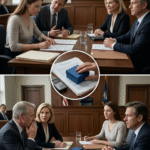
It contained an audio file recovered from Ashbourne’s wine cellar security system.
The microphone had been installed legally as part of the estate’s internal security network.
A sign near the cellar entrance disclosed audio and video monitoring.
Grant knew it was there.
He had simply forgotten.
The recording was from the weekend of Sloane’s photograph.
Their voices filled the courtroom.
Sloane laughed first.
“Does Evelyn really not know the house isn’t hers after the transfer?”
Grant answered.
“She thinks everything is hers.”
A cork popped.
Then Sloane said, “When do you tell her?”
“After the gala.”
“And the shares?”
“She’ll sign the settlement if I use Clara.”
My body went cold.
The courtroom disappeared.
Only his voice remained.
Sloane asked, “Use her how?”
“Evelyn won’t risk a custody fight.”
“What if she does?”
“She won’t.”
His confidence was absolute.
“She grew up watching her mother lose every public battle with her father.”
There was a pause.
Then Grant added, “She’ll pay anything to keep it quiet.”
The recording ended.
Grant’s attorney leaned toward him, whispering urgently.
The judge’s face had changed.
“What was the context of that conversation?” she asked.
Grant stood slowly.
“It was private speculation.”
“About using your child to obtain financial concessions?”
“I was angry.”
“This occurred before your wife knew about the affair.”
He had no answer.
The judge adjusted the temporary order.
Grant’s visits would remain supervised pending further review.
All direct discussions about custody were prohibited outside counsel and the appointed specialist.
As we left the courtroom, Grant followed me into the corridor.
Margaret moved between us.
I touched her arm.
“It’s all right.”
Grant stopped several feet away.
His eyes were bloodshot.
“You recorded me in my own house.”
“It was not your house.”
He flinched.
“You’re enjoying this.”
“You expect me to believe that?”
“I expected you to tell the truth in court.”
His face twisted.
“That recording was a joke.”
“You laughed about using our daughter.”