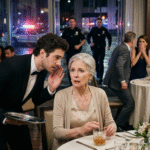
“Do you know him?”
“Ava,” Lena said, rising, “please let me explain.”
The betrayal was small compared to Caleb’s, perhaps.
But betrayal does not measure itself by size when it enters the body.
It simply finds the nearest wound and pours salt into it.
“You brought me here,” Ava said.
“You begged me to come.”
“Yes.”
“You said it was just dancing.
You said one harmless night.”
Lena’s eyes filled again.
“I thought if you saw him in a public place, with help nearby—”
Ava stepped back as though Lena had struck her.
“You knew Caleb might come?”
“No.
I didn’t know.
I suspected.”
The word suspected opened like a trapdoor beneath Ava.
Elias stood.
“Mrs. Mercer, your friend contacted me three weeks ago because she was afraid Caleb had found your new address.”
Ava turned on him.
“And neither of you told me?”
Lena pressed a hand to her mouth.
Elias did not look away.
“We had no proof.”
“No proof?”
Ava’s voice rose.
“I have been living on proof.
Proof is the chair under my door.
Proof is the voicemail where he breathes for two minutes and hangs up.
Proof is the dead roses on my porch.
Proof is me, standing here, unable to stop shaking.”
“I know,” Elias said.
“No, you don’t.”
This time his face changed.
Just slightly.
Enough.
“You’re right,” he said.
“I don’t know your fear from inside your skin.
But I know his pattern.”
Ava laughed once, bitter and breathless.
“His pattern.
Is that what my life is now?
Evidence?”
Lena whispered, “Honey—”
“Don’t.”
Ava turned away.
“Don’t honey me.”
The police arrived then, two officers with tired eyes and notebooks that made Ava feel as though her terror had to be formatted correctly before it could matter.
She gave her statement.
Elias gave his.
The guard gave his.
One of the men from the VIP table gave his, a retired surgeon named Paul whose own sister, Ava later learned, had died under circumstances everyone called tragic and no one called suspicious until Elias Ward began calling them by their proper name.
Caleb was not found outside.
Of course he wasn’t.
Men like Caleb seemed to vanish whenever authority arrived and reappear only when women were alone.
By two in the morning, Ava sat in the back of Elias’s black sedan while Lena followed in her own car.
Elias drove not to Ava’s little rental house, not to Lena’s apartment, but to a quiet residential street lined with old sycamores and sleeping brick homes.
His house stood at the end, white with deep blue shutters and curtains the color of rain.
“You can stay here until morning,” Elias said.
“There is a guest room with a lock.
No one else lives here.”
Ava stared at the house.
“I shouldn’t.”
“You shouldn’t have to.”
That was not the same answer.
Inside, the house smelled faintly of lemon oil, old books, and coffee.
The living room was neat but not sterile.
A folded quilt rested over the back of a sofa.
Photographs lined the mantel: a younger Elias in a courtroom; Elias beside an elderly Black woman in a church hat; a little boy with missing front teeth; and a woman with dark hair sitting on a beach, laughing into the wind.
Ava stopped before that photograph.
Lena came in behind her, quiet and ashamed.
“Her name was Marion,” Elias said.
Ava did not turn.
“Your wife?”
“My sister.”
Ava looked at him.
“She was fifty-seven when she met him,” Elias said.
“Widowed.
Financially comfortable.
Lonely in a way she would never admit because women of her generation were trained to be grateful for whatever life left them.”
Ava felt the words settle too close to her own bones.
“She died?”
“Officially, she fell down her basement stairs.”
The room became very still.
“Unofficially?”
Elias’s jaw moved once.
“She had filed a police report nine days earlier against a man named Martin Bell.
She withdrew it three days before she died.
After her funeral, we discovered her savings were gone, her jewelry missing, and her friends convinced she had become unstable.”
Ava’s mouth went dry.
“Martin Bell?”
she said.
“One of his names.”
Lena made a small sound and sat heavily on the sofa.
Elias walked to a cabinet and removed a thin folder.
He did not hand it to Ava immediately.
“I don’t want to overwhelm you.”
Ava almost smiled.
“That’s a little late.”
He gave her the folder.
Inside were photographs.
Caleb at different ages, though not always Caleb.
Caleb with darker hair.
Caleb with a beard.
Caleb standing beside women Ava did not know.
Older women.
Elegant women.
Women with hopeful faces.
There were newspaper clippings too.
A fall.
An overdose.
A boating accident.
A house fire.
A widow whose son insisted his mother would never have changed her will, though the will had been changed anyway.
Ava sat down because her legs could not hold the weight of it.
“How many?”
she whispered.
“We believe five dead.
At least nine financially ruined.
Possibly more.”
Lena began crying again.
Ava looked at the photographs.
Caleb’s face smiled back at her, again and again, in the company of women who had probably believed themselves chosen.
She touched one image with a shaking finger.
A woman in a lavender sweater stood beside Caleb on a pier, her head tilted toward him with shy joy.
“What was her name?”
“Ruth Bellamy,” Elias said.
“Retired school principal.
Drowned three years ago in Lake Lanier.
Caleb told police she had been depressed.”
Ava closed her eyes.
Depressed.
Confused.
Unstable.
Dramatic.
Oversensitive.
Words men like Caleb used as shovels.
Lena whispered, “Ava, I should have told you.”
Ava opened her eyes.
Her anger had not vanished, but grief had entered the room and rearranged the furniture.
“Yes,” she said.
“You should have.”
“I was afraid you’d run.”
“I might have.”
“I know.”
Ava looked at Elias.
“Why tonight?
Why that club?”
“Club Elysium belongs to a friend of mine,” Elias said.
“A friend whose aunt was one of the women in that folder.
We knew Caleb had started coming there two weeks ago.
He was approaching a widow named Diane Sutter.
We were watching him.”
Ava’s thoughts moved slowly, as though through deep water.
“And then he saw me.”
“So I wasn’t the bait.”
Elias hesitated.
Ava stood.
“Was I bait?”
“No,” Lena said quickly.
“No, I swear to you.
I wanted you near people who knew what he was.”
“That’s still bait,” Ava said.
Elias’s voice softened.
“It was a mistake.
Mine.
Not hers.”
Ava turned toward him.
“Why do you care what happens to me?”
The question came out sharper than she intended, but she needed the sharpness.
Trust had once been the road Caleb used to reach her.
Elias met her eyes.
“Because my sister called me the night before she died,” he said.
“I missed the call.”
No one spoke.
“I was in court.
I saw her name on the screen and thought I would call her back after the verdict.
By the time I did, she didn’t answer.”
He looked at Marion’s photograph.
“I have spent twelve years calling back.”
Ava’s anger faltered.
Elias placed the folder on the table.
“I cannot undo what happened to Marion.
But I can tell you this: Caleb Voss is not only dangerous because he is violent.
He is dangerous because he studies what people need, then becomes it.
To a lonely woman, he is devotion.
To a frightened woman, he is protection.
To a woman with money, he is a plan.
To police, he is reasonable.
To judges, he is respectable.”
Ava whispered, “To me, he was a second chance.”
Her voice broke on the last word.
Lena rose and reached for her, then stopped, waiting.
For a long moment Ava could not move.
Then she stepped into Lena’s arms.
“I am angry with you,” Ava said into her shoulder.
“I love you.”
“I know that too.”
The guest room was upstairs.
Elias showed Ava the lock, the spare phone charger, the bathroom, the window latch.
He did not tell her she was safe.
She appreciated that.
Safe was too large a word to hand someone in the dark.
Before he left, Ava asked, “What did Caleb mean?
When he said I should ask who you are.”
Elias stood in the doorway.
The hall light carved one side of his face in gold and left the other in shadow.
“He meant to frighten you.”
“Did he lie?”
“What aren’t you telling me?”
His hand tightened on the doorknob.
“At least one thing,” he said.
Ava waited.
Elias looked as if the truth had aged him while he stood there.
“Your late husband called me six days before he died.”
The room vanished.
Ava gripped the bedpost.
“Robert?”
The name struck her with such force that for a moment Caleb disappeared entirely.
Robert Mercer, her first husband, dead three years.
Robert with his warm hands and terrible singing voice.
Robert, who had labeled every jar in the garage and cried openly at their daughter’s wedding.
Robert, whose sudden heart attack had left Ava wandering through rooms she no longer knew how to inhabit.
“What did he want?”
she asked.
Elias’s answer was barely audible.
“He said he had found the real reason Caleb Voss should not exist.”
Part Three — What the Dead Leave Behind
Morning arrived pale and merciless.
Ava slept for perhaps an hour, waking from a dream in which Caleb stood at the foot of the bed wearing Robert’s old bathrobe.
For several seconds she did not know where she was.
Then she saw the blue curtains, the locked door, the chair she had dragged in front of it despite the lock, and the shame came with a familiar whisper.
You are being ridiculous.
She sat up.
“No,” she said aloud to the empty room.
“I am being alive.”
Downstairs, Lena was making coffee with the solemn concentration of a woman attempting penance through caffeine.
Elias sat at the kitchen table with his sleeves rolled to his forearms and a stack of documents before him.
He looked as though he had not slept at all.
Ava entered slowly.
Lena looked up.
“There’s toast.”
“I’m not hungry.”
“You should eat.”
“I said I’m not hungry.”
Lena nodded, wounded but accepting.
Ava regretted the edge in her voice and did not yet have the strength to soften it.
Elias pushed a manila envelope across the table.
“These are copies.
The originals are elsewhere.”
Ava remained standing.
“Tell me about Robert.”
Elias folded his hands.
“Your husband contacted me through an attorney we both knew.
He had been volunteering with a veterans’ housing charity.
He discovered irregular withdrawals connected to shell companies.
One of the companies led to a man using the name Caleb Voss.”
Ava’s skin prickled.
“I didn’t know Caleb then,” she said.
Robert did not say you did.”
“Then why would Caleb come after me later?”
Elias looked at the envelope.
“Because Robert believed the charity fraud was only the surface.
He thought Caleb had stolen identities, laundered money, and targeted widows for years.
He had gathered proof.
He was frightened, but he was also stubborn.
He said he had hidden something in your house in case anything happened to him.”
Ava sank into a chair.
Hidden something in your house.
The house she had sold after Robert’s death because every room hurt.
The house Caleb had helped her clean out.
Caleb, so gentle then.
Caleb holding boxes while Ava wept over Christmas ornaments.
Caleb saying, You don’t have to do this alone.
“Did Robert know he was going to die?”
“No,” Elias said carefully.
“But he was afraid.”
“My Robert wasn’t afraid of anything.”
The words came automatically, loyally.
Then Ava remembered Robert checking the front window one night.
Robert changing the password on their computer.
Robert telling her, with forced brightness, that if anything ever happened to him she should keep the old oak chair from his workshop because he had finally fixed the loose rung.
Ava stopped breathing.
Lena noticed.
“What?”
“The chair,” Ava said.
Elias leaned forward.
“What chair?”
“After Robert died, I sold or donated almost everything.
Caleb said it would help me move forward.
But I kept one chair.
Robert made it when our daughter was born.
It’s ugly and too heavy and one leg is uneven.”
Lena’s face went white.
Ava continued, each word arriving from farther away.
“For four months, I’ve been wedging it under my doorknob at night.”
The kitchen went silent.
“Where is it now?”
“My rental house.”
No one moved for one heartbeat.
Then Elias said, “We need to get it before Caleb does.”
Ava laughed in disbelief.
“You think Caleb knows?”
“I think if Robert hid proof, Caleb has been looking for it since the day your husband died.
I think he helped you clear out that house because he wanted access.
I think he entered your life through grief because grief opens doors locks never could.”
Ava pushed back from the table so violently the chair scraped the floor.