Her apartment lease ended.
The ivory gown from the gala appeared on a luxury resale site two weeks later.
She never apologized to me.
I never asked her to.
An apology given only after the locks change is usually grief for lost access.
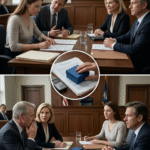
Three months into the divorce, Camille was deposed.
Naomi asked why she had worn my mother’s diamond on the podcast.
Camille looked toward her attorney.
Then she answered.
“Graham said Vivienne would recognize it.”
The room went quiet.
Naomi asked, “Why did he want her to recognize it?”
“He said it would make the situation feel final.”
“Did he use the word final?”
Camille lowered her eyes.
“He said she cared more about family objects than people.”
Naomi glanced at me.
I gave no reaction.
“Whose idea was it for you to sit in the chair marked wife?” Naomi asked.
“I thought it would create a strong clip.”
“Did Mr. Vale object?”
“What did he say?”
Camille swallowed.
“He said Vivienne would understand the message.”
I had understood.
Just not the message they intended.
They believed the chair represented replacement.
To me, it represented occupancy without title.
That was the flaw beneath their entire plan.
Camille thought sitting in my place made it hers.
Graham thought using my family’s company made it his.
Both confused possession with ownership.
The distinction cost them more than they imagined.
Six months after the podcast, the financial investigation concluded.
Graham agreed to repay the diverted funds.
He surrendered additional equity under the bad-leaver formula.
He resigned from three nonprofit boards.
He accepted a five-year restriction preventing him from using the Vale House name in a competing hospitality venture.
The company did not pursue criminal charges as part of the negotiated resolution, though regulators retained independent authority.
The divorce settlement was signed in a private conference room overlooking Foley Square.
No cameras waited outside.
No string quartet played.
No one wore ivory.
Graham arrived early.
He had lost weight.
The silver at his temples no longer looked distinguished.
It made him look tired.
For the first time since I had known him, his suit fit imperfectly.
We sat on opposite sides of the table.
Naomi reviewed the final terms.
The Fifth Avenue apartment remained with my trust.
The Hamptons estate remained with the Ashford holding company.
Graham retained personal assets purchased with verified separate funds.
He received the adjusted value of the small portion of his shares not subject to forfeiture or repurchase.
He waived claims to the Vale House name.
He agreed to a mutual nondisparagement clause.
The word mutual made him look at me.
“You could say anything you wanted,” he said.
“I could.”
“But you agreed not to.”
“Because I don’t want to spend the rest of my life discussing you.”
His eyes dropped.
Naomi placed the signature page before me.
I signed Vivienne Ashford Vale for the final time.
Graham took the pen.
His hand hovered over the line.
“Did you ever consider forgiving me?” he asked.
The attorneys became very still.
“This is not the place,” his own lawyer murmured.
Graham ignored him.
I looked through the windows at the courthouse steps below.
People moved through the square carrying coffee, folders, flowers, children, and private disasters.
“I forgave you many times,” I said.
“You just never knew because I protected you from the cost.”
He closed his eyes.
“I mean after the podcast.”
“After the podcast, I stopped confusing forgiveness with permission.”
He signed.
The marriage ended at 2:17 on a Thursday afternoon.
Twelve years reduced to ink, initials, and a stamped judgment.
Graham remained seated after the attorneys began gathering papers.
“I loved you,” he said.
I believed him.
That was the saddest part.
He had loved me according to the limits of his character.
He loved my loyalty.
He loved the rooms I opened.
He loved the version of himself reflected in my confidence.
He loved being forgiven before he apologized.
He simply had not loved me enough to resist humiliating me when humiliation seemed useful.
“I know,” I said.
He looked surprised.
“Then why does it sound like you don’t care?”
“Because caring is no longer the same as staying.”
I left him in the conference room.
Outside, winter had finally broken.
Rain darkened the sidewalks.
Taxi tires hissed across wet pavement.
Naomi opened an umbrella over both of us.
“Where to?” she asked.
For twelve years, the answer had usually been a hotel, a board meeting, a gala, a hospital, or a home arranged around Graham’s needs.
That afternoon, I had nowhere I was required to be.
The freedom felt strange.
Then it felt expensive.
Then it felt mine.
“The studio,” I said.
Linden Media had renovated the *Uncoupled* set.
The cream chairs were gone.
The brass plaques had been removed.
In their place stood one deep blue chair facing a single camera.
I had approved a new limited series through the Ashford Foundation.
It would provide women leaving financially coercive marriages with free consultations from attorneys, accountants, housing specialists, and career advisers.
The show would not focus on revenge.
It would focus on documents.
Deeds.
Contracts.
Credit reports.
Trusts.
Employment agreements.
The quiet architecture that could imprison a woman or set her free.
We called it *Read Before You Sign*.
The first guest was a nurse from Ohio whose husband had hidden debt in her name.
The second was a teacher from Arizona who discovered her spouse had emptied their children’s college accounts.
The third was a former corporate executive who had signed away stock rights while recovering from childbirth.
They were not famous.
They did not arrive with stylists.
They did not need perfect language.
They needed someone to believe that confusion was not consent.
Before the first recording, a production assistant approached me with a small brass plaque.
“What would you like the chair to say?” she asked.
I considered several possibilities.
**WIFE** felt too small.
**EX-WIFE** gave Graham too much space in my future.
**CHAIRWOMAN** was accurate but formal.
**SURVIVOR** was true but incomplete.
I picked up a marker and wrote one word.
**OWNER**.
The assistant smiled.
“Perfect.”
“Earned.”
I sat beneath the lights.
The camera operator counted down.
Three.
Two.
One.
The red light came on.
For a moment, I saw the old studio in my mind.
Camille’s white dress.
Graham’s charcoal suit.
My mother’s diamond.
The brass word beneath her hand.
I remembered the host’s uncomfortable laugh.
I remembered Camille saying, “Future wife is close enough.”
I remembered Graham calling me a mistake.
The memories no longer cut.
They had edges, but they belonged to the past now.
I looked into the camera.
“My name is Vivienne Ashford,” I said.
“And before we discuss how a woman rebuilds her life, we are going to discuss what she already owns.”
The episode became Linden Media’s most-watched premiere of the year.
The network asked whether I wanted to host a second season.
I agreed on one condition.
Every featured woman would receive professional assistance whether her episode aired or not.
They accepted.
A year after the divorce, I returned to the Hamptons estate alone.
The house stood above the Atlantic behind wind-shaped hedges and pale stone walls.
Graham had once called it his refuge.
Camille had selected fabric samples for the east wing before the podcast aired.
I removed none of the furniture.
I simply opened the windows.
Salt air moved through the rooms.
In the garden, the first white roses had begun to bloom.
I cut seven and placed them in my grandmother’s silver bowl.
Not because guests were coming.
Not because a photographer would see them.
Not because perfection might save someone else’s evening.
I arranged them because they were beautiful.
That night, I ate dinner on the terrace with Naomi, Lydia, and my younger cousin Claire, who had recently joined the foundation.
We drank wine beneath strings of soft lights.
No one discussed Graham until dessert.
Claire held up her phone.
“The original podcast clip is circulating again,” she said.
“Someone made a video about the anniversary.”
Naomi sighed.
“The internet never buries a body.”
Claire turned the screen toward me.
The clip showed Camille entering the studio.
It showed her lowering herself into the chair.
It showed Julian reminding her that the seat belonged to the legal wife.
Then came the sentence that had once felt like a public slap.
“Future wife is close enough.”
The video cut to the legal disclaimer.
Then it cut to footage from my first episode of *Read Before You Sign*.
I sat in the blue chair beneath the word **OWNER**.
The caption read:
*She took the podcast chair.*
*The wife took the transcript.*
Claire watched my face.
“Do you hate it?”
I looked beyond the terrace toward the darkening ocean.
“Do you want me to ask them to remove it?”
Naomi lifted her glass.
“To the transcript.”
Lydia raised hers.
“To Schedule C.”
Claire laughed and raised her wine.
“To women who read everything.”
I lifted my glass last.
“To women who learn they can.”
The ocean moved below us, steady and endless.
For years, I had believed strength meant keeping every room beautiful while someone else filled it with smoke.
I knew better now.
Strength was opening the doors.
Strength was preserving the evidence.
Strength was leaving before the fire convinced you it was warmth.
Graham had believed the podcast would write the final chapter of our marriage.
Camille had believed sitting in my chair would make her the heroine.
Neither understood that stories do not belong to the loudest person in the room.
They belong to the person who survives long enough to tell the truth.
# CONCLUSION
## THE CHAIR I CHOSE
There are betrayals that arrive like storms.
Mine arrived beneath studio lighting, wearing white silk and my mother’s diamond.
For one terrible night, millions of people watched another woman sit in my place while my husband explained why I no longer deserved it.
They expected tears.
They expected rage.
They expected me to fight for a man who had already used my dignity as a weapon.
Instead, I listened.
I read the contracts.
I followed the money.
I remembered that love could make a home, but only truth could tell you who owned it.
The world called my silence cold.
It was not cold.
It was controlled.
It was the silence of a woman refusing to spend her pain before she knew what it was worth.
I lost a husband.
I lost the future I once imagined.
I lost the comforting lie that loyalty could make another person loyal in return.
But I recovered my mother’s diamond.
I protected the company my family built.
I gave other women access to the knowledge that saved me.
Most importantly, I recovered the woman I had been before I learned to make myself smaller for someone else’s comfort.
The chair marked **WIFE** was never the prize.
A wife can be betrayed.
A title can be mocked.
A place can be temporarily occupied by anyone bold enough to sit down.
What mattered was the woman who knew where the deed was kept.
What mattered was the signature no one remembered she held.
What mattered was the truth waiting patiently in the transcript.
Camille took my chair for one night.
Graham took my loyalty for twelve years.
I took back my name, my company, my story, and every room I had once allowed him to believe was his.
Then I opened those rooms to the light.
That was not revenge.
That was ownership.