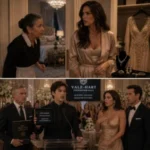
There were white roses on the balcony, a photographer hidden behind a pine tree, and a ring chosen by a man who knew carat weight better than emotional intimacy.
I was twenty-nine.
He was thirty-four.
I had just inherited Avery Holdings, though the public still thought I was only my father’s grieving daughter.
Grant was handsome in the American dynasty way.
Tall, dark-haired, Yale smile, family crest on stationery, old photographs of ancestors who looked stern enough to own weather.
He knew when to take my coat.
He knew when to lower his voice.
He knew how to say my name like it had cost him something.
I loved him.
That is the part I do not apologize for.
Women are not foolish because they believed a man who studied them carefully.
Grant did not stumble into my heart.
He researched the floor plan.
When we met, the Whitaker family was drowning politely.
Their hotel group looked immaculate from the outside.
Marble lobbies.
Black cars.
Presidential suites.
A foundation gala every spring.
But beneath the polished brass, Whitaker Hospitality was carrying debt like a body under a rug.
My father had known.
So had my mother.
The Averys had land, liquidity, and something Whitakers respected more than money.
Control.
My mother did not like Grant.
She smiled at him once over lunch at Le Bernardin and later told me he had “the eyes of a man who counts exits before blessings.”
I laughed then.
I wish I had not.
When Grant proposed, his father insisted on a prenup.
Preston Whitaker called it “routine.”
Lydia called it “protection for both families.”
Grant kissed my forehead and told me it was only paperwork.
I said yes because I was in love and because love, when dressed in cashmere, can make even a contract look romantic.
But my attorney was Nadia Cole.
Nadia had been my mother’s attorney for twenty years.
She wore navy suits, no wedding ring, and the expression of a woman who had watched too many heiresses mistake charm for character.
When Grant’s lawyers sent the first draft, Nadia read it once and laughed.
Not kindly.
“They want your money to rescue their company,” she said, “your name to soften their reputation, your body at their galas, and your silence if he humiliates you.”
I remember sitting in her office above Madison Avenue, rain sliding down the windows like the city was trying to warn me.
“He won’t,” I said.
Nadia looked at me for a long moment.
Then she wrote something in red ink.
“That is what every bride says.”
The final prenup was not romantic.
It was surgical.
Grant’s side focused on protecting the Whitaker name and limiting what I could claim if the marriage failed.
Nadia let them feel clever.
Then she built the Avery Contingency into the structure beneath everything.
The Whitaker family needed access to Avery capital to refinance their flagship hotels.
They needed our land trusts to secure loans.
They needed my signature to keep the Kingsley, the Magnolia House in Charleston, the Marlowe in Palm Beach, and three resort properties in Colorado out of bankruptcy.
The public story was a merger.
The private truth was a rescue.
My wedding date, October twelfth, became more than an anniversary.
It became the trigger date for Grant’s vesting.
If we reached five years without documented marital misconduct, Grant would receive expanded control over a portion of the Avery-backed Whitaker assets.
Not ownership.
Even then, Nadia would not let him touch the root.
The root was mine.
Grant knew enough to be patient.
For four years, he played the husband.
He held my hand at openings.
He called me “my brilliant wife” in interviews.
He let photographers catch him looking at me like I was the last candle in a storm.
At home, he became more efficient with affection.
A kiss on the temple.
A text instead of a conversation.
Flowers sent by assistants.
Apologies timed between flights.
Then came Brielle.
She started in events, which meant she knew how to make entrances look accidental.
Grant hired her to modernize the foundation gala.
She wore white to the first planning meeting and apologized for it twice.
I remember because I told her it was fine.
I meant it.
Back then, I still believed small disrespect was only insecurity.
Brielle learned the family quickly.
She learned Lydia liked compliments on her garden.
She learned Preston hated being interrupted.
She learned Caroline had a soft spot for wounded things and designer handbags.
She learned Grant liked admiration served warm and constant.
I learned last.
That is another thing nobody tells wives.
You are often the last to know because you are the only person still honoring the marriage.
The first sign was his phone facedown.
Then the gym cologne at midnight.
Then the way he said “work dinner” too quickly.
Then the receipt.
Suite 1408.
The Pierre.
Two glasses of champagne.
One chocolate soufflé.
No business dinner in Manhattan ends with one soufflé unless the business is betrayal.
I did not confront him.
Not then.
A woman can scream once and lose every advantage.
Or she can go quiet and become a file.
I hired Maris Quinn, a private investigator from Boston who wore leather gloves in May and had a voice like gravel poured into silk.
Maris did not ask me if I was sure.
Good investigators never ask wives if they are sure.
They know women do not hire strangers when the first lie happens.
They hire them when the lies start repeating themselves in expensive places.
Maris sent me photographs.
Grant and Brielle leaving the Pierre.
Grant and Brielle entering a townhouse in the West Village.
Grant and Brielle at a jeweler.
Grant and Brielle in Palm Beach, where he told me he was meeting with investors.
Then came the recording.
Brielle’s voice, light and triumphant, caught from the private terrace of the Magnolia House during the spring foundation retreat.
“She’s so calm it’s creepy,” Brielle said.
Grant laughed.
“Vivian cares about appearances more than feelings.”
“Then break the appearance,” Brielle said.
“I want her to know.”
“She knows.”
“I want everyone to know.”
Grant was quiet for a moment.
Then he said the sentence that ended my marriage even before the tattoo.
“After October twelfth, it won’t matter what she knows.”
I played that line three times.
Then I called Nadia.
She was silent while I explained.
Then she asked, “Do you still have the original prenup binder?”
“Good.”
Her voice sharpened.
“Because he is counting the date wrong.”
That was the hidden blade.
Grant believed that at midnight on our fifth anniversary, he would gain enough control to force a favorable separation.
He thought he could turn my heartbreak into leverage.
He thought the fifth anniversary was his finish line.
But Nadia had drafted the clause with a phrase most people skim.
On or before.
Not after.
On.
Meaning October twelfth was not safe.
It was the final trapdoor.
If Grant publicly humiliated me with Brielle on that date, before witnesses, the vesting did not just fail.
It reversed.
Every temporary authority tied to my assets snapped back to me.
Every share transfer froze.
Every marital residence claim vanished.
Every dollar spent on Brielle from Whitaker accounts became recoverable.
Every board seat attached to Avery-backed collateral became subject to removal.
Nadia called it a legal seatbelt.
Maris called it a bear trap in pearls.
I called it patience.
The dinner invitation came two weeks before our anniversary.
Grant told me his mother wanted “a family evening.”
His tone carried the careful brightness of a man arranging a scene.
I asked who would be there.
“Family,” he said.
Then he paused.
“And a few people from the foundation.”
That meant witnesses.
I asked if Brielle would attend.
He looked up from his cufflinks.
The bedroom mirror caught both of us.
Me in a robe.
Him in a tuxedo.
A marriage reflected as distance.
“She may stop by,” he said.
He studied my face.
“You’re not going to make this difficult, are you?”
I almost laughed.
That was the thing about men like Grant.
They mistake a woman’s restraint for permission because it benefits them to do so.
“No,” I said.
“I won’t make it difficult.”
Then I called The Kingsley and reserved the Bellamy Room myself.
Grant believed his family owned that hotel because the brass plaque in the lobby still said Whitaker.
It had said Whitaker since 1926.
But plaques are not deeds.
The land beneath The Kingsley belonged to the Avery Trust.
The debt beneath the renovation belonged to me.
The management agreement was controlled by a holding company with my signature on every operating authority.
The room where he planned to humiliate me was legally mine.
So were the cameras.
So was the staff.
So was the wine.
And if he wanted witnesses, I would give him witnesses.
PART 3 — THE ROOM THAT WASN’T HIS
After I read the clause aloud, nobody reached for their wine.
Brielle stared at her wrist as if the ink might rearrange itself into mercy.
Grant’s jaw moved once.
His father’s face had gone the color of hotel stationery.
Lydia whispered, “Grant, what have you done?”
That was almost funny.
Not what have you been doing.
Not how could you bring her here.
Not how could you hurt your wife.
What have you done.
The Whitakers were not shocked by cruelty.
They were shocked by consequences.
Grant placed both hands on the table.
“Everyone relax,” he said.
His voice had gone smooth.
That was his boardroom voice.
That was the voice he used before firing people with pregnant wives and mortgages.
“This is a private family dinner, and Vivian is clearly emotional.”
I closed the prenup.
“Careful.”
His eyes flicked to mine.
“One more sentence like that and I add defamation to the folder.”
Brielle gave a nervous little laugh.
“Folder?”
Caroline looked at me.
She knew.
Not all of it.
But enough.
Caroline Whitaker had never liked me exactly, but she understood the family’s rot better than anyone.
She was the only one who had texted me last winter after a gala where Grant left early and Brielle disappeared ten minutes later.
Are you okay?
I had typed back, Yes.
It was not true, but it was kind.
Grant turned to his father.
“Dad.”
Preston did not answer.
The great Preston Whitaker, who had spent forty years moving money through rooms without leaving fingerprints, understood one thing clearly.
Grant had set fire to a document he had not reread.
I lifted my hand, and the captain appeared.