Adrian arrived alone.
He had lost weight.
His hair was grayer.
Without the drivers, assistants, security detail, and constant movement of his old life, he looked less like a fallen king than an ordinary man who had once occupied expensive rooms.
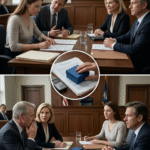
Inside the courtroom, our attorneys presented the settlement.
I retained all trust assets.
Adrian waived claims to the townhouse, the Palm Beach property, the ranch, and the foundation.
He retained his personal investment accounts after restitution.
He received no interest in Cross Meridian.
He agreed to a confidential but substantial payment into Sophie’s independent trust.
Custody was no longer contested because Sophie was months from turning eighteen and refused unsupervised visits.
I had not asked her to refuse.
I had not needed to.
The judge reviewed the documents.
Then she looked at Adrian.
“Mr. Cross, do you understand that this agreement permanently terminates any claim to assets held by the Wrenford Trust?”
“Do you understand that you are waiving any claim to voting or managerial authority in Cross Meridian?”
“Do you enter this agreement voluntarily?”
His eyes moved to me.
For a second, I saw the man I met at a charity auction twenty years earlier.
He had been charming, hungry, and almost painfully alive.
He told me he intended to build something no one could ignore.
I had believed ambition and character were the same thing.
They are not.
“Yes,” he said.
The judge turned to me.
“Mrs. Cross?”
“Yes, Your Honor.”
“I do.”
The judge signed.
Eighteen years ended beneath fluorescent lights with two signatures and the quiet turn of paper.
There was no dramatic music.
No applause.
No satisfaction large enough to fill the space where a marriage had been.
When we stepped into the courthouse corridor, Adrian asked his attorney for a moment alone with me.
Mara looked at me.
She moved several feet away but remained within sight.
Adrian stood beside a tall window.
Snow blurred the city behind him.
“Did you ever plan to forgive me?” he asked.
The answer surprised him.
“Not even before the gala?”
“Before the gala, I planned to divorce you privately.”
His mouth tightened.
“You could have.”
“Then why didn’t you?”
“Because you tried to take the foundation.”
“I was trying to secure its future.”
“You forged a case that I was mentally impaired.”
“I was advised that temporary control might be necessary.”
“You drafted the petition before my surgery.”
He looked away.
Owen had found the earlier version in Celeste’s files.
The date proved my medical emergency was merely an opportunity.
“You were distant for years,” Adrian said.
There it was.
The final excuse.
Not denial.
Not remorse.
A revision.
“You stopped needing me.”
“I stopped performing need to protect your ego.”
“You made me feel unnecessary.”
“You were my husband.”
I held his gaze.
“You decided that was not enough unless I was also helpless.”
He looked down the corridor.
People passed us carrying briefcases and coffee.
No one recognized him.
Or perhaps they did and no longer cared.
“I loved you,” he said.
“I believe you loved the life I made possible.”
“That is unfair.”
“It is precise.”
He closed his eyes.
“What happened between us?”
“You kept testing how much I would endure.”
My voice remained quiet.
“One day, you reached the answer.”
He opened his eyes.
“Was it the photograph?”
“The photograph was simply the first time you made the truth impossible for everyone else to ignore.”
He studied my face.
“You knew she would tell you to move.”
“I suspected.”
“And you let her.”
“Why?”
“Because I needed her to believe she had won.”
That answer hurt him more than anger would have.
He had spent months telling himself the gala had been a trap created by lawyers and accountants.
He wanted to believe Celeste alone had ruined him with her vanity.
Now he understood that his own confidence had completed the design.
“If I had let you stand beside me,” he said, “would any of this be different?”
“The photograph would be different.”
“That is not what I asked.”
I looked toward Mara.
“We were already finished.”
He swallowed.
“Sophie graduates in June.”
“Will you let me attend?”
“That is her decision.”
“You could convince her.”
“I will never again use my relationship with our daughter to protect you from the consequences of yours.”
“You sound like a lawyer.”
“I sound like a woman you can no longer interrupt.”
Mara approached.
The conversation was over.
Adrian looked at me one last time.
“I hope winning was worth it.”
I buttoned my coat.
“This was never about winning.”
“It was about refusing to lose myself just because you had already lost sight of me.”
I walked away.
He did not follow.
The press waited outside the courthouse.
Cameras flashed against the snow.
Reporters called my name.
I gave no statement about Adrian.
I did not call him a monster.
I did not call Celeste a thief.
I did not perform heartbreak for people who would turn it into entertainment.
I announced only that the Evelyn Cross Foundation had recovered all diverted funds and would open three new pediatric trauma centers.
Then I stepped into the car beside my daughter.
Sophie had cut her hair to her shoulders.
She wore red lipstick and held an acceptance letter from Stanford in her gloved hands.
“Are you okay?” she asked.
I looked back at the courthouse.
Adrian stood beneath the stone columns, alone among the cameras.
“Yes,” I said.
This time, it was true.
CONCLUSION
THE LIFE AFTER THE APPLAUSE
Spring arrived slowly that year.
The magnolia tree behind the townhouse bloomed two weeks late.
For the first time in eighteen years, no one complained about the gardeners, the dinner schedule, or the way morning light reflected from the breakfast-room mirrors.
The house became quiet.
Not empty.
Quiet.
Emptiness asks to be filled.
Quiet allows you to hear what was always there.
Sophie played music while packing for college.
Claire came for Sunday dinner and stayed until midnight.
Mrs. Alvarez taught me how to make empanadas, though mine opened in the oven and spilled across the tray.
We laughed until I cried.
It was the first time tears did not feel like defeat.
Cross Meridian appointed its first woman chief executive, Danielle Brooks, a brilliant operations director Adrian had kept one title below the role she had performed for five years.
Under her leadership, the company sold Adrian’s vanity projects, strengthened compliance, and posted its best employee-retention numbers in a decade.
I remained chair of the voting trust.
I did not take Adrian’s old office.
We removed his portrait from the lobby and replaced it with a wall displaying the names of the first forty employees who had worked without salaries during the company’s hardest year.
My name was there.
So was his.
The truth did not require erasing him.
It required reducing him to his correct size.
The foundation opened its first trauma center in Brooklyn in May.
The recovery wing included private rooms for parents of critically ill children.
I insisted on beds wide enough for family members to sleep beside one another.
No patient would wake alone because someone important had chosen another room.
At the opening ceremony, a reporter asked whether the design had personal meaning.
Then I moved to the next question.
Not every wound needed to become public property.
Celeste gave birth to a healthy boy.
Her criminal case ended with restitution, probation, and a prohibition against serving as an officer of a charitable organization.
She sent me a letter before sentencing.
It was eight pages long.
She apologized twice.
She blamed Adrian eleven times.
She wrote that she had envied the way people looked at me when I entered a room.
She believed standing beside him would make them look at her the same way.
I read the letter once.
Then I placed it in the legal archive.
I did not respond.
Some women think they want your husband.
What they want is the authority they imagine he gave you.
They do not understand that the authority was never his to give.
Adrian moved to a smaller apartment downtown.
He started a consulting firm.
For several months, business publications reported that he was preparing a comeback.
The comeback did not arrive.
People still invited him to certain dinners.
Money forgives many things.
Power forgives less.
Sophie allowed him to attend her graduation.
He sat in the last row.
After the ceremony, she accepted a brief hug and introduced him to none of her friends.
I watched from beneath an oak tree.
I did not interfere.
Healing does not always look like reconciliation.
Sometimes it looks like a boundary held without anger.
That evening, Sophie and I returned to the Whitmore Museum for the foundation’s annual youth art exhibition.
The ballroom looked different without anniversary flowers.
The chandeliers were the same.
The marble floor was the same.
The west column still concealed the narrow hallway where Mara had waited with the lawsuit papers.
Near the entrance, the museum director stopped me.
“We are updating the donor gallery,” she said.
“We would like to include your portrait.”
I almost refused.
Then Sophie touched my hand.
“Do it.”
The museum photographer positioned us beneath the largest chandelier.
“Would you like to stand in front?” he asked me.
I looked at my daughter.
She smiled.
“Together,” I said.
We stood side by side.
No one asked either of us to step back.
The camera flashed.
This time, I smiled.
Not because the story had become painless.
Not because betrayal had secretly been a gift.
Pain is not generous.
It takes what it takes.
The warmth came from knowing I had survived without becoming cruel.
I had protected my daughter without teaching her that love required surrender.
I had protected the company without pretending its success excused the man who nearly destroyed it.
I had protected the foundation without allowing scandal to eclipse the children it served.
Most of all, I had protected the woman in the photograph.
The woman standing behind her husband and his mistress was not weak.
She was not defeated.
She was not waiting to be chosen.
She was watching.
She was calculating.
She was letting them create the evidence in full view of everyone who mattered.
Celeste wanted the photograph.
I gave her one.
Adrian wanted my silence.
I gave him that too.
Neither of them understood that silence can be a locked door.
Neither understood that a photograph can become testimony.
Neither understood that the woman they pushed into the background owned the company, the houses, the foundation, the contracts, the room, and the final word.
That photo became the cover of the lawsuit packet.