PART 4: THE HOUSE THAT WAS NEVER HIS
After the gala, the internet did what it always does with rich people bleeding under good lighting.
It replayed the wound.
By midnight, clips of Grant applauding Sloane had spread across every platform.
By 12:20 a.m., a reel showed the donor screen revealing his zero-dollar contribution.
By 1:00 a.m., someone had placed Sloane’s “grief should not define a woman” line over footage of her sitting in my chair.
By dawn, the caption under the most shared clip read, She performed compassion. The wife owned the cause.
I did not post it.
I did not need to.
Public humiliation is most effective when the public edits for you.
Grant came home at 2:38 a.m.
I know because I was in the library, wearing cashmere, drinking tea, and reading the divorce petition Mara had already filed electronically.
The Greenwich house was quiet.
Snow pressed against the windows.
The fire had burned down to a red glow.
Grant walked in without his tie.
He looked younger when panicked.
Not innocent.
Just unfinished.
“You destroyed me,” he said.
I turned a page.
“No. I stopped helping you pretend.”
He stood near the doorway.
His tuxedo jacket hung open.
There was a smear of something on his cuff, maybe champagne, maybe Sloane’s makeup, maybe the first visible stain of his actual character.
“My mother is furious,” he said.
“I assumed.”
“My father is calling the bank.”
“He should.”
Grant stared at me.
“You don’t understand what you did tonight.”
“Grant, I am a lawyer with a trust, a foundation, an audit trail, and your signature on nine documents. Understanding is the one thing I have never lacked.”
He crossed the room.
“You think this makes you powerful?”
“No. Power made this possible.”
His face twisted.
“You were nothing when I married you.”
The sentence beneath all the others.
Not I loved you.
Not I am sorry.
Not forgive me.
You were nothing.
“When you married me, your father’s hotel debt was being held together with wire and donor dinners. My trust bought the note. My lawyers structured the rescue. My name kept Whitmore Capital out of the Journal.”
Grant froze.
The fire popped softly.
“You knew?”
“I signed the money.”
“My father said—”
“Your father lied.”
He swallowed.
For the first time in our marriage, he looked at me as if I had a door behind my face he had never noticed.
I almost felt sorry for him.
Almost.
“You let me think—”
“That you rescued me?”
I stood.
“Grant, I let you think many things because you were more useful confident.”
His mouth parted.
Men like Grant do not know what to do when the mirror speaks back.
He recovered badly.
“You won’t get away with this. The house is mine.”
He hated that smile.
“Which house?”
“The Greenwich house.”
“This one?”
“Do not play games.”
I walked to the desk and opened a drawer.
Inside was a cream envelope with his name written in Mara’s hand.
I gave it to him.
He tore it open.
The first page was the deed.
He read.
Then read again.
His color changed.
“This is impossible.”
“The property was transferred to the Bennett Hart Trust two years before our wedding when your father used it as collateral. The trust leased it back to your family at one dollar a year for appearances.”
His hand shook.
“My mother lives here.”
“No, Grant. Your mother poses here.”
He looked up sharply.
“The lease terminates upon material breach of the marital firewall agreement. Security will help her move her personal belongings next week.”
He took one step toward me.
The door opened.
Mara entered with two private security officers.
She did not raise her voice.
“Mr. Whitmore, do not make this a criminal matter.”
Grant laughed once.
It was not amusement.
It was the sound of a man falling through floors.
“You had security in our house?”
“My house,” I said.
His eyes flicked to the ring on my hand.
My mother’s sapphire.
“You’re enjoying this.”
I looked at him honestly.
“That is what you still do not understand. I would have enjoyed never needing this.”
For a moment, something like shame crossed his face.
Then his phone rang.
Sloane.
Her name lit the screen.
Neither of us moved.
He let it ring.
That told me everything.
He had carried a mistress into my gala, kissed her on camera, announced her as my replacement, and abandoned her before sunrise because she had become inconvenient.
Sloane would learn soon enough.
The man who cheats with you is also a man trained to leave.
Grant rejected the call.
Then another name appeared.
Mother.
He rejected that too.
“Evelyn,” he said.
Softer now.
Dangerously soft.
“I made mistakes.”
I laughed.
Not loudly.
Just enough.
“No, Grant. You made arrangements.”
He looked down.
“I didn’t mean for it to go this far.”
“You moved my chair.”
He flinched.
It sounded small.
It was not.
People think betrayal is the affair.
It is not.
The affair is only the headline.
Betrayal is the seating chart.
It is the mother-in-law who knows.
It is the assistant booking hotel rooms.
It is the credit card disguised as business development.
It is the husband who decides you can be humiliated as long as the flowers are tasteful.
He whispered, “I’m sorry.”
I searched his face for the man who once kissed my temple and said I built architecture from pain.
I did not find him.
Maybe he had never existed.
Maybe I had furnished him myself.
“Mara will speak to your attorney,” I said.
His expression hardened.
“There it is.”
“There what is?”
“The ice.”
I stepped closer.
The room was silent except for the snow tapping the windows.
“You mistook warmth for ignorance,” I said.
“Then you mistook dignity for ice. That was your second mistake.”
He stared at me.
“What was my first?”
“Thinking I was grateful to be chosen.”
Mara handed him another document.
He looked at it and went still.
“What is this?”
“Notice of voting proxy activation,” she said.
Grant read faster this time.
His mouth opened.
“Yes,” Mara said.
He looked at me.
“You can’t control my shares.”
“I do not control your shares,” I said.
“The trust controls the voting rights tied to the emergency financing agreement you signed after your hotel division nearly collapsed.”
“That clause was only triggered by criminal conduct.”
Mara tilted her head.
“Or by public conduct causing reputational damage to trust-secured assets, including charitable entities and hospitality holdings.”
Grant’s face went blank.
He remembered.
Again.
It is astonishing how often powerful men forget the fine print until it becomes their obituary.
“You set me up,” he said.
“No. I gave you a fence. You climbed it in a tuxedo.”
Mara almost smiled.
Grant sat down heavily in the leather chair opposite the fire.
For years, he had looked regal there.
Now he looked like a guest who had overstayed.
“What do you want?” he asked.
That was the first intelligent question he had asked all night.
“I want a divorce without theater.”
His jaw tightened.
“I want the foundation left untouched.”
He said nothing.
“I want your family to stop using my mother’s name by noon tomorrow.”
His eyes flickered.
“And I want you to tell Sloane the truth before she hears it from Page Six.”
He frowned.
“What truth?”
I looked at Mara.
She gave one small nod.
I walked to the window and watched snow settle over the driveway where his black car waited.
“Sloane is pregnant,” I said.
His hand tightened around the document.
“So your mother said.”
“Grant.”
I turned.
“The paternity test was filed under seal in connection with the restraining order her ex-husband requested last month.”
He stared.
“What?”
I chose my words carefully.
“The child is not yours.”
The room became colder.
He stood too fast.
“That is impossible.”
“No. It is inconvenient.”
His face collapsed in pieces.
First disbelief.
Then rage.
Then the kind of humiliation only men feel when they realize the woman they used to humiliate someone else has humiliated them too.
I did not enjoy it.
That surprised me.
I had imagined, in darker moments, that revenge would taste sweet.
It tasted clean.
There is a difference.
Grant grabbed his phone.
Mara said, “Mr. Whitmore, I would advise against threatening anyone tonight.”
He lowered it.
His eyes moved back to me.
“You knew before the gala.”
“And you let me stand there.”
I looked at him for a long moment.
“You let me sit at Table Fourteen.”
The sentence hit harder than I expected.
Maybe because it was small enough to be undeniable.
Grant sank back into the chair.
Outside, a car door closed.
Security lights swept over the snow.
I removed my wedding ring.
Not dramatically.
Not like a woman in a movie throwing it into the fire.
I placed it on the desk beside the signed divorce petition.
Quiet things can end loudly inside the body.
Grant watched the ring.
I walked to the door.
He sounded frightened now.
Not of losing me.
Of losing the version of himself that existed only because I had stood beside him.
“Good night, Grant.”
I left him in the library with the documents, the fire, and the house that had never been his.
PART 5: THE WOMAN WHO OWNED THE ENDING
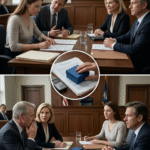
The divorce hearing lasted less than eighteen minutes.
That offended Grant more than the divorce itself.
He arrived with three attorneys, a navy suit, and the ruined confidence of a man who had discovered judges read attachments.
I arrived with Mara and a black coat belted at the waist.
No entourage.
No tears.
No visible wound.
The courtroom was not glamorous.
Fluorescent lights.
Old wood.
A clerk chewing gum with quiet dedication.
After the gala, people expected opera.
They expected shouting in marble hallways.
They expected Sloane in sunglasses and Greer in pearls giving quotes about family privacy.
They got paperwork instead.
Paperwork is where revenge becomes permanent.