I took my seat behind the prosecutors.
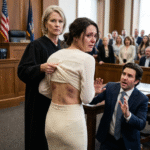
Sloane testified on the third day.
She wore a simple gray dress.
Without the silver gown, diamond ring, and ballroom lighting, she looked younger.
Smaller.
She described the accounts.
The forged documents.
The promises Adrian made about ownership.
The way he instructed her to move funds before the merger.
Then the prosecutor asked about the engagement dinner.
“Whose idea was the slideshow?” he said.
“Mine.”
“Did Mr. Vale approve it?”
“Did he review the captions?”
“Some of them.”
“Which ones?”
Sloane looked toward me.
“The ones about Mrs. Vale’s wedding.”
“And the photograph outside the hospital?”
Her voice dropped.
“Did you know she had suffered a miscarriage?”
“Not when I wrote the caption.”
“When did you learn?”
“That night.”
“What did you do after learning?”
Sloane’s eyes filled.
“Nothing.”
The prosecutor let the silence remain.
It was the correct choice.
Remorse cannot rewrite behavior.
It can only describe the person who finally understands it.
Adrian testified against the advice of his attorneys.
He claimed the transfers were legitimate.
He claimed my signature had been applied with implied consent.
He claimed Hartwell executives had long treated him with hostility.
He described himself as an outsider who had fought for acceptance in an old-money family.
Parts of that were true.
My mother had not trusted him.
My father had required safeguards.
Adrian had resented every room in which his charm did not produce immediate control.
Truth is often present inside a lie.
It simply is not carrying the same meaning.
During cross-examination, the prosecutor played the library recordings.
Adrian listened to himself call me a sad woman with old money.
He listened to his own laughter.
He listened to his plan to question my mental stability.
The jury watched him.
He stopped looking at them.
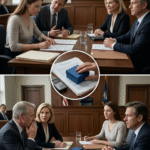
On the final day, I was called to testify about the forged documents and trust structure.
Adrian’s attorney approached gently.
He wanted the jury to see a wealthy wife punishing a self-made husband.
“Mrs. Hartwell Vale,” he began.
“Ms. Hartwell,” I corrected.
He nodded.
“Ms. Hartwell, you possessed the power to remove Mr. Vale from the company at any time, correct?”
“Under specific conditions.”
“But you chose not to disclose your controlling interest to him.”
“The trust documents were available to his counsel during every financing transaction.”
“That was not my question.”
“I did not personally remind him.”
“Why not?”
“Because my ownership did not change his legal obligations.”
The attorney walked closer.
“You allowed him to believe he had greater authority than he did.”
“I allowed him to reveal what he would do when he believed no one could stop him.”
A juror looked down to hide a reaction.
The attorney’s jaw tightened.
“You also allowed the engagement dinner to proceed.”
“You permitted your wedding photographs to be used.”
“Knowing the presentation would embarrass you.”
I folded my hands in my lap.
“Because before that night, everything was deniable.”
“The affair?”
“The affair, the fraud, the cruelty, the conspiracy to portray me as mentally unstable.”
I looked toward the jury.
“Powerful people often survive by making each victim feel isolated.”
“That night, Adrian and Sloane invited every person whose approval they valued.”
“They created the witnesses.”
“I simply changed the presentation.”
The courtroom remained still.
The attorney returned to his table.
He had no more questions.
Adrian was convicted on all major counts.
At sentencing, he stood before the judge and apologized.
He apologized to the company.
To investors.
To employees.
To the court.
Then he turned toward me.
“I am sorry to my former wife,” he said.
“I betrayed a woman who loved me before I had anything.”
The sentence was designed to sound humble.
It was also inaccurate.
Adrian had something when I met him.
Intelligence.
Ambition.
Charm.
A mother who adored him.
A small apartment in Tribeca.
A company with debts but real potential.
He had not been nothing.
That belief had become one of his excuses.
People who think they began with nothing often convince themselves they owe nothing to anyone who helped them rise.
The judge sentenced him to prison and ordered restitution.
As officers led him away, Adrian looked at me once.
There was no anger left.
No strategy.
Only the understanding that I would continue existing beyond the limits of his story.
That was the last thing he lost.
The belief that he had authored me.
After the trial, reporters crowded the courthouse steps.
Questions came from every direction.
“Evelyn, do you feel vindicated?”
“Do you forgive your ex-husband?”
“Will you remain chair of Vale Meridian?”
“Did you plan the ballroom confrontation for publicity?”
I stopped before entering the car.
Snow had begun to fall.
Tiny white pieces settled against the shoulders of my coat.
“I did not win because my former husband went to prison,” I said.
“I won when I stopped asking a dishonest person to confirm the truth I already knew.”
Then I got into the car.
I did not answer another question.
The video spread online before I reached the Blackthorne.
People used the words ruthless, elegant, powerful, and cold.
Cold appeared most often.
I understood why.
A woman who does not collapse in public is often called cold by people who came to watch her burn.
They did not see the nights I slept on the bathroom floor because the bed held too many memories.
They did not see me sit in the nursery we had painted pale green before the miscarriage.
They did not see me press my hand against the empty crib and wonder whether grief had made me foolish.
They did not see Naomi remove every bottle of sleeping medication from the townhouse because she was afraid to leave me alone.
They saw the black dress.
The evidence.
The ownership chart.
They saw the moment my voice did not shake.
Strength is often remembered only after the trembling has ended.
Six months after the trial, the Vale Meridian board asked me to remain permanent chair.
I declined the chief executive position.
Daniel Cho accepted it instead.
He rebuilt the finance department, strengthened reporting protections, and established an independent ethics office.
Vale Meridian recovered the diverted funds through asset sales and insurance.
The merger closed under revised terms.
No buildings were named after Adrian.
At the Blackthorne, I ordered the ballroom restored.
Not renovated.
Restored.
Sloane’s florist removed the silver arch.
The staff polished the marble.
The screen was replaced.
I considered destroying my wedding album.
For weeks, it remained inside a conservation box in the archive.
Then one afternoon, I opened it.
The photographs had not changed.
My father still looked proud.
My mother still cried during the ceremony.
My college friends still danced badly.
I still looked hopeful.
Adrian’s betrayal did not travel backward through time and poison every person in those images.
The woman in the white dress had not been pathetic.
She had not been weak.
She had believed a promise.
There is no shame in believing someone you love.
The shame belongs to the person who learns the value of that trust and spends it carelessly.
I removed three photographs.
One of my father walking me down the aisle.
One of my mother fastening the diamonds around my neck.
One of me standing alone in the conservatory before the ceremony.
In that last photograph, I was not yet a wife.
I was simply Evelyn.
I framed it for my office.
The rest of the album returned to the archive.
Not hidden.
Not displayed.
Preserved.
The past did not need to be worshiped or burned.
It only needed to stop controlling the room.
CONCLUSION
AFTER THE APPLAUSE
One year after the engagement dinner, the Blackthorne Ballroom opened its doors again.
This time, there were no cruel captions.
No engagement announcement.
No men pretending borrowed power belonged to them.
The room hosted the first Hartwell Justice Foundation gala.
We had created the foundation to provide legal assistance to women facing financial abuse, coercive control, workplace retaliation, and identity theft within marriages.
Naomi served as chair.
Daniel funded the first corporate partnership.
Judge Calloway gave the opening speech and ignored every time limit the event planner placed on his notes.
More than six hundred people attended.
Some knew my story.
Most did not.
That was exactly what I wanted.
The foundation was not built to turn my pain into mythology.
It was built so other women could obtain forensic accountants, attorneys, safe housing, and financial counseling before their lives became public entertainment.
Near the end of the evening, I slipped away from the ballroom.
The conservatory was quiet.
Rain tapped gently against the glass ceiling, just as it had on the morning of my wedding.
White roses grew along the far wall.
I had almost ordered them removed.
Instead, I let them remain.
A young woman named Claire found me there.
She was one of the foundation’s first clients.
Her husband had opened loans in her name, emptied their daughter’s college fund, and convinced their friends she was unstable when she asked questions.
With the foundation’s help, she had secured custody, cleared the fraudulent debt, and started working again.
She stood beside me in a dark green dress.
“I watched the video of you at the engagement dinner,” she said.
“I’m sorry.”
“Most people begin conversations by asking about it.”
“I was going to say you looked fearless.”
I smiled.
“I was terrified.”
Claire looked surprised.
“But you didn’t look terrified.”
“That is not the same thing.”
She glanced toward the ballroom.
“I keep waiting to feel powerful.”
“You may be waiting for the wrong feeling.”
“What does power feel like?”
I thought of signatures.
Hospital corridors.
A black dress.
My father’s voice.
The silence after Adrian realized I owned the vote.
“Sometimes it feels like grief with a plan,” I said.
Claire laughed softly.
Then she became serious.
“Do you ever miss him?”
It was a question people rarely asked directly.
They preferred to imagine betrayal erased love instantly.
For a long time, I missed the man Adrian had been when we first met.
Or the man I believed he had been.
I missed Sunday mornings, private jokes, his hand finding mine beneath restaurant tables, and the way he once carried my shoes through Rome after I broke a heel.
I missed a future that never existed.
But missing something does not mean you should return to it.
“I miss who I was before I learned the truth,” I said.
“Not him.”
Music drifted through the doors behind us.
The orchestra had begun the final song.
Claire’s daughter ran into the conservatory wearing a gold dress and light-up sneakers.
She pulled her mother toward the ballroom.
Claire looked back at me.
“Are you coming?”
“In a minute.”
They disappeared through the doors.
I remained beneath the glass ceiling.
For once, being alone did not feel like abandonment.
It felt like ownership.
Not ownership of hotels.
Not shares.
Not companies.
My life.
My silence.
My name.
My next decision.
My father once told me to let a man reveal his character before revealing my leverage.
He was right.
But there was another lesson he never had the chance to teach me.
Leverage can remove a dangerous person from your life.
Evidence can protect your assets.
Contracts can return what was stolen.
None of them can heal you.
Healing arrived differently.
It came when I stopped replaying the night Adrian ignored my calls.
It came when I forgave the woman in the hospital bed for believing his excuse.
It came when I opened the wedding album and felt tenderness for the bride instead of contempt.
It came when I understood that dignity was not the absence of pain.
Dignity was refusing to let pain choose what I became.
Inside the ballroom, people began applauding.
Naomi had probably announced the final fundraising total.
I walked toward the sound.
Before entering, I looked once at the dark glass of the conservatory.
My reflection stood alone beneath the roses.
No husband.
No father.
No diamonds.
No screen explaining who I was.
I did not need one.
Sloane had shown my wedding because she believed the worst thing a woman could be was replaced.
Adrian had watched because he believed my humiliation would make his betrayal look like victory.
They were both wrong.
The worst thing was never losing a man who lied.
The worst thing would have been losing myself while begging him to tell the truth.
I opened the ballroom doors.
Warm light spilled across the marble.
Hundreds of people turned toward me, but the room no longer felt like a courtroom.
It felt like a beginning.
Naomi lifted a glass from the stage.
Claire waved from a table near the dance floor.
Daniel stood beside a group of employees who had survived the scandal and rebuilt the company without the man who claimed it could not exist without him.
I stepped into the light.
No slideshow followed me.
No caption appeared.
The story was mine now.
And this time, I did not need revenge to finish it.
I only needed the truth.
She showed the wedding.
The wife showed the affair.
But the woman who walked away showed everyone what happened after.