He believed shame would make me surrender the marriage, the board, and the company.
He had mistaken grief for weakness.
He had mistaken cruelty for strategy.
When Celeste reached the door, I stopped her.
“The penthouse will be returned to the company.”
Her shoulders sank.
“You will also provide sworn testimony and surrender all claims to the acquisition fund.”
She turned slowly.
“And the baby?”
“I will ensure Daniel cannot use the child to threaten you.”
“Because the child did not steal from me.”
Celeste searched my face.
“Do you forgive me?”
I picked up the genetic report.
“But I am not interested in becoming you.”
PART FOUR — THE GALA WHERE HE LOST HIS NAME
The Ashford Winter Gala had been my father’s favorite event.
Every February, our foundation filled the American Museum of Natural History with candlelight, music, and people who donated large amounts of money to have their names printed on walls.
The gala funded pediatric oncology research.
My father had started it after my mother died of leukemia.
Grant served as honorary chairman for eight years.
He loved the photographs.
He loved entering beneath the blue whale while hundreds of guests turned toward him.
He believed charity was most useful when properly lit.
Three weeks before the gala, his lawyers sent a demand.
Grant wanted his suspension lifted, his company access restored, and the separation negotiations kept confidential.
In exchange, he would not challenge my control of the trust.
It was a generous offer from a man bargaining with property he did not own.
Naomi drafted a two-word response.
We declined.
The next morning, Grant filed suit.
He claimed my father had manipulated the corporate structure to deprive him of his rightful ownership.
He claimed I had exploited his “brief extramarital relationship” to seize the company.
He requested an emergency injunction.
The hearing was scheduled two days before the gala.
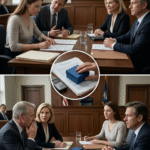
The courtroom in Lower Manhattan lacked the glamour of the opera.
Fluorescent light flattened everyone equally.
Grant arrived with Charles and four attorneys.
He wore a navy suit, a sober tie, and the expression of a man who expected the law to recognize him from magazine covers.
I arrived with Naomi, Samuel, and three binders.
Celeste was not present.
Daniel Mercer had been arrested at JFK the previous evening while attempting to board a flight to Zurich.
Federal agents had found two phones, six hundred thousand dollars in bearer bonds, and a passport issued under another name.
By sunrise, he was negotiating.
That news reached Grant five minutes before the judge entered.
I watched him read it on his attorney’s phone.
His face became still.
Naomi presented the trust documents.
She presented the conversion clause.
She presented Grant’s signature.
Then she presented emails in which Grant discussed moving money, concealing the penthouse, and replacing board members after launching the competing company.
Grant’s attorney argued that the messages had been taken out of context.
Naomi provided the context.
It was worse.
The judge denied the injunction.
He also referred several matters to the appropriate regulatory agencies.
Outside the courthouse, cameras waited behind metal barricades.
Grant stopped beside me on the steps.
For one strange second, we stood as we had on our wedding day, shoulder to shoulder before an audience.
Only the flowers were gone.
“You’ve made me a criminal,” he said under his breath.
I looked toward the cameras.
“I stopped making you look innocent.”
“Celeste gave you the files.”
I did not answer.
He stepped closer.
“She’s lying about Daniel.”
“Which part?”
“All of it.”
“You should ask for a paternity test.”
His face changed.
That was how I learned Celeste had not told him.
“What did you say?”
I met his eyes.
“Ask for the test, Grant.”
Cameras clicked.
Then I walked down the steps.
The gala took place forty-eight hours later.
The museum’s great hall shimmered with gold light and winter branches.
Women in black gowns moved beneath towering dinosaur skeletons.
A string quartet played near the marble staircase.
White orchids floated in glass bowls across long tables.
My father’s name appeared on the program.
Grant’s did not.
He came anyway.
His invitation had been canceled, but Charles was still a foundation donor and brought him as a guest.
That was a mistake.
Men who cannot enter a room as kings often come as witnesses to prove the room still needs them.
I stood near the entrance greeting guests in a silver silk gown.
At my throat, I wore my mother’s emerald pendant.
The black scarf remained at home.
Some grief deserved privacy.
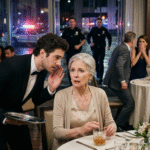
Grant approached at nine fifteen.
Conversations softened around us.
He looked thinner.
His hair was cut too recently.
The left sleeve of his tuxedo showed the faint fold of hotel pressing.
“Eleanor.”
“Grant.”
“You look well.”
We both knew that was false.
Charles hovered several feet away.
His expression carried the exhausted contempt of a patriarch discovering that money could not restore obedience.
Grant glanced toward the donors.
“Can we speak privately?”
His jaw tightened.
“You have destroyed my reputation.”
“You filed a public lawsuit.”
“You forced me to.”
“I did not force you to steal.”
“Celeste says the baby isn’t mine.”
Not grief.
Not heartbreak.
Disbelief that he had been made ridiculous.
“I suggested you verify.”
“She claims Daniel manipulated everything.”
“She claims many things.”
“You believe her over me?”
I looked at him for several seconds.
“I believe documents over both of you.”
Grant’s eyes moved across my face.
For the first time, he seemed to understand that there was no emotional door left open.
Not anger.
Not longing.
Not even hatred.
He had become a case file.
“I loved you,” he said.
The words landed without weight.
“You loved being loved by me.”
“That isn’t fair.”
“Fairness ended in my dressing room.”
Music rose beneath the museum ceiling.
Grant looked toward the whale suspended above us.
Its enormous skeleton floated through blue light, ancient and impossible.
“I made one mistake,” he said.
I kept my voice soft.
“You made hundreds of decisions and expected me to call them one mistake because they all served the same desire.”
“What desire?”
“To discover how much you could take before I stopped being useful.”
He looked away.
At the far end of the hall, the foundation’s director stepped toward the microphone.
Dinner was about to begin.
Grant leaned closer.
“I can still help you contain this.”
I almost admired his persistence.
“You no longer have access to the company.”
“I have relationships.”
“You have subpoenas.”
His face hardened.
“You think these people respect you?”
He gestured subtly toward the room.
“They respect your name and your money.”
I smiled faintly.
“And unlike you, I know the difference.”
The foundation director called guests to their seats.
I turned to leave.
Grant caught my wrist.
It was not violent.
It was familiar.
The same hand that had steadied me at my father’s grave now tried to stop me from walking away from him.
Security moved immediately.
I lifted one finger, and they paused.
Grant looked at my wrist in his hand.
Then he released me.
“I want to come home,” he said.
The sentence was quiet.
Almost lost beneath the music.
“Which home?”
He did not answer.
“The townhouse belongs to me,” I continued.
“The Hamptons house belongs to my mother’s trust.”
“The Aspen property belongs to the foundation.”
“The apartment you bought for Celeste belongs to the company.”
I stepped closer so only he could hear.
“You spent eleven years calling every room yours because I allowed you to stand in it.”
His face broke then.
Not dramatically.
A small collapse around the eyes.
He finally understood that he had not merely lost a wife.
He had lost the architecture that made his life appear self-made.
“I have nowhere to go,” he whispered.
I thought of my father’s hospital room.
The rain at the cemetery.
The empty chair beside me while Grant watched a fashion show in Paris with another woman.
“You had a home,” I said.
“You used it as evidence against yourself.”
Then I walked to the stage.
The room settled as I approached the microphone.
Hundreds of faces turned toward me.
For years, Grant had delivered the opening speech.
He enjoyed pausing for applause.
I looked at the hospital families seated near the front.
Children in formal clothes sat beside exhausted parents.
Behind them were doctors, researchers, donors, and nurses.
This was not the place for scandal.
It was the place for purpose.
“My father believed wealth was only honorable when it survived its owner,” I began.
The hall became still.
“He also believed grief could become either a monument or a doorway.”
I looked toward the great blue whale suspended overhead.
“For a long time, I thought preserving what we loved meant protecting it from change.”
My voice did not shake.
“But preservation is not the same as silence.”
Several board members watched me closely.
Grant stood at the back of the room beside his father.
“This year, the Ashford Foundation is committing one hundred million dollars to expand family housing and experimental treatment access at four pediatric cancer centers.”
A breath moved through the hall.
It was the largest grant in the foundation’s history.
The donation would be funded partly through the recovery of misappropriated assets from the abandoned surgical-center acquisition.
Money Grant and Celeste had tried to steal would now pay for hospital rooms where parents could sleep beside sick children.
Applause rose slowly.
Then all at once.
People stood.
I did not look at Grant.
The night no longer belonged to him.
After dinner, federal agents entered through the west doors.
They did not rush.
They did not need to.
Daniel’s cooperation had produced an indictment, and Grant’s signatures appeared on enough documents to support charges of wire fraud, conspiracy, and breach of fiduciary duty.
The agents approached him beneath the suspended bones of an extinct animal.
Even then, Grant looked toward me.
He expected intervention.
Perhaps he remembered the years I had corrected his mistakes before anyone saw them.
Perhaps he believed marriage was an endless form of rescue.
I held his gaze.
Then I turned back to the family seated beside me and asked their daughter about the silver stars on her shoes.
Grant was escorted out without handcuffs.
The cameras outside captured everything.
By morning, the photograph had appeared across the country.
The headline read:
VALE MERIDIAN FOUNDER ARRESTED AT GALA HOSTED BY ESTRANGED WIFE.
The company issued a correction within the hour.
Grant was not the founder.
He had merely been the former chief executive.
PART FIVE — THE ROOM THAT KEPT MY NAME
The criminal case lasted eleven months.
Grant pleaded guilty to conspiracy and misuse of corporate funds in exchange for reduced charges.
Daniel received a longer sentence.
Celeste cooperated fully and avoided prison, though she surrendered the penthouse, the jewelry, the art, and every dollar linked to the scheme.
She gave birth to a daughter in a private hospital room overlooking the East River.
The child was named Lily.
I learned the name from a legal filing.
For one strange moment, I thought of the lilies at my father’s grave.
Life has an unsettling habit of reusing symbols without asking permission.
Daniel contested paternity until a court-ordered test confirmed it.
His wife filed for divorce.
His adult sons refused public comment.
Celeste moved back to Ohio for six months, then returned to New York under her maiden name.
She did not work in finance again.
People asked whether I had ruined her career.
I had not.
Consequences are not the same as revenge.
Grant and I settled our divorce before his sentencing.
The dissipation clause required him to reimburse the marital estate for every asset spent on Celeste.
His remaining interest in Vale Meridian was transferred to satisfy part of that obligation.
He kept a modest investment account, several family heirlooms, and the vintage Porsche he loved more faithfully than he had loved most people.
He also asked for the black silk scarf.
That request arrived through his attorney.
Naomi read it aloud in her office, then looked over the page.
“Is he insane?”
“Possibly.”
“He says it represents a significant memory from the marriage.”
“It represents my father’s funeral.”
She set down the letter.
“Do you want me to respond?”
“What should I say?”