Just patterns.
Bank statements.
A calendar.
A hotel folio from The Langham Chicago that listed two robes, one bottle of Sancerre, and room service for two on a night Ethan claimed he was at an airport.
Vanessa had not asked if I was sure.
Good attorneys don’t insult women with that question.
She had spread the documents across her desk and said, “You don’t have to decide today. But you do need to protect yourself before he decides for you.”
So I had.
Quietly.
While Ethan thought I was attending Pilates and school committee meetings, I was learning the shape of my own life on paper.
The house on Willowmere Lane was not his.
That was the first thing Vanessa found.
Ethan had let everyone believe it was a Whitmore property because his family name opened doors in Connecticut. But the deed was held by Harrow Lane Trust, created by my grandmother before she died. I had forgotten the exact details because Ethan had always treated family finances like weather: complicated, boring, and best handled by men in suits.
But Harrow Lane Trust named me sole beneficiary.
Not Ethan.
Not the Whitmore family.
Not any future “Mrs. Whitmore.”
Me.
The second thing Vanessa found was worse.
Six years into our marriage, when Ethan’s father was still alive, the Whitmore Group had needed emergency liquidity to close on a luxury hotel in Charleston. Ethan had come to me at midnight, pale and desperate, saying the deal would collapse and his father would never trust him again. I signed a limited collateral agreement using part of my inheritance as security.
But Ethan had hidden what came after.
The company had used that agreement to secure further credit lines. My assets had stabilized their expansion. My family money had protected their empire.
And over the years, they had repaid themselves generously while quietly treating me like decorative furniture at galas.
Vanessa had uncovered emails.
Minutes from board meetings.
Internal memos referring to me as “the trust guarantor.”
Not wife.
Not partner.
Guarantor.
The third thing Vanessa found was the most personal.
Our prenuptial agreement, which Ethan’s father had insisted on, included an infidelity clause so humiliatingly strict that at twenty-six I had cried after signing it. At the time, Ethan had sworn it was meaningless. “My dad is old-school,” he had said. “We’ll never need it.”
The clause stated that if either spouse engaged in a documented extramarital affair that caused reputational harm to the family or children, the offending spouse forfeited claims to certain jointly held assets, triggered accelerated trust protections, and agreed to a custody schedule weighted toward the non-offending parent if public conduct could be shown to affect the children’s emotional well-being.
The Whitmore men had built a cage for the imaginary woman they feared I might become.
They never imagined Ethan would be the one locked inside it.
By noon that day, Vanessa had the gift shop invoice, screenshots of Sloane’s champagne post, a sworn statement from the delivery driver, and the photo Mrs. Callahan had taken from across the street.
“I wasn’t spying,” Mrs. Callahan said when I called her.
“I know.”
“I just thought you might need proof someday.”
Her voice softened.
“My daughter needed proof once. She didn’t have it.”
I thanked her and cried only after the call ended.
Not because of the sign.
Because sometimes a stranger can show more loyalty than the man who promised God he would honor you.
That afternoon, Ethan did not come home for dinner.
He texted at 7:12 p.m.
Need space tonight. Don’t make this harder than it has to be.
I did not answer.
At 8:03, another message appeared.
Sloane feels terrible.
That one made me stare.
Not because it hurt more.
Because he still believed her feelings belonged in my hands.
I typed one sentence.
Tell Sloane not to put her name on my property again.
He did not reply.
The next week moved like a knife under silk.
Ethan came home late and left early. He stopped pretending his phone was for work. Sometimes he answered calls in the foyer, speaking low, saying things like, “Not now” and “Claire is being difficult” and “My attorney says we should keep everything civilized.”
Civilized.
Another word people use when they want the injured person to bleed quietly.
Then the invitation arrived.
White card stock. Embossed silver letters.
The Whitmore Group invites you to celebrate the grand reopening of The Halston Hotel, Manhattan.
Beneath that:
Hosted by Ethan Whitmore and the Whitmore Family Foundation.
And there, handwritten across the bottom in Sloane’s looping script:
Claire, I hope you’ll come. It would mean so much to Ethan for this transition to look graceful. —S
I read it twice.
Then I laughed.
It startled me.
I had not laughed like that in weeks.
Sloane did not just want my husband.
She wanted my chair at the table.
She wanted my silence served chilled beside the champagne.
The Halston Hotel had once been the pride of the Whitmore portfolio, a Beaux-Arts landmark near Bryant Park with crystal chandeliers, imported marble floors, and suites that cost more per night than some people’s rent. The reopening gala would bring donors, investors, influencers, board members, and half the social circle that had watched me smile beside Ethan for fourteen years.
It would be the perfect place to humiliate me.
It would also be the perfect place to end things.
I called Vanessa.
“She invited me,” I said.
“I assumed she would.”
“You did?”
“Mistresses who think they’re becoming wives usually want witnesses.”
I looked at the invitation on my desk.
“Should I go?”
Vanessa’s voice remained calm. “Legally? Yes. Emotionally? Only if you can stay exactly who you are.”
I looked down at my hands.
No shaking.
Not anymore.
“I can.”
“Good. Wear something simple.”
“Why?”
“Because people remember elegance when everyone else is making noise.”
On the evening of the gala, I wore black.
Not mourning black.
War black.
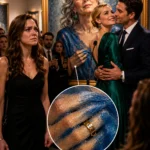
A floor-length column gown with long sleeves, a high neck, and no jewelry except my wedding ring.
One last time.
Lily watched from my bedroom doorway.
“You look like a queen,” she said.
I turned.
Her face was pale.
“Are you and Dad getting divorced?”
The question had been living in the room for days.
I sat on the edge of the bed and held out my hand. She came to me, suddenly small again.
“I don’t know all the details yet,” I said carefully. “But I know this. You and Owen are safe. You are loved. And none of this is your fault.”
“Is he going to marry her?”
Pain moved through me, but I did not let it reach my voice.
“Adults sometimes make choices that hurt people. But his choices do not decide your worth. Or mine.”
Lily leaned against me.
“I hate her.”
I closed my eyes.
“You’re allowed to be angry,” I said. “But don’t let her teach you how to become cruel.”
She nodded into my shoulder.
At the door, Owen appeared in dinosaur pajamas.
“Mom?”
“Yes, sweetheart?”
“Can you tell Dad not to let Sloane take my room?”
I held both my children then.
I held them until the black dress wrinkled, until my makeup had to be fixed, until the car waiting outside called twice.
Then I kissed them goodbye and went to Manhattan.
The Halston glowed like a palace when I arrived.
Photographers stood behind velvet ropes. Women shimmered in satin and diamonds. Men in tuxedos checked their phones with the bored confidence of people whose mistakes were usually cleaned up by assistants.
The moment I stepped out of the car, conversation shifted.
People always pretend not to stare.
But silence has a sound.
I walked into it.
Inside the ballroom, two hundred guests stood beneath chandeliers spilling light over white orchids and gold-rimmed champagne towers. A jazz trio played near the balcony. The Whitmore family crest had been projected onto one wall, large enough to remind everyone who owned the evening.
At least, who thought they did.
I saw Ethan near the stage.
And beside him, wearing ivory.
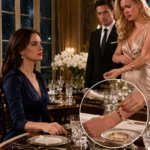
Sloane Pierce had chosen an ivory silk gown with a plunging neckline and a diamond tennis bracelet I recognized immediately.
My tenth-anniversary bracelet.
The one Ethan said was being reset because the clasp had broken.
Sloane saw me noticing it.
She smiled.
Then she lifted her champagne flute and gave me a tiny toast across the room.
That was the moment I understood something important.
She did not just want to replace me.
She wanted me to watch.
Chapter 3: The Gala Where the Mistress Took My Seat
Margot Ellison intercepted me before I reached the bar.
“Claire,” she breathed, kissing the air beside my cheek. “You are so brave.”
Brave.
Like I had survived a flood.
Like I had not walked into a room built partly with my own money.
“Thank you, Margot.”
“I mean it. Most women would hide.”
“Most women are underestimated.”
She blinked, uncertain whether to laugh.
I moved past her.
Across the ballroom, Ethan had seen me.
His face changed—not enough for anyone else to notice, but I had spent fourteen years reading him across crowded rooms. He was surprised. Nervous. Angry.
Sloane leaned toward him and whispered something. He didn’t smile.
Better.
I accepted a glass of sparkling water from a server and stood near one of the marble columns. From there, I could see everything: the stage, the board table, the entrance, the private doors leading to the executive salon.
Vanessa was not in the ballroom.
But she was in the building.
So were two representatives from First Atlantic Bank.
So was a family court mediator.
So was Daniel Hart, the Whitmore Group’s outside counsel, who had once called me “sweetheart” at a Christmas party and tonight would learn the cost of condescension.
The first hour passed in satin cruelty.
People came to me softly, gently, with sympathetic eyes and empty mouths.
“How are the kids?”
“You look beautiful.”
“Ethan has been under such pressure.”
That last one came from his mother, Evelyn Whitmore.
She wore silver lace, pearls, and the expression of a woman who believed family scandal was more vulgar than family betrayal.
“Claire,” she said, touching my arm. “I’m glad you came.”
“I was invited.”
Her smile tightened. “Yes. Sloane thought it would be healing.”
I looked at the diamond bracelet on Sloane’s wrist across the room.
“How thoughtful.”
Evelyn lowered her voice. “This does not need to become ugly.”
“No,” I agreed. “It doesn’t.”
“The children need stability.”
“They have it.”
Her eyes sharpened. “Ethan is their father.”
“I’ve never forgotten that.”
“Good. Because men make mistakes. Women hold families together.”
I looked at her for a long second.
The entire architecture of her world in two sentences.
Men wander. Women absorb.
Men damage. Women decorate the damage.
Men return when tired. Women thank them for coming home.
I gently removed her hand from my arm.
“Evelyn, I have held this family together for fourteen years. I’m done confusing endurance with love.”
Her face paled.
Before she could respond, Sloane appeared.
Up close, she was flawless in a way that felt rehearsed. Smooth blonde waves. Soft pink mouth. Skin glowing under the chandelier light. She smelled like gardenias and money that had recently become accessible.
“Claire,” she said.
Her eyes flicked to my black dress. “That’s a very dramatic color.”
“It photographs well.”
Her smile twitched.
Evelyn looked between us, suddenly eager to disappear. “I should greet the mayor.”
She left.
Sloane stepped closer.
“I’m really glad you came,” she said.
“I’m sure you are.”
Her voice dropped, sweet enough to rot teeth. “I know the sign must have upset you.”
“The sign educated me.”
She laughed softly. “Ethan said you’d make it sound poetic.”
“Ethan says many things when he needs an audience.”
Her eyes hardened for half a second.
Then she lifted her wrist, letting the bracelet catch the light.
“You have lovely taste,” she said.
I looked at it.
Then at her.
“That bracelet belonged to me.”
She tilted her head. “Ethan said you weren’t wearing it anymore.”
“He said it was being repaired.”
Sloane’s smile widened. “Maybe he meant some things can’t be repaired.”
The cruelty was clean.
Practiced.
I thought of Lily asking whether Sloane would take Owen’s room.
I thought of Owen staring at that wooden sign.