“Mom?” she said.
“Yes, love?”
“Do I have to go?”
I wanted to say no. I wanted to take her to Aspen, or Santa Fe, or anywhere people did not know her father’s name.
But children needed steadiness when adults detonated their world.
“You don’t have to talk to anyone,” I said. “You don’t have to explain anything. You just have to remember who you are.”
Her mouth trembled. “Who am I?”
I knelt.
“You are Lily Anne Whitmore. You are kind. You are loved. And no one else’s bad behavior changes your worth.”
She nodded, but she was nine, and nine-year-olds still believed fathers were supposed to show up.
At Grayson Academy, the parking circle was full of Range Rovers and quiet judgment.
Mothers in designer coats looked away too quickly. One father gave me a pitying smile so rehearsed I almost admired it.
Then Serena appeared.
Of course she did.
She stepped out of a white Bentley that did not belong to her. Grant’s white Bentley.
Ava hopped out behind her, holding a pink backpack with a gold monogram.
A.H.
Ava Hawthorne.
My stomach tightened, but my face did not change.
Serena saw me and approached with the bright cruelty of a woman who needed witnesses.
“Claire,” she said. “You left so early last night. I hope Lily wasn’t too upset.”
Lily’s grip tightened around my hand.
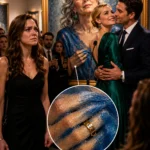
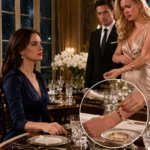
I looked at Serena’s mouth, her earrings, the diamond tennis bracelet on her wrist.
My diamond tennis bracelet.
A gift Grant had given me after Lily was born. I had not worn it in years.
Serena lifted her wrist slightly so I would see.
“She’s a child,” I said. “So I protect her from adult ugliness whenever possible.”
Serena laughed softly. “That sounds exhausting. Always protecting. Always managing. Maybe that’s why Grant feels like he can breathe around me.”
There it was.
The mistress’s favorite fantasy: that she was oxygen, not smoke.
Lily stared at the bracelet.
“Mom,” she whispered, “isn’t that yours?”
Serena’s smile flickered.
I squeezed Lily’s hand.
“It used to be,” I said.
Serena tilted her head. “Grant told me you didn’t care about things like that.”
“I don’t,” I replied. “I care about what people reveal when they take them.”
Her eyes hardened.
She leaned closer, lowering her voice.
“You know what your problem is, Claire? You think because your name is on buildings, people should stay. But men don’t fall in love with trust funds. They fall in love with women who make them feel alive.”
I looked at her for a long moment.
Then I said, “Is that what he told you?”
Her face flushed.
Grant had probably told her many things.
That I was cold. That our marriage was dead. That I did not understand him. That we were separated in every way that mattered. That the money was his as much as mine. That Lily would adjust. That society would accept Serena because Grant Whitmore always landed on his feet.
Men like Grant never cheated with the truth.
They cheated with edited versions of themselves.
A teacher opened the school doors.
Children began moving inside.
I kissed Lily’s forehead.
“I’ll be here at three.”
She nodded, then paused. “Mom?”
“Yes?”
“Don’t let her take our name.”
It took everything in me not to break.
“I won’t,” I said.
Serena heard.
Her smile returned.
“Oh, sweetheart,” she said to Lily, “names are just words. Family is who shows up.”
I turned toward her fully.
For the first time that morning, my voice cooled.
“Then you should be careful standing next to a man who missed his own daughter’s birthday.”
The parents nearby went silent.
Serena’s lips parted.
I walked away before she could answer.
By the time I reached my car, my phone buzzed.
Grant.
I let it ring.
Then a text came.
What did you say to Serena at school? She’s upset.
I stared at the message until the absurdity became almost peaceful.
His mistress was upset.
Not his daughter.
Not his wife.
His mistress.
I forwarded the text to Evelyn.
She replied within seconds.
Good. Let him keep writing.
Chapter 3: The Silence Before the Papers
People think betrayal begins with lipstick on a collar or perfume in a car.
It does not.
Betrayal begins in the tiny rearrangements of loyalty.
A phone turned facedown.
A story that arrives too smoothly.
A husband who starts calling your standards “control.”
A woman who asks about your daughter’s schedule with too much interest.
Looking back, Serena had been entering my life for almost a year.
She first appeared at a foundation luncheon in a pale blue dress, laughing at Grant’s jokes like he had invented wit. She introduced herself as a brand strategist and single mother who cared deeply about children’s literacy because “stories saved her life.”
I liked her at first.
That is the part that still embarrassed me.
I invited her onto a volunteer committee. I approved her proposal for a social media campaign. I even sent Ava a birthday gift the previous year when Serena mentioned, with practiced sadness, that Ava’s father was not involved.
Grant had praised my generosity that night.
“You’re a better person than most people in this world, Claire,” he had said, kissing my temple.
Now I wondered whether he had gone to her afterward and laughed at me.
Evelyn told me not to wonder.
“Wondering is emotional quicksand,” she said. “Documents are pavement.”
We met at Brooks & Madden on the thirty-second floor of the Halcyon Tower downtown. Evelyn’s office had glass walls, a view of the mountains, and no family photos. She believed sentiment belonged in the heart, not on a desk where opposing counsel could study it.
She was sixty-one, silver-haired, and terrifying in beige.
When I arrived, she slid a stack of folders toward me.
“Before we discuss divorce,” she said, “we discuss control.”
“I don’t want a war.”
“No one intelligent wants a war. But when one arrives at your front door wearing your bracelet, you do not answer in pajamas.”
I almost smiled.
She opened the first folder.
“Your prenuptial agreement is unusually strong. Your grandfather insisted on three clauses that Grant’s attorney hated.”
“My grandfather never trusted charm.”
“He was correct.” Evelyn tapped the page. “Infidelity does not financially punish him by itself. Colorado courts do not care who was morally ugly unless it affects assets or children. However, the agreement includes a misconduct clause tied to misuse of Hawthorne-controlled entities.”
“The foundation charges.”
“Yes. Also Hawthorne Ridge Development expenses, family office reimbursements, and one corporate card issued for donor relations.”
My pulse slowed.
The more she spoke, the calmer I became.
Not because it hurt less.
Because shape was forming around the pain.
Evelyn continued, “Grant has authorized approximately $384,000 in expenses benefiting Serena Vale or her child over fourteen months.”
I stared at her.
“Fourteen months?”
Not one drunken mistake.
Not a midlife crisis that began last week.
Fourteen months of hotel rooms, tuition payments, gifts, dinners, flights, medical memberships, and lies.
Fourteen months while he came home and asked Lily about math homework.
Fourteen months while I sat beside him at donor dinners.
Fourteen months while Serena smiled at me over salads and told me she admired my marriage.
Evelyn’s voice softened by half an inch. “Claire.”
“You can feel later. Right now, you need to decide how much truth you want.”
“All of it.”
She nodded once.
The second folder contained photographs.
Grant and Serena entering The Crawford Hotel.
Grant carrying Ava through a pumpkin patch in Boulder.
Grant at Belle Sucre Bakery, signing the receipt.
Grant kissing Serena in the parking garage beneath Rosegate Pediatrics.
Then one photo stopped me cold.
Grant, Serena, and Ava standing outside Grayson Academy.
Serena was holding paperwork.
Grant had his arm around her shoulders.
The file name read:
Admissions Visit — Ava Vale Hawthorne Sponsorship Interview.
“Hawthorne?” I asked.
Evelyn’s expression turned sharp.
“Serena submitted Ava’s school application under the name Ava Vale Hawthorne. She listed Grant as her educational sponsor and stated that Ava was being considered for inclusion in a Hawthorne family guardianship plan.”
I could hear my own heartbeat.
“A what?”
“Not legally valid. But persuasive enough for a private school admissions office impressed by donors. Grant signed a letter on Hawthorne Foundation letterhead.”
My hand flattened on the table.
For the first time, anger rose bright and clean.
Not loud.
Not messy.
A white flame.
“He used my grandmother’s foundation letterhead to get his mistress’s daughter into Lily’s school under my family name?”
“Does the board know?”
“Does Serena know it’s illegal?”
“She knows enough to be nervous. Which means she knows enough.”
I sat back.
Outside the window, Denver glittered beneath a hard blue sky.
When I married Grant, he had no family money. That had never mattered to me. I thought ambition was admirable when it came with humility. I thought his hunger meant he understood the value of things.
For years, I watched him become polished.
Better suits. Better watches. Better posture in front of donors.
He learned which wines to order and which names to drop. He learned that old money rarely raises its voice. He learned that my family’s silence could be mistaken for permission.