“That answer has not served you well.”
He looked toward the chair.
I remained standing.
“My mother named me Jonah.”
“You knew.”
“You called me Jack.”
“Evelyn chose that name.”
“So you honored the kidnapper.”
“I honored the name you knew.”
“You stayed close to me for thirty-six years.”
“At first, guilt.”
“And later?”
“Love.”
The word angered me.
“Do not use love as a clean cloth.”
“I am not cleaning anything.”
He looked at his hands.
“I came to Nashville in 1989 because I heard you had opened the garage.”
“I planned to tell you who I was.”
“You did not.”
“You were twenty.”
“You were proud, angry, and suspicious of everyone.”
“Sounds familiar.”
A weak smile touched his mouth.
“I thought I would earn your trust first.”
“Then Anna was born.”
“And you helped take her.”
His smile disappeared.
“Evelyn said Mara would be moved overseas if I refused.”
“She showed me documents.”
“I believed her.”
“You always believed the lie that required less courage.”
There was no defense left to strike.
Outside, rainwater moved along the hospital windows in thin lines.
“Did you know Lillian?”
“I loved her.”
“Then why stay with Evelyn?”
“Fear.”
“Of what?”
“Scandal.”
“Poverty.”
“Your grandparents.”
“My own weakness.”
“I can give you a longer answer if you want one, but it will not become a better answer.”
“Did Lillian forgive you?”
“Did you ask?”
“What did she say?”
“She said forgiveness was not a receipt I could demand because I had finally paid attention to the debt.”
I looked toward the window.
“She sounds like Kate.”
“She would have liked Kate.”
“You met her?”
“Twice after you were grown.”
“Did she see me?”
“From a distance.”
The old anger returned.
“You people enjoyed watching children from a distance.”
He accepted that.
“She was afraid Evelyn would hurt you.”
“And you agreed.”
“I had seen what Evelyn could do.”
“None of you understood that silence was what made her powerful.”
“We understood too late.”
I leaned forward.
“Why did Vale say I should have drowned in 1972?”
Preacher’s face tightened.
“That was when I tried to take you back to Lillian.”
“I put you in my car.”
“You were asleep.”
“Evelyn followed us to the bridge near Ashland City.”
“She forced us off the road.”
“The car went into the river.”
A fragment of memory stirred.
Dark water against glass.
A man’s hand pushing me upward.
A woman screaming from the bank.
“I remember a red light,” I said.
“The brake lights stayed on underwater.”
“You got me out.”
“Then what?”
“Evelyn told police I had kidnapped you.”
“She said I was drunk.”
“Harlan Vale helped prepare the charges.”
“He was young, ambitious, and already useful to her.”
“You disappeared.”
“I believed prison would leave you alone with Evelyn permanently.”
“So you left me alone with her voluntarily.”
His eyes closed.
“My name is still Jack.”
I surprised myself by saying it.
Preacher opened his eyes.
“Lillian named me Jonah.”
“Evelyn named me Jack.”
“Kate loved Jack.”
“Mara found Jack.”
“Rose will know Jack.”
“I will not let either woman erase the other.”
Preacher nodded.
“That is wiser than anything I deserve to hear.”
I walked to the door.
“Do you forgive me?” he asked.
I looked back.
His face fell.
“Not yet,” I said.
“That is not the same as never.”
Two weeks later, Mara and Rose moved into the apartment above the garage.
The arrangement was supposed to be temporary.
Temporary became a crib near the window, bottles in the refrigerator, and tiny socks mixed with my work rags in the laundry.
Rose woke every three hours.
Atlas woke before she cried.
He slept beside the crib and lifted his head at the slightest movement.
Mara had trained him for search and rescue after adopting him from a police kennel.
He had been retired because of arthritis.
He did not seem aware of retirement.
One night, I found Mara sitting alone in the garage.
Rose slept upstairs.
Atlas lay between us.
Mara held Kate’s unopened letter.
“I am afraid to read it,” she said.
“That makes sense.”
“I waited my whole life to know who my mother was.”
“Now you do.”
She looked at the envelope.
“Now I know what was taken from us.”
I sat beside her on the workbench.
“When Kate became sick, she stopped talking about the future.”
“I thought she was protecting me.”
“Maybe she was tired of futures being taken.”
Mara turned the envelope over.
“Will you read it with me?”
“It belongs to you.”
“That is why I am asking.”
She opened the letter.
Kate’s handwriting filled six pages.
Mara read aloud.
“My dear Anna, although I know you as Mara.”
“Both names are yours, and no one has the right to make you choose between them.”
Her eyes filled.
I placed one hand over hers.
She continued.
“I have watched you grow from far away.”
“I saw you win a spelling contest when you were nine.”
“I saw you break your arm at twelve.”
“I saw you refuse to leave a lost dog outside a grocery store until someone came for him.”
Mara looked down at Atlas.
“I remember that dog.”
Kate’s letter continued.
“You were brave before anyone had the right to ask bravery from you.”
“I want you to know your father is not the man they described.”
“He is stubborn, loud, impatient, and far too proud of repairing things other people have given up on.”
Despite her tears, Mara laughed.
“That sounds accurate.”
“Your mother was observant.”
“He believes he failed you, but he was never given the chance.”
“If you find him, do not let his guilt become another person who steals time from you.”
Mara’s voice weakened.
“Tell him I loved him.”
“Tell him the worst night of our lives was not the whole story of our marriage.”
“Tell him I was happy.”
I lowered my head.
For years, I had remembered Kate through suffering.
The hospital.
The empty nursery.
The chemotherapy chair.
Her final breath.
I had reduced the woman I loved to the pain I could not escape.
She had been more than that.
She had danced barefoot in the kitchen.
She had cheated at cards.
She had sung loudly and badly during road trips.
She had once painted the bathroom orange because a magazine called it sunrise clay, then admitted it looked like soup.
**She had been happy.**
Grief had hidden that truth because grief is jealous of every memory that does not belong to it.
Mara reached the final lines.
“If Rose ever reads this, then perhaps the world became kinder than the one I knew.”
“Teach her that blood is history, not destiny.”
“Teach her that mercy without consent is control.”
“And teach her that love is not proven by what we take from people.”
“It is proven by what we return.”
Mara folded the letter.
For a long time, we sat without speaking.
Then Rose cried upstairs.
Atlas stood.
Mara wiped her face.
“Your turn,” she said.
“My turn?”
“You are her grandfather.”
“I repaired a transmission until two in the morning.”
“Rose does not respect shop hours.”
Atlas started toward the stairs.
I followed him.
Rose stopped crying when I lifted her.
Her eyes were dark and unfocused.
She wrapped one tiny hand around my finger.
I had held thousands of tools in my life.
Wrenches, hammers, cutting torches, air guns, and engine blocks.
Nothing had ever made my hands feel as powerful or as frightened as that child’s grip.
“Your name is Rose,” I whispered.
“Your mother is Mara and Anna.”
“My name is Jack and Jonah.”
“Your family has too many names because too many people thought names meant ownership.”
She yawned.
“You do not have to understand tonight.”
Atlas lay beside the rocking chair.
“Neither do I.”
The trials began the following spring.
Harlan Vale accepted a plea agreement after Rusk provided recordings, bank records, and the locations of hidden files.
Evelyn refused every offer.
She insisted on testifying.
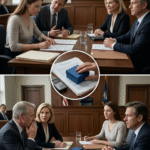
The courtroom filled with people whose names had appeared in the Mercy Ledger.
Some carried photographs of birth mothers.
Some carried photographs of adoptive parents.
Some carried nothing because they had no idea which grief belonged in their hands.
Evelyn entered wearing white.
She looked at me once.
Then she looked at Rose.
Mara held the baby close.
The prosecutor asked Evelyn whether she had altered birth records.
“Did you tell biological parents their children had died?”
“Did you accept money from adoptive families?”
“The foundation accepted donations.”
“Did you determine which parents were unfit?”
“Someone had to.”
“Under what legal authority?”
“Under moral authority.”
A murmur moved through the courtroom.
The prosecutor held up Lillian’s photograph.
“Was this woman unfit?”
Evelyn looked at the image.
“She was alone.”
“That was not my question.”
“She sang in bars.”
“She slept with a married man.”
Preacher sat behind me.
His breathing changed.
The prosecutor stepped closer.
“Did she love her child?”
Evelyn’s face tightened.
“Did Katherine Mercer love her child?”
“Did Jack Mercer love his child?”
Evelyn looked at me.
“Then what exactly were you saving these children from?”
For the first time, Evelyn had no answer.
The silence lasted eleven seconds.
I counted each one.
It was the longest silence she had ever been forced to inhabit.
The jury found her guilty on every major count.
She received a sentence that ensured she would die in custody.
As officers led her away, she asked to speak to me.
Ortiz objected.
I agreed.
We met in a holding room separated by thick glass.
Evelyn lifted the telephone.
I did the same.
“You let them make me a monster,” she said.
“I told them what you did.”
“You told them what they could understand.”
“What part did they miss?”
“I loved you.”
She looked startled.
“I believe you loved me.”
“Then you understand.”
“Love does not erase harm.”
“Love is not permission.”
Her hand tightened around the receiver.
“I saved you from poverty.”
“You stole me from a mother who wanted me.”
“I gave you everything.”
“You gave me what you chose.”
“What would you have done without me?”
“That frightens you.”
She leaned closer to the glass.
“Then admit I may have been right.”
“Because my uncertainty does not make your theft holy.”
Her face hardened.
“You are ungrateful.”
“I am alive.”
“There is a difference.”
I looked at the woman who had raised me.
The woman who had bandaged my knees, packed my lunches, stolen my daughter, terrorized my wife, and hidden my birth mother’s letters.
Human beings are rarely one thing.
That does not mean all things deserve equal forgiveness.
“I brought you something,” I said.
I held up a copy of Lillian’s first letter.
Evelyn stared at it.
“She wrote that when I was three months old.”
“She said she forgave you.”
Evelyn’s lips parted.
“She did not.”
“She wrote that forgiveness was the only way to stop you from living inside her.”
Tears filled Evelyn’s eyes.
“She forgave me?”
“She released herself.”
“That is not the same.”
“It is better.”
I placed the copy against the glass.
“She wrote one sentence for you.”
Evelyn waited.
“Read it.”
I did.
“Evelyn, a child is not proof that God chose you over another woman.”
Her face collapsed.
For the first time, I understood the true center of her cruelty.
She had not wanted children only to love them.
She had wanted them to prove she had not been forgotten.
Every stolen baby had been placed upon an altar built to her own wound.
She had called the altar mercy.
I lowered the phone.
“Goodbye.”
Her voice came through the receiver, faint behind the glass.
Perhaps she meant it.
Perhaps she was sorry for losing me.
Perhaps, at eighty-one, she had finally glimpsed the difference.
I did not return to the phone.
Some apologies are doors.
Others are rooms built to keep you from leaving.
I walked out.
Summer came slowly to Nashville.
The Cumberland dropped.
Mud dried beneath the Shelby Avenue bridge.
The city repaired roads, cleared debris, and painted over watermarks.
Mercer Motor Works reopened after reporters lost interest.
Mara began producing a documentary about the Mercy children, but she refused to make herself the center of it.
Preacher moved into a small apartment near the garage.
He attended physical therapy twice a week.
We ate breakfast on Sundays.
Sometimes we spoke.
Sometimes silence was the most honest thing available.
He never asked again whether I forgave him.
One Sunday, Rose took her first steps across the garage floor.
Mara stood near the office.
I knelt beside the tool cabinet.
Rose released her mother’s hands and stepped toward the dog.
One step.
Atlas rose carefully.
He moved behind her, close enough to catch her without touching.
Rose laughed.
The sound filled the garage.
Tiny and Switch cheered.
Preacher covered his mouth.
I thought of the river.
I thought of the basket spinning beyond my reach.
I thought of Atlas chained to concrete, water pressing against his throat.
He could have spent his final strength saving himself.
Instead, he had called for a child who could not call loudly enough.
Later that evening, Mara brought me Atlas’s old training notebook.
“I found this in the evidence boxes,” she said.
The cover was stained from the flood.
Inside were scent logs, commands, maps, and handwritten notes.
Mara turned to the final page.
“I forgot I wrote this.”
The entry was dated three days before the storm.
TARGET SCENT: JACK MERCER.
ROUTE: SHELBY AVENUE BRIDGE.
COMMAND: FIND HOME.
“You knew I would ride there.”
“Kate’s letter mentioned your Friday route.”
“I was trying to reach the bridge when Rusk caught me.”
“Why the bridge?”
“I planned to release Atlas near the road with the medal tied to his collar.”
“I thought he would find you.”
She looked toward the Shepherd.
“Rusk took Rose and locked me beneath Saint Agnes.”
“He chained Atlas under the bridge because Atlas kept attacking him.”
“He put Rose in the basket to make the death look like flood debris.”
“How did Atlas know she was there?”
“He heard her cry.”
I read the final line in the notebook.
IF SEPARATED, ATLAS WILL NOT ABANDON INFANT.
My throat tightened.
“So he was not waiting for me.”
Mara smiled through tears.
“He was.”
“He was also waiting for Rose.”
Atlas lifted his head at the sound of his name.
There was one more page beneath the training log.
A folded document had been taped inside the back cover.
It was not in Mara’s handwriting.
The paper was old.
Kate’s name appeared at the bottom.
Mara opened it.
The document was a transfer form from an animal rescue organization dated eighteen years earlier.
The dog listed on the form was a female German Shepherd named Belle.
Her adopter was Katherine Mercer.
I frowned.
“Kate never owned a dog.”
“Read the notes.”
Beneath the form, Kate had written a paragraph.
Belle was pregnant when she arrived at the shelter.
I could not keep her because Jack’s landlord does not allow animals.
One male puppy has a bent right ear.
I asked the trainer to reserve him for a search program.
I named him Atlas because Jack once said the strongest creatures are not the ones who carry the world, but the ones who refuse to drop it.
I looked at Atlas.
Eighteen years was too old for a Shepherd.
Mara saw my confusion.
“Atlas was not the puppy.”
She turned the page.
A second form showed that the original Atlas had served with a county search team and fathered one litter before dying.
The final surviving puppy from that line had been given the same name.
Mara had adopted him nine years earlier.
Kate had unknowingly named the grandfather of the dog who would one day save her daughter and great-granddaughter.
The room became very still.
“Did you know?” I asked.
“How did you choose him?”
“The kennel had six dogs.”
“Atlas walked past everyone and sat beside me.”
Preacher looked at the old form.
“Kate started the chain.”
“No,” Mara said.
She rested one hand on Atlas’s head.
“She returned something.”
That night, after everyone left, I rode to the Shelby Avenue bridge.
Atlas came with me in the sidecar Tiny had built for him.
The river was low.
Traffic moved above us.
Wild grass had begun growing across the muddy bank where the basket had struck the concrete.
I sat beside Atlas.
“You knew before I did,” I said.
He looked toward the water.
“You knew someone needed me.”
His bent ear moved in the wind.
For most of my life, I believed the worst thing that could happen to a man was losing his family.
I was wrong.
The worst thing was being taught that loss was the same as death.
Death ends a life.
A lie keeps ending it every morning.
The truth had not returned the years stolen from us.
It had not allowed Kate to hold Mara.
It had not given Lillian the son she named Jonah.
It had not made Preacher innocent or Evelyn whole.
Truth is not a machine that repairs the past.
It is a light.
Sometimes it shows you the road home.
Sometimes it shows you how far away home has always been.
Atlas stood and walked to the edge of the river.
He looked back at me.
That was when I finally understood the expression in his eyes beneath the flood.
It had not been a command.
It had not been desperation.
It had been recognition.
Mara had trained him with my scent and one instruction.
Find home.
When I climbed down that muddy bank, Atlas had not seen a stranger coming to rescue him.
**He had seen home arriving late.**
I placed my hand on the scar across his nose.
“Let us go,” I said.
He turned toward the road.
Behind us, the Cumberland moved through Nashville, carrying branches, light, and the reflections of a thousand windows.
The river had nearly taken Rose.
It had nearly taken Evelyn.
It had taken years, names, evidence, and every excuse we tried to throw into it.
Yet the river had returned the one thing none of us expected.
Not justice.
Not innocence.
Not the past.
**A second chance.**
Atlas climbed into the sidecar.
I started the Harley.
As we rode toward the garage, dawn opened above the city.
Mara would be awake with Rose.
Preacher would be making coffee too strong for any decent person.
Tiny would complain about the sidecar suspension.
Switch would tell him he had installed it backward.
Life would be noisy.
Imperfect.
Unfinished.
It would be ours.
And beneath the sound of the engine, I could almost hear Kate laughing.
Not crying.
Not saying goodbye.
Laughing.
For the first time in thirty-two years, I allowed that to be the memory that carried me home.