“I made a mistake.”
“A mistake is sending flowers to the wrong address.”
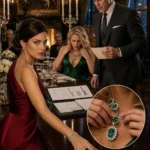
I glanced toward the woman wearing my grandmother’s necklace.
“You funded a second life.”
“It didn’t mean what you think.”
“That may be the cruelest thing you’ve said tonight.”
He frowned.
“If you were willing to risk our daughter, our marriage, and thousands of employees for something meaningless, then you are even smaller than I believed.”
At the mention of our daughter, his face tightened.
“Emma doesn’t need to know about this.”
“She already knows you stopped coming home.”
“She’s ten.”
“She’s observant.”
“You will not turn her against me.”
“I won’t have to.”
The car door remained open beside me.
Warm amber light spilled onto the snow.
Alexander took one step closer.
“What happens at midnight?”
I looked at the watch he wore.
It had been a gift from my father.
The platinum case caught the streetlight.
“At midnight, the things you called yours begin returning to their actual owner.”
Then I got into the car.
PART TWO — THE LEDGER BENEATH THE SILK
I did not discover the affair because of lipstick, perfume, or an intimate message flashing across a careless screen.
I discovered it because Alexander billed the company forty-eight thousand dollars for flowers.
The invoice came from Mercer Strategies, Sloane’s luxury branding agency.
According to the expense description, the arrangements had been purchased for a leadership retreat in Napa Valley.
There had been no leadership retreat.
There had, however, been a private dinner at one of our vineyard properties.
I knew because I owned the vineyard.
The estate manager had sent me a handwritten note thanking me for allowing Mr. Whitmore to celebrate his “engagement.”
At first, I assumed the man had made a mistake.
Then I saw the photographs attached to the property report.
Sloane stood beneath an arch of white roses in the courtyard.
Alexander stood before her with a ring box in his hand.
Behind them, a quartet played beneath the windows of a villa my grandfather had built for my grandmother.
The image did not hurt immediately.
That came later.
In the first few seconds, I felt nothing except a strange sense of distance.
It was as though I were looking at a photograph taken after my own death.
I zoomed in.
Alexander was smiling.
Not politely.
Not cautiously.
He looked young.
He looked relieved.
I had not seen that expression on his face in years.
That was the detail that broke something inside me.
Not the ring.
Not the flowers.
Not even Sloane.
It was the relief.
He looked as though loving me had been a sentence and betraying me was freedom.
I closed the report before Emma came into the library.
She wore her navy school uniform and carried a music folder against her chest.
“Is Dad coming tonight?” she asked.
Her winter piano recital began at seven.
Alexander had promised to attend.
“He said he would.”
“He said that last time too.”
There are moments when a child reveals how thoroughly adults have failed them without understanding the weight of what they are saying.
I looked at my daughter’s face and saw that she was already learning not to expect him.
That realization hurt more than the photograph.
“He should be there,” I said.
“That isn’t what I asked.”
I had raised Emma never to confuse courtesy with truth.
In that moment, I regretted teaching her so well.
“I don’t know,” I admitted.
She nodded once.
“Okay.”
Alexander did not come.
At seven twelve, he sent a message saying a board dinner was running late.
At eight thirty, after Emma played Debussy without missing a note, I received another photograph from the vineyard’s security archive.
Alexander and Sloane were boarding the company helicopter.
The timestamp was seven eighteen.
I applauded my daughter with both hands while my heart became something colder.
The next morning, I called Naomi Price.
Naomi had served as my family’s attorney for fifteen years.
She was fifty-three, precise, and incapable of being intimidated by expensive men.
We met in a private conference room on the forty-first floor of Carrington Meridian’s headquarters.
Snow pressed against the windows.
Below us, Manhattan looked clean from a distance.
I placed the photograph on the table.
Naomi studied it for several seconds.
“Do you want a divorce?”
“Do you want revenge?”
She looked up.
“That answer usually changes.”
“I want accuracy.”
Naomi’s expression softened almost imperceptibly.
“That is often more expensive.”
“I can afford it.”
We began with the marriage.
Alexander and I had signed a prenuptial agreement six weeks before our wedding.
The original document protected my inherited assets, the family trust, and any controlling interest in Carrington-owned companies.
At the time, Alexander had joked that he would never want money he had not earned.
Seven years later, after I discovered that he had hidden a gambling debt incurred by his younger brother, we signed a postnuptial amendment.
The amendment included a financial misconduct clause, a reputational harm clause, and an infidelity provision.
Alexander had insisted on narrowing the adultery language.
He demanded that betrayal be proven through financial records, written communication, or sworn testimony rather than suspicion.
He believed the requirement would protect him from emotional accusations.
Instead, it gave me a checklist.
Naomi hired a forensic accounting firm.
We did not hire a private detective.
We did not need one.
Alexander had used company resources with the carelessness of a man who believed the company belonged to him.
Over eighteen months, Carrington Meridian had paid Mercer Strategies nearly four million dollars.
Some invoices were legitimate.
Most were inflated.
Several listed events that had never occurred.
Others routed payments through consulting entities registered to Sloane’s cousin in Delaware.
Alexander had authorized every transfer.
The money funded Sloane’s penthouse suite, jewelry, private travel, a leased Aston Martin, and a planned wedding at the Carrington-owned Rosehaven Resort in Charleston.
Their wedding date was six months away.
They had selected menus.
They had chosen flowers.
They had even reserved the chapel.
My husband had planned to marry his mistress at a property held in my daughter’s trust.
The audacity would have been impressive if it had not been so stupid.
There was more.
Alexander had promised Sloane that once they married, he would separate Carrington Meridian Hospitality from the parent company.
He claimed he controlled enough board votes to force the division.
He planned to rename the division Mercer Whitmore International.
Sloane’s branding agency would receive an exclusive ten-year contract.
They discussed the arrangement in emails written from Alexander’s corporate account.
They also discussed me.
Sloane called me “the widow in waiting.”
Alexander referred to me as “a ceremonial shareholder.”
In one message, he wrote, “Vivienne reads people, not financial statements.”
I printed that line and placed it on my desk.
For twelve years, I had allowed Alexander to believe I stayed outside the company because I lacked interest.
The truth was less flattering to him.
My father had trained me from childhood.
By sixteen, I could read a hotel balance sheet.
By twenty, I had negotiated a labor agreement for one of our properties under another executive’s name.
At twenty-six, I restructured the debt that saved Carrington Meridian during the recession.
I stepped away from daily operations after Emma was born because I wanted to raise my daughter without turning motherhood into an appointment between meetings.
Alexander interpreted my choice as surrender.
Men like him often mistake a woman’s silence for emptiness because they cannot imagine power that does not announce itself.
Three weeks into the audit, Naomi placed a thick folder in front of me.
“This is enough for divorce,” she said.
“Is it enough for removal?”
“From the company?”
She tapped the folder.
“Financial misconduct, unauthorized related-party transactions, falsified expense reports, misuse of trust assets, and failure to disclose a personal relationship with a vendor.”
She paused.
“It is more than enough.”
I looked through the glass wall toward Alexander’s corner office.
He was standing beside the window, speaking into his phone.
He looked confident.
He always looked most confident immediately before underestimating me.
“What percentage of Carrington Meridian Hospitality does he actually own?” I asked.
“Six-point-two percent in restricted, nonvoting units.”
“What does he believe he owns?”
Naomi almost smiled.
“Enough.”
The ownership structure had been designed by my grandfather.
Carrington Meridian’s public image suggested a traditional corporate board, but voting control remained inside the Carrington Legacy Trust.
My mother controlled twenty percent.
I controlled fifty-one.
A further twelve percent was reserved for Emma and would remain under trusteeship until she turned thirty.
Alexander had been granted profit participation and an executive title.
He had never been given control.
The distinction was written clearly in every agreement.
He simply believed his name on hotel stationery mattered more than the clauses beneath it.
“Do not remove him yet,” I said.
Naomi watched me.
“What are you waiting for?”
“I want to know how far he intends to go.”
The answer came six days later.
Alexander entered my dressing room while I was preparing for the Asterion dinner.
He leaned against the doorway wearing his tuxedo.
“You should wear the Carrington sapphire tonight,” he said.
I kept my eyes on the mirror.
“It’s in the vault.”
“I checked.”
My hand paused over an earring.
“Why?”
“The clasp needs repair.”
The lie arrived smoothly.
Alexander had always been a talented liar because he included unnecessary details.
“Then I’ll wear emeralds.”
“You always wear the sapphire to the winter benefit.”
“Not tonight.”
His gaze met mine in the mirror.
For one second, I wondered whether he knew I knew.
Then he smiled.
“Emeralds suit you better anyway.”
He came behind me and placed his hands on my bare shoulders.
My body remembered loving him before my mind could stop it.
That was the private humiliation no one talks about.
Betrayal does not erase tenderness in a single clean stroke.
The person who destroys you still knows where you are ticklish.
He still remembers how you take your coffee.
He still carries a face you once searched for in every room.
I looked at our reflection.
Alexander’s hands rested gently against my skin.
In three hours, he would allow his mistress to announce their wedding at my family’s table.
“You look beautiful,” he said.
“So does the truth.”
“What does that mean?”
“It means mirrors are honest.”
I stood and stepped away from him.
The emerald earrings had belonged to my mother.
Unlike the sapphire, they had never left my possession.
Before leaving the dressing room, I opened the bottom drawer of my vanity.
Inside lay a small digital recorder.
Two nights earlier, Alexander had taken a call in the library, unaware that the home security system had captured his side of the conversation.
The voice belonged to him.
The words belonged to the case.
“Once Vivienne signs the annual proxy, she’s irrelevant.”
A pause followed.
Then he laughed.
“Her name opens doors, Sloane.”
Another pause.
“I’m the one who walks through them.”
I had listened to the recording only once.
I did not need to hear it again.
The recording was not what ended my marriage.
That had happened long before.
It was what ended my mercy.
PART THREE — AT MIDNIGHT, THE HOUSE REMEMBERED ITS OWNER
At eleven fifty-eight, Alexander still believed I would reconsider.
He called me from the Maybach as my mother and I crossed the lobby of Carrington House.
Carrington House was not merely our Manhattan residence.