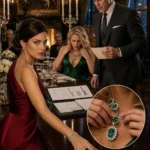
By then, the story had reached the press.
SOCIETY MARRIAGE COLLAPSES AFTER GALA ANNOUNCEMENT.
CARRINGTON HEIRESS OUSTS HUSBAND FROM FAMILY COMPANY.
EXECUTIVE ACCUSED OF SECRET PAYMENTS TO MISTRESS’S FIRM.
The photographs were worse than the headlines.
One showed me leaving the Asterion Club in black velvet.
Another showed Alexander and Sloane standing outside Carrington House in the snow.
A close-up captured the pale mark around Sloane’s neck after she removed the sapphire.
For three days, the internet called it the most expensive necklace return in Manhattan history.
I did not comment.
Silence made people uncomfortable.
They filled it with speculation.
Alexander released a statement accusing me of using family influence to punish him for a personal matter.
He described himself as the co-creator of Carrington Meridian Hospitality.
He claimed the audit was retaliation.
He said our marriage had been privately over for years.
Three hours later, Naomi released corporate records showing that Alexander had booked an anniversary trip for us two months earlier and described our marriage as “the foundation of my life” in a company interview.
She also released the public portion of the board resolution.
The vote had been seven to one.
The single opposing vote belonged to Alexander.
His public relations strategy collapsed by the weekend.
The custody hearing took place in a quiet courtroom in Lower Manhattan.
There were no chandeliers.
No orchids.
No champagne.
Only fluorescent light, polished wood, and a judge who had spent twenty-two years listening to wealthy people explain why rules should bend around them.
Alexander wore a navy suit.
He looked thinner.
For the first time since I had known him, his clothes did not appear to belong to the room.
Sloane did not attend.
She had moved out of the Beaumont before the deadline and into a furnished apartment leased by her agency.
Two weeks later, Mercer Strategies filed for restructuring after Carrington Meridian suspended its contracts.
Alexander sat beside his attorneys without looking at me.
Our daughter’s name appeared in the case as E.W., a small attempt to protect her from a public scandal created by adults.
Alexander requested equal physical custody.
He claimed I was emotionally alienating Emma from him.
His attorney described the Asterion dinner as an ambush.
Naomi placed the event program into evidence.
Alexander had personally added Sloane to the guest list.
He had seated her across from me.
He had also approved the final table arrangement.
Next came the messages.
In one, Sloane asked whether I suspected anything.
Alexander replied, “Vivienne would rather preserve appearances than admit she lost.”
In another, Sloane asked what would happen if she announced the engagement at dinner.
Alexander wrote, “She won’t react in public.”
He had been right.
That was what ruined him.
The court reviewed eighteen months of missed school events, canceled weekends, and travel records.
Alexander had spent forty-seven nights at the Beaumont while telling Emma he was attending board retreats.
He had used the company plane to fly Sloane to Aspen on the weekend of Emma’s tenth birthday.
He had sent Emma a gift from the airport.
The card said he wished he could be there.
When the judge asked him why he had requested equal custody after exercising so little parental time during the marriage, Alexander finally looked at me.
“Because my wife has taken everything else.”
The courtroom became very still.
His attorney closed his eyes.
The judge leaned forward.
“Your daughter is not an asset to be allocated after financial loss, Mr. Whitmore.”
Alexander’s face flushed.
“That is not what I meant.”
“It is what you said.”
The judge granted me primary physical custody.
Alexander received structured visitation, expanding over time if he attended consistently.
I had agreed to that arrangement before the hearing.
I did not want Emma deprived of her father.
I wanted her protected from his unpredictability.
After the ruling, Alexander followed me into the courthouse corridor.
Naomi stepped between us.
I touched her arm.
“It’s all right.”
Alexander waited until Naomi moved several feet away.
“You made me look like a stranger to my own child.”
“You did that yourself.”
“You documented every mistake.”
“I documented a pattern.”
“You enjoyed this.”
He searched my face, perhaps hoping to find cruelty.
He found exhaustion instead.
“I would have given almost anything not to know what I know about you.”
His expression faltered.
For one brief second, I saw the man who had once stood beside antique maps and made me laugh.
Then he disappeared again.
“You could have confronted me privately.”
“You planned to humiliate me publicly.”
“That was Sloane.”
“You keep saying her name when the decisions were yours.”
He looked toward the courtroom doors.
“She’s pregnant.”
The words landed between us.
I felt no jealousy.
Only a cold, immediate concern for the child.
“How far along?”
“Four months.”
The timing placed the conception during our marriage.
Alexander watched me carefully.
“I suppose your lawyers will use that too.”
He seemed surprised.
“A child is not evidence of financial misconduct.”
“You always do that.”
“Do what?”
“Make yourself sound reasonable while destroying people.”
I considered him.
“I did not destroy you, Alexander.”
“You took my company.”
“It was never your company.”
“I built it.”
“You ran it.”
“I made it valuable.”
“You also diverted money from it.”
He stepped closer.
“I gave twelve years of my life to the Carrington name.”
“And I gave twelve years of mine to a man who believed access to my family was payment for tolerating me.”
His face changed.
“That isn’t fair.”
I picked up my coat from the bench.
“It isn’t.”
The corporate proceeding began one month later.
Unlike the divorce, parts of it were public because lenders and minority investors had requested disclosure.
Alexander’s defense rested on one claim.
He argued that the payments to Mercer Strategies were legitimate business expenses approved within his authority.
Marcus Bell testified first.
He presented invoices, travel records, hotel surveillance, and internal messages.
Several invoices contained charges for private dinners described as investor events.
No investors attended.
A seventy-six-thousand-dollar “brand research trip” to Paris included Alexander, Sloane, a photographer, and a jeweler who designed her engagement ring.
The ring itself had been purchased through a hospitality vendor and listed as a prototype ceremonial object for a new luxury property.
When asked to identify the object, Alexander stared at the table.
His attorney answered for him.
“It was a diamond ring.”
Then came the Rosehaven wedding.
Sloane had signed the venue contract using the name Sloane Mercer-Whitmore.
The resort’s internal value for the three-day event was nine hundred thousand dollars.
Alexander had authorized a full waiver.
He claimed it was part of a promotional partnership.
The proposed campaign materials contained no mention of Carrington Meridian.
They consisted almost entirely of photographs of Sloane.
Naomi presented the ownership structure last.
A large screen displayed every class of shares.
Carrington Legacy Trust held seventy-one percent of voting control.
My mother held an additional nine percent through a separate trust.
Independent directors and long-term employees held the remainder.
Alexander’s restricted units carried economic value but no voting authority.
His employment agreement stated the arrangement in plain language.
Naomi enlarged his signature.
“Mr. Whitmore, did you sign this document?”
“Did you read it?”
“Then why did you tell Ms. Mercer that you controlled the company?”
Alexander looked toward Sloane.
She had been compelled to testify.
She sat behind her attorney wearing a cream suit and no jewelry.
“I believed my contribution gave me practical control.”
Naomi’s voice remained level.
“Did you believe contribution and ownership were legally identical?”
“Did you tell Ms. Mercer that the Carrington family held only ceremonial shares?”
“I may have used simplified language.”
“Did you tell her Mrs. Whitmore did not read financial statements?”
Alexander’s jaw tightened.
“I don’t recall.”
Naomi played the library recording.
His voice filled the hearing room.
A pause.
No one moved.
Naomi turned toward him.
“Do you recall now?”
Alexander looked at me.
It was the first honest answer he had given in months.
Sloane testified after lunch.
She admitted the relationship.
She admitted the false invoices.
She admitted Alexander had promised her an ownership stake after their marriage.
Her attorney had negotiated limited civil immunity in exchange for cooperation.
Alexander learned that morning.
He stared at her as she explained how he instructed her agency to route personal expenses through consulting contracts.
“You told me it was legal,” she said.
His attorney objected.
The panel allowed the answer to remain.
Sloane continued.
“You said Vivienne had never worked a day in the company.”
My mother’s expression did not change.
“You said she inherited everything and understood nothing.”
I watched Alexander absorb the betrayal.
It would have been easy to enjoy the symmetry.
I did not.
Pain does not become justice simply because it changes direction.
Then Naomi asked about the pregnancy.
Sloane’s attorney objected immediately.
Naomi produced an email in which Alexander cited the unborn child as justification for accelerating the corporate split.
The panel allowed limited questioning.
Sloane looked down at her hands.
“I am no longer pregnant.”
For the first time that day, Alexander showed emotion.
His face went white.
Sloane did not look at him.
“I lost the pregnancy three weeks ago.”
The room became painfully quiet.
Alexander’s anger vanished.
“I didn’t know.”
“I told your attorney.”
“My attorney did not tell me.”
His lead counsel leaned toward him.
“You instructed us not to accept personal communications from Ms. Mercer.”
Sloane closed her eyes.
For one suspended moment, none of us were rivals.
There was no wife, husband, or mistress.
There were only three damaged adults sitting around the absence of a child who had never chosen any of us.
I asked Naomi to request a recess.
Outside the hearing room, I found Sloane alone near the windows.
Rain moved across the city.
She looked smaller than she had beneath the chandeliers.
“I’m sorry,” I said.
Her laugh came out broken.
“Are you?”
“After everything I did?”
“What you did does not make that loss less real.”
She looked at me then.
Mascara had gathered beneath one eye.
“He said you were cold.”
“I can be.”
“He said you cared more about contracts than people.”
“Sometimes contracts reveal what people are willing to do.”
Her mouth trembled.
“I thought he chose me because I was different.”
“He chose how you made him feel.”
“Powerful.”
Sloane looked through the glass at the towers across the street.
“He told me you made him feel small.”
I folded my arms against the chill.
“He felt small beside things he could not control.”
She wiped beneath her eye.
“Do you hate me?”
“I hated what you were willing to do to my daughter.”
The words made her flinch.
“I never met her.”
“You helped him lie to her.”
We stood in silence.
Then she reached into her bag and removed a small silver drive.
“There are recordings.”
I did not take it immediately.
“Of what?”
“Alexander talking to investors.”
“What investors?”
“Men he approached about buying the hospitality division after he forced the split.”
“He had no authority to sell.”
“He said the documents would be handled.”
A cold pressure formed beneath my ribs.
“What documents?”
“He planned to forge your proxy.”
The final twist did not arrive with thunder.
It arrived on a silver drive in the trembling hand of my husband’s mistress.
I accepted it.
“Why are you giving me this?”