## PART I — THE GIRL WHO BLED
By the time the diamond sliced open Iris Dalton’s face, she had already spent half her life learning how to bleed quietly.
She had learned it first as a child, when her father died on a rainy county road and the adults around her spoke in gentle voices that made grief sound like an unpaid bill.
She learned it again when her mother followed him into the grave three years later, leaving Iris with a frightened little brother, a shoebox of photographs, and the terrible understanding that love could not keep the lights on.
And she learned it completely at forty-two, while carrying trays through the homes of people who smiled at her without ever seeing her.
That evening, beneath the chandeliers of the Heartwell estate, Iris was a shadow in a black uniform and sensible shoes.
Her feet ached so sharply that each step felt like walking over broken salt.
She had been working since before sunrise, first at the diner on East Vinton, then at the catering company, and the only thing she had eaten all day was half a banana gone brown at the edges.
But she did not think about hunger.
Hunger was ordinary.
She thought about **Liam’s medication**, sitting behind the pharmacy counter with a price tag that might as well have been a ransom note.
She thought about the eviction notice folded into the side pocket of her purse.
She thought about the way Liam had smiled that morning, trying to hide how blue his lips looked when he said, “Don’t worry about me, Iris.
I’ve been hard to kill since 1989.”
He had always been able to make her laugh, even when the world was standing on her chest.
So she carried champagne beneath chandeliers worth more than her childhood home.
She watched senators, bankers, foundation presidents, and judges raise crystal glasses to the engagement of Vanessa Sterling and Preston Hartwell.
Everyone called it a love match.
Iris knew better.
There were no soft glances between the bride-to-be and the groom, no private warmth, no trembling joy.
There was only a merger dressed in ivory silk.
Sterling Shipping and Hartwell Global were joining hands, fortunes, and secrets.
Vanessa Sterling was beautiful in a way that made people careful.
Her gown looked like moonlight poured over a knife.
A diamond ring flashed on her finger whenever she lifted her hand, and every time it caught the chandelier light, someone noticed.
Vanessa liked being noticed.
She moved through the ballroom as if the marble floor had been laid for the purpose of carrying her from one admiration to the next.
May you like
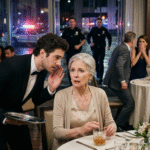
Then Iris saw the old woman.
She stood near a table of roses and caviar, clutching a worn leather purse with both hands.
She looked terribly out of place, not because her dress was cheap—it was not—but because her eyes carried confusion and loneliness in equal measure.
She turned her head slowly, scanning faces as if searching for a voice she had not heard in years.
Iris recognized that look.
It was the look of someone who had lived long enough to discover that the world can forget you while you are still standing in the room.
She moved toward her.
“Ma’am?
Are you all right?”
Before the woman could answer, Vanessa turned too sharply.
A waiter bumped, a glass tilted, and red wine spilled across Vanessa’s ivory gown like blood blooming on snow.
The ballroom stopped breathing.
The orchestra faltered.
Conversations died mid-sentence.
Every polished face turned toward the old woman, who stared at the ruined gown in horror.
“I’m so sorry,” she whispered.
“I didn’t mean—”
“You clumsy old hag,” Vanessa hissed.
The words seemed to strike harder than any hand could have.
The old woman shrank into herself.
Her fingers tightened around her purse.
“I was only looking for my son,” she said.
“Please, I—”
Vanessa seized the woman’s shoulder.
And that was when something inside Iris broke.
She had endured insults before.
She had swallowed unfairness until it became part of her diet.
She had been invisible for so long that invisibility felt like a uniform.
But the sight of Vanessa’s manicured hand closing on that trembling shoulder filled Iris with a fury so clean and sudden that she no longer felt tired.
“Please don’t touch her,” Iris said.
The room froze.
A servant had spoken.
Vanessa slowly turned her head.
“Excuse me?”
Iris knew the rules.
She knew that people like her were not supposed to interrupt cruelty when cruelty wore diamonds.
She knew her paycheck depended on silence.
She knew Liam’s medicine, their rent, and tomorrow’s groceries were all balanced on the thin wire of her obedience.
Still, she stepped closer.
“She apologized,” Iris said.
Her voice shook, but it held.
“She didn’t do it on purpose.”
Vanessa’s lips parted in disbelief, then curved with contempt.
“How sweet.
The help has developed opinions.”
The old woman whispered, “Please, dear, it’s all right.”
But it was not all right.
Iris could feel the whole ballroom watching, and the worst part was not Vanessa’s anger.
It was everyone else’s silence.
Men who chaired charities.
Women who led hospital boards.
A judge who had once given a speech about public decency.
They all stood there with champagne in their hands and let ugliness fill the room.
Vanessa lifted her hand.
She meant to slap the old woman.
Iris moved before thought could stop her.
She stepped between them, wrapped both arms around the trembling woman, and turned her own face into the path of the blow.
**The slap cracked across the ballroom like a gunshot.**
Pain burst beneath Iris’s left eye.
The diamond ring tore skin as it scraped across her cheekbone.
For one bright second the world became white, then red, then soundless.
She tasted copper.
Blood slid warm down her cheek.
Vanessa stared at her hand, then at Iris’s face, as if offended that a servant’s blood had dared to touch her jewelry.
Iris did not raise her hand to the wound.
She did not cry out.
She held the old woman more tightly and whispered, “Are you all right?”
The woman looked up at her, and the confusion was gone.
In its place was something so sharp and sorrowful that Iris would remember it for the rest of her life.
“Yes,” the woman said softly.
“Because of you.”
Then Vanessa found her voice.
“Fire her.”
The catering manager appeared so quickly that Iris understood he had been waiting for permission.
“Iris, go downstairs.”
“She assaulted me,” Iris said, though her voice sounded distant to her own ears.
Vanessa laughed.
“You put your face where it didn’t belong.”
The room remained silent.
That silence followed Iris through the service corridor, past the kitchens, past the silver carts and trash bins and sweating dishwashers, into the cold air behind the mansion.
The catering manager pressed an envelope into her hand.
“Half your pay,” he muttered.
“You’re lucky I don’t charge you for the scene.”
She looked at the envelope.
“I worked fourteen hours.”
“And you ruined a Hartwell engagement.”
“I stopped her from hitting an old woman.”
His eyes flicked toward her bleeding cheek and away again.
“You people never learn.
There are things you can afford to care about, and things you can’t.”
She almost laughed, but the wound pulled at her skin and made her wince.
She walked to the bus stop in the dark with blood drying on her cheek and the envelope clenched in her fist.
Her phone had twelve percent battery.
Liam had called five times.
She called him back.
“Iris?”
His voice was hoarse.
“Where are you?”
“On my way.”
“You sound funny.”
“I’m fine.”
“You say that when you’re not.”
She closed her eyes.
The bus shelter smelled of wet metal and cigarette smoke.
“I lost the catering job.”
There was a pause.
Then Liam said quietly, “What happened?”
She looked back toward the estate.
Through the windows, the chandeliers still glowed.
Music had resumed.
The party had swallowed the violence and gone on shining.
“I remembered I was human,” she said.
By dawn, she was sitting in a free clinic with a butterfly bandage beneath her eye, a paper cup of water in her hands, and an unpaid emergency bill folded beside Liam’s prescription.
The doctor had told her the cut might scar.
He had said it gently, as if gentleness reduced the cost.
When the black car stopped outside, Iris noticed it only because the clinic’s front window reflected its length and shine.
A man stepped out in a dark overcoat.
Tall, composed, with silver at his temples and a face built for withholding emotion, he moved through the waiting room like winter had entered in human form.
His eyes found her bandage.
Something dangerous tightened in his jaw.
“Iris Dalton,” he said.
She stood slowly.
“Yes?”
“My name is Roman Cross.”
His voice was low, controlled.
“Elena Cross is my mother.”
The old woman.
Iris forgot her fear long enough to ask, “Is she all right?”
Roman looked at her for a long moment, and the first crack appeared in his coldness.
“That was the first thing she said you would ask.”
“Is she?”
She is safe because of you.”
Relief weakened Iris’s knees.
She sat back down.
Roman remained standing.
“May I sit?”
It was such an odd question from a man who looked accustomed to owning every chair in every room that Iris almost smiled.
“It’s a free clinic.”
He sat.
For several seconds, neither spoke.
Around them, a child coughed.
An old man argued softly with a receptionist about insurance.
Somewhere, a vending machine hummed as if the whole world could be reduced to coins and waiting.
Roman reached into his coat and withdrew a folder.
Iris stiffened.
“What is that?”
“Information.”
“I don’t need trouble.”
“You already have trouble.”
“I don’t need more.”
His gaze flickered to her cheek.
“Last night, my mother watched a room full of powerful people allow a woman to bleed because stopping it would have been inconvenient.
She has lived eighty-one years.
She is not easily shocked.
But last night shocked her.”
Iris looked down at her hands.
They were rough from dishwater and cold.
“I did what anyone should have done.”
“No,” Roman said.
“You did what anyone should have done.
That is not the same thing as what anyone would do.”
He opened the folder.
Inside were papers with hospital names, doctor names, and numbers large enough to make Iris feel as if she were falling.
She whispered, “How do you know about Liam?”
“My office made inquiries.”
Fear flared.
“You investigated me?”
“At six in the morning?”
“At two.”
She stood.
“I don’t know what rich people think kindness means, Mr. Cross, but where I come from, looking into someone’s life without asking is not kindness.”
He rose too, but did not step closer.
“You are right.”
That stopped her.
He continued, “I apologize.
My mother insisted we find you immediately.
She also insisted we not arrive with flowers and gratitude while your brother went without medicine.”
Iris swallowed.
“We don’t take charity.”
“This is not charity.”
“What is it, then?”
“A debt.”
“I don’t want anybody’s debt.”
“Good,” Roman said.
“Then call it a witness protection plan for the conscience.”
Despite herself, she stared.
He slid one page toward her.
“Liam has been approved for care at St. Bartholomew Medical Center.
A specialist in his condition will see him this afternoon.
His medication has been covered.
Transportation is waiting outside.
Your rent has been paid through the end of the year, and the eviction notice has been challenged by counsel.”
The words should have brought relief.
Instead, they frightened her.
Relief this large always had teeth.
“What do you want from me?”
Iris asked.
Roman’s face changed then.
Not much.
Just enough for her to glimpse the anger beneath his polish.
“The right,” he said, “to make every person who watched you bleed regret their silence.”
Iris touched the bandage beneath her eye.
The pain was dull now, pulsing with her heartbeat.
“Revenge?” she asked.
“Justice.”
“My experience is that rich people call it justice when they have enough money to make revenge sound respectable.”
For the first time, Roman Cross smiled.
It was brief, reluctant, and almost sad.
“My mother,” he said, “is going to adore you.”
## PART II — HOUSE OF POLITE WOLVES
Liam Dalton was sitting upright in a hospital bed that afternoon, wearing a paper gown and an expression of deep suspicion.
“Iris,” he said as soon as she entered, “either I died and this is a very expensive heaven, or you have some explaining to do.”
The room had a view of the river.
Actual sunlight spilled across the floor.