“We fed her.”
“With her own money.”
“We clothed her.”
“We gave her a family.”
Arthur’s face hardened.
“You gave her a cage and sent invoices for the bars.”
My mother’s hand shot across the table.
She might have struck him if Ms. Alvarez had not stood.
“Mrs. Vale,” the prosecutor said.
“Sit down.”
My mother sat, but the room changed.
For the first time in my life, someone had told Vivian Vale to sit, and she had obeyed.
It should have pleased me.
Instead, grief moved through me like cold water.
Chloe stared at the ledger.
“Mom,” she said.
“What is this?”
My mother did not turn.
“Adult matters.”
“I am thirty-eight.”
“You are my child.”
“And Elena?”
The silence that followed was the shape of the answer.
My father removed his glasses and pinched the bridge of his nose.
“Vivian, we need to be careful.”
That was when I knew he had known everything.
Not suspected.
Not wondered.
Known.
My heart did not break loudly.
It simply lowered itself into a chair and stopped pretending.
Arthur opened the white box.
My mother’s composure cracked.
“You had no right to open that.”
“It was in Elena’s home,” Arthur said.
“It belonged to Margaret.”
“It belonged to Lydia.”
His eyes sharpened.
My mother realized her mistake half a second too late.
Ms. Alvarez wrote something down.
Arthur removed the birth certificate, the photographs, Margaret’s letter, and an old cassette tape sealed in plastic.
My mother went still.
My father whispered, “Vivian.”
Arthur lifted the tape.
“Margaret recorded this conversation in 1998, after my conviction was overturned.”
My mother’s face became waxen.
“She was senile.”
“She was lucid.”
“She was dying.”
“She was recording a confession.”
My father stood.
“This meeting is over.”
“It is not.”
Arthur pressed a button on a small recorder.
Static filled the room.
Then Margaret Rowan’s voice emerged, frail but unmistakably fierce.
Vivian, I know what you did.
My mother’s younger voice answered from the past, smooth and bored.
You know nothing.
I know Robert went to Lydia’s apartment that night.
I know she refused him.
I know she was leaving for Boston with Arthur and the baby.
On the tape, there was a pause.
Then my mother laughed.
Lydia was always dramatic.
Robert loved her.
Robert loved her money.
He loved what she represented.
He loved winning.
The room around us had vanished.
All that existed was the tape.
Margaret spoke again.
The fire was not an accident.
My mother’s recorded voice turned sharp.
Be careful, old woman.
Margaret did not stop.
You lied in court.
You said Arthur threatened Lydia.
You said you saw him leave the building.
I said what had to be said.
For whom?
For the child.
For yourself.
Another silence.
Then Vivian, younger and crueler, said words that seemed to crawl out of the machine and settle on my skin.
Do you think Arthur could have raised her from prison?
Do you think Lydia could have raised her from a grave?
I gave that baby a name people respected.
I gave her a house.
I gave her parents.
You gave her Lydia’s money.
I earned every penny.
The tape clicked off.
No one moved.
No one even breathed properly.
Chloe was crying soundlessly.
My father stared at the table.
My mother’s eyes were dry.
They found me.
That was the thought that came, absurd and childlike.
Not my parents.
Not my sister.
Not the courts.
Not the world.
A dead woman and a ruined man had kept searching for me through ledgers, clauses, letters, and locked rooms.
Arthur’s voice broke the silence.
“Elena was six months old when Lydia died.”
“Robert had pursued Lydia before marrying Vivian.”
“When Lydia refused him and prepared to leave New York, the fire occurred.”
“Vivian testified that she saw me near the service stairwell.”
“I was convicted.”
“Vivian and Robert petitioned for guardianship of Elena under emergency circumstances.”
My mother turned toward me at last.
“You were a baby.”
Her voice was almost gentle.
“You needed someone.”
I stared at her.
“Did you kill my mother?”
Her mouth tightened.
“I protected you.”
My father said, “Elena, listen—”
I slammed my palm on the table.
The sound shocked me.
I looked at him.
“You do not get to say my name like you own it.”
My mother’s face hardened.
“Lydia was weak.”
There it was.
Not remorse.
Not denial.
Judgment.
“She had money, beauty, talent, and no spine.”
“She would have dragged you from one artistic disaster to another.”
“She would have made you soft.”
“She would have made you like her.”
Arthur’s knuckles whitened on his cane.
I stood.
“You mean loved.”
My mother flinched.
“She would have loved me.”
“She would have spoiled you.”
My voice shook, but it did not collapse.
“She would have known my birthday.”
Chloe sobbed then, a small broken sound.
I had not meant the sentence for her, but it found her anyway.
My mother looked around the table as if searching for someone still loyal enough to lie.
She found only my father.
He did not meet her eyes.
“Robert,” she said.
He was silent.
“Tell them.”
Still silent.
For the first time, I saw Vivian Vale afraid not of exposure but abandonment.
It made her reckless.
“You wanted Lydia,” she hissed at him.
“You wanted her money.”
“You said if she would not marry you, she should not leave with it.”
My father’s face turned purple.
“Shut up.”
“You lit the match.”
The words struck the room like a gunshot.
Chloe covered her mouth.
Ms. Alvarez stopped writing.
Arthur’s face went white, not with shock but with the terrible confirmation of a suspicion too old to die.
My father rose slowly.
“You stupid woman.”
My mother laughed once.
It was not sanity.
It was pride falling down a staircase.
“You think you can put this on me now?”
“You think I kept your secrets for fifty-six years so you could sit there like a gentleman?”
My father lunged for the recorder.
Two security officers entered before he reached it.
Later, people would ask me whether I felt satisfaction when Robert Vale was escorted from the room.
They would ask whether I felt relief when Vivian was advised of potential charges.
They would ask whether I felt triumph when the district attorney opened a formal investigation into arson, fraud, perjury, wrongful conviction, identity theft, and financial exploitation.
The truth is less cinematic.
I felt tired.
I felt hollow.
I felt like a house after the wallpaper has been stripped and every crack is visible.
As they led my mother past me, she stopped.
Her perfume was the same as it had been all my life.
Jasmine.
Powder.
Control.
“You will come back,” she said.
“Children always come back to their mothers.”
I looked into her eyes and finally saw the emptiness I had mistaken for strength.
“You were never my mother.”
Her mouth trembled.
Just once.
Then she lifted her chin.
“I fed you.”
I thought of Margaret’s ledgers.
Arthur’s prison years.
Lydia’s photograph.
The baby cap in the white box.
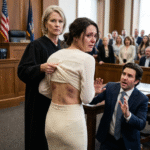
The blood on my neck at Chloe’s wedding.
“You fed me lies.”
## PART FIVE: THE DEAD MAN’S DAUGHTER
The newspapers called it the Wedding Night Scandal.
They always choose the smallest possible title for the largest possible wound.
For three weeks, my family’s name appeared in headlines, opinion columns, podcasts, and the kind of television segments where people who had never met us discussed forgiveness between commercial breaks.
A former bridesmaid sold a video.
A cousin gave an interview saying she had always sensed tension.
My father’s company lost clients first, then credit, then its good name.
Investigators found that millions had been moved over decades through trusts, shell consultancies, education accounts, renovation funds, and charitable reimbursements.
Most of the money had begun with Margaret Rowan.
All of the lies had begun before I could speak.
Chloe retreated from the public faster than I expected.
She sent me one letter, handwritten on cream stationery that still smelled faintly of her wedding flowers.
Elena, I do not know how to apologize without making it about me, so I will only say this.
I believed what they told me because believing it made my life easier.
I am ashamed.
I have returned the wedding gifts I could return.
Mason has moved out.
I am not asking you to forgive me.
I am asking you not to think the worst thing I did is the only thing I am.
I read it at my kitchen counter with coffee going cold beside me.
Then I folded it and placed it in a drawer.
Not forgiveness.
Not punishment.
Just a drawer.
Some wounds should not be forced into conclusions for the comfort of people who caused them.
Arthur came to the penthouse every Thursday after that.
At first, we spoke only of practical things.
Court dates.
Trust documents.
Security.
The restoration of my legal name, if I wanted it.
“Elena Rowan-Reed,” he said one afternoon, testing it gently.
“It sounds like a law firm.”
He smiled.
It changed his whole face.
“You would have made a formidable attorney.”
“I learned cross-examination at the dinner table.”
His smile faded.
“You keep saying that.”
“I have decades to cover.”
We were awkward with each other in the way of strangers who have inherited one another’s hearts.
He did not touch me without asking.
He never called himself my father.
He let me set the distance, and because of that, the distance slowly shortened.
One Thursday in late October, the city turned gold beneath the windows.
The trees along the river had begun to burn with autumn.
Arthur arrived carrying a flat wooden case.
“I have something for you,” he said.
“If it is another document, I may throw myself off the balcony.”
“It is not a document.”
He placed the case on Margaret’s desk.
His hands trembled as he opened it.
Inside was a violin.
The varnish had darkened with age.
A small brass plate on the inside of the case read **LYDIA ROWAN, 1968**.
I did not touch it.
“She played?” I asked.
“Beautifully.”
His voice softened into a place I had never heard before.
“She played when she was happy.”
“She played when she was furious.”
“She played badly on purpose when Margaret criticized her tempo.”
A laugh rose in me, surprising and painful.
“That sounds like someone I would have liked.”
“She would have adored you.”
The words entered me carefully.
They did not heal everything.
They healed one inch.