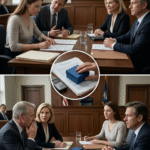
She remembered screaming Michael’s name.
She remembered hands pulling her back from the heat.
She remembered seeing a man through the smoke with her child wrapped in a blue blanket.
Not Dominic.
She knew that now.
But for years, grief had painted all men with the same face.
When she woke in a clinic outside Milwaukee, half-conscious, bandaged, and nameless, a priest told her Dominic Falcone had buried an empty coffin and vanished into vengeance.
A nurse told her her baby was gone.
A man she did not know told her she would be safer dead.
So Clara Marino Falcone died on paper.
Clara Hayes learned how to survive.
She worked in libraries, hospitals, county offices.
She learned records systems before computers and databases after them.
She learned that men lied loudly but paperwork whispered forever.
She learned how to listen until people forgot she was there.
She also learned something else.
**Revenge can keep a person alive, but it cannot tell her what to do with morning.**
Morning after morning, decade after decade, she woke with the same question lodged beneath her ribs:
Where is my son?
Now, in Dominic’s mansion, the answer was walking through Chicago with a gun, a temper, and another man’s last name.
Dominic called for a private meeting two nights after Gabriel’s exposure.
To Clara’s surprise, he chose not the library but the conservatory, a glass-walled room filled with orange trees, winter roses, and the soft mechanical hum of heated air.
Beyond the glass, snow lay heavy on the garden statues.
Clara found him seated beneath a small lemon tree, an old photograph in his hand.
Her photograph.
Her with Michael near the lake.
He did not look up when she entered.
“I kept telling myself age changes people,” he said.
Clara stopped near the door.
“That grief makes strangers of the living.”
His thumb brushed the edge of the photograph.
“That my mind was playing tricks because I wanted the dead to return.”
She could not speak.
He looked at her then.
“Say my name.”
It was a cruel request.
Or perhaps a desperate one.
“Dominic,” she whispered.
His face collapsed.
Not dramatically.
Dominic Falcone had too much pride for that.
But his mouth trembled once, and the photograph bent slightly in his hand.
Her name in his voice was unbearable.
She had imagined this moment a thousand ways.
In some, she shot him.
In others, she cursed him.
In a few, the weakest ones, she fell against him and wept until thirty years dissolved.
Reality was quieter.
They stood ten feet apart in a room full of artificial spring while winter pressed its face to the glass.
“You were dead,” he said.
“So were you, for all that mattered.”
He flinched.
“Did you know?” she asked.
The answer came too quickly, too raw.
Clara wanted to believe him.
That frightened her more than doubt.
“Did you order the fire?”
His eyes filled with something close to horror.
“Did you take my son?”
“Our son,” he said, and the correction nearly broke her.
She turned away, pressing one hand to her mouth.
Dominic stood but did not approach.
“I came that night after Gabriel called.
He said Marino men had found the house.
By the time I arrived, it was burning.
They held me back.”
“Who held you?”
“Gabriel.
Two others.
I fought them.”
“I saw a man carry Michael out.”
Dominic’s voice lowered.
“I never saw him.”
“She said he died.”
“Who?”
“The nurse.”
Dominic closed his eyes.
“I buried a coffin the size of a breadbox with ashes someone swore were my son.”
Clara’s legs weakened.
She sat before she fell.
Dominic moved toward her, then stopped himself.
“I searched,” he said.
“For years, Clara.
I tore families apart looking for you.
For him.
Stefano swore he knew nothing.”
“My father lies best when he tells the truth halfway.”
“Stefano wanted war after that.
I gave it to him.”
“Yes,” she said bitterly.
“Chicago remembers.”
Dominic looked down.
“I became the man grief permitted.”
“And I became the woman grief required.”
The silence between them was no longer empty.
It was crowded with all they had lost.
After a while, Dominic said, “Where is he?”
Clara looked up.
“Our son,” Dominic said.
“You know something.”
She took the folded nurse’s paper from inside her sleeve and handed it to him.
He read it once.
Then again.
His hand began to shake.
“Male infant,” he said.
“Six months.
Crescent birthmark.”
He looked at her, and she saw the conclusion strike him before he allowed himself to believe it.
“No,” he whispered.
“Leo Marino is thirty-one.
No verified birth record.
Raised by Stefano as a nephew no one can explain.
Left-handed under stress.
Your eyes.
My father’s cruelty.
A crescent mark on his left shoulder, if the rumor is true.”
Dominic sank back into his chair.
The most feared man in Chicago looked suddenly old.
“Leo,” he said.
The name tasted like punishment.
Clara’s voice broke.
“I don’t know if there’s anything left of Michael in him.”
Dominic covered his mouth with one hand.
His eyes shone, but no tears fell.
“Gabriel,” he said.
“He knows.”
Dominic stared at the photograph.
“Why?”
Clara almost laughed.
“Power.
Jealousy.
Hatred.
Does it matter?”
“It matters to the dead.”
It matters to the living because we want evil to make sense.”
He looked at her then with a kind of anguish she had not expected.
“What do you want from me?”
The honest answer rose in her throat.
I wanted to hate you.
I wanted you guilty.
I wanted my life to have one clean villain.
Instead she said, “I want the truth exposed before Gabriel turns father and son into executioners.”
Dominic stood.
The old king returned piece by piece, but now grief burned beneath the crown.
“If Leo is my son, I will bring him here.”
“You will not drag him in chains.”
“He is dangerous.”
“He was made dangerous.”
“He has killed men, Clara.”
“So have you.”
That struck him harder than accusation.
She rose.
“Do not pretend blood makes him worth saving now when the same blood did not stop you from filling this city with widows.”
Dominic’s face tightened.
“You think I don’t know what I am?”
“I think you know exactly what you are.
That is why you stopped asking whether you could be anything else.”
For a long moment, neither moved.
Then Dominic said quietly, “And you?
What are you now?”
Clara looked at the winter garden beyond the glass, the buried roses, the white statues, the dark trees.
“I am a mother,” she said.
“That has been enough to keep me alive.
It may not be enough to keep me good.”
Gabriel made his move before dawn.
A bomb beneath Dominic’s car failed to detonate because Clara had switched the ignition relay at three in the morning after noticing frost disturbed near the garage wall.
Gabriel’s backup shooter missed because Dominic did not take his usual exit.
By breakfast, two guards were dead, three were missing, and the mansion had become a fortress under siege.
Dominic summoned every captain still loyal.
Clara stood beside the fireplace this time, not with a tray, not in shadow.
Men stared openly now.
Some with resentment.
Some with fear.
All with the discomfort of people realizing furniture has been listening for years.
Gabriel had vanished.
So had several ledgers, two offshore account keys, and a safe-deposit box list from Dominic’s private office.
Nicky Bell slammed his fist on the table.
“Walsh sold us.”
Dominic’s voice cut through the room.
“Walsh built the sale.”
“What does that mean?”
“It means every missing shipment, every Marino provocation, every dead boy behind a warehouse was arranged to make war inevitable.”
Another captain said, “Why would he want that?”
Clara answered before Dominic could.
“Because when old kings burn, clever servants inherit the ashes.”
The men turned toward her.
Nicky sneered.
“And who the hell are you exactly?”
Dominic’s eyes remained on the table.
“She is my wife.”
The room exploded into silence.
It was a silence with teeth.
Someone whispered, “Impossible.”
Another man crossed himself.
Nicky looked from Dominic to Clara and back again.
“Your wife died.”
Clara said, “So I was told.”
No one knew what to do with a ghost who spoke calmly.
“You will listen to her as you listen to me.”
Nicky’s face darkened.
“With respect, boss—”
Dominic looked at him.
Nicky shut his mouth.
Clara stepped forward.
“Gabriel wants you angry.
He wants you moving fast.
He has spent years placing men in both families.
If you attack the Marinos tonight, you’ll be walking into positions he chose.”
One of the older captains, Sal Benedetti, leaned back.
“Then what do we do?”
“We give him what he wants,” Clara said.
“But not the way he wants it.”
Dominic looked at her.
For the first time, not as a ghost.
As an equal.
Clara unfolded a map of Chicago and smoothed it across the table.
“Gabriel believes women remember emotions but not geography,” she said.
“That has always been one of his weaknesses.”
Despite everything, Sal Benedetti smiled.
Clara pointed to three locations.
“He will push Leo toward the old Imperial Theater on Wabash.
It has two street exits, one alley exit, and basement access to utility tunnels.
Gabriel used it in 1994 for a weapons exchange.”
Dominic’s voice was quiet.
“How do you know that?”
“I was a librarian.
We keep records.”
No one laughed.
Clara looked around the table.
“The theater is where he wants Dominic dead and Leo blamed.
Then Stefano retaliates.
Then the city fractures.
Gabriel steps in as the man with accounts, routes, and enough blackmail to buy obedience.”
Sal frowned.
“And where will Gabriel be?”
Clara tapped the map.
“In the balcony.
Men like him enjoy watching.”
## Part Four: The Theater of Old Ghosts
The Imperial Theater had once hosted vaudeville acts, political fundraisers, jazz quartets, and one disastrous touring production of Oklahoma! before decline swallowed the block whole.
Now its marquee hung crooked over the sidewalk, half the bulbs dead, the letters long gone.
Snow piled against the ticket booth.
Graffiti crawled over the boarded doors.
Inside, the theater smelled of damp velvet, plaster dust, and memories abandoned mid-song.
Clara entered through the side door at 9:17 p.m.
She wore a black coat, flat shoes, and no jewelry except the locket.
Beneath the coat, taped against her ribs, was a small recorder Anthony Russo had obtained from a retired federal agent who owed him a favor and liked Clara better than he liked the law.
Dominic had wanted guards around her.
She refused.
“Leo won’t talk if he sees an army,” she had said.
“He may shoot if he sees you.”
“He might.”
Dominic had gripped the back of a chair until the wood creaked.
“I lost you once.”
“You had me taken from you.
There’s a difference.”
That ended the argument.
Now she stood beneath the ruined chandelier and listened to the building settle around her.
Rows of red seats disappeared into darkness.
The stage curtain hung in torn folds.
Up in the balcony, shadows gathered thickly.
“Mrs. Falcone.”
The voice came from the aisle.
Leo Marino stepped into view with a gun in his right hand and suspicion in every line of his body.
Clara’s breath caught despite herself.
He was closer than he had been at Vittorio’s.
Taller than Dominic had been at thirty-one.
His jaw was hers.
His eyes were Dominic’s.
His anger belonged to everyone who had touched him.
“Or should I call you Miss Hayes?” he said.
“You can call me Clara.”
He laughed.
“I don’t call strange women by their first names unless they buy me dinner.”
“I bought you a blue blanket once.”
His smile disappeared.
The silence widened.
“What did you say?”
Clara’s hand moved to the locket.
“You were six months old.
You hated sleeping unless someone sang to you.
Not well.
Just softly.”
Leo lifted the gun slightly.
“Careful.”
“You had a crescent-shaped birthmark on your left shoulder.”
His face hardened, but something flickered behind his eyes.
Fear.
Not of her.
Of memory.
“Because I gave birth to you on a rainy morning in August while your father cried and lied that he wasn’t crying.”
Leo stared at her.
Then he laughed again, louder this time, too loud for the empty theater.
“You people are sick.”
“Yes,” Clara said.
“But not about this.”
He stepped closer.
“My mother was Sofia Marino.”
Sofia Marino entered a convent in 1986 and died in Arizona in 2009.
She never had children.”
“Shut up.”
“Your birth certificate was created when you were four.
The doctor who signed it had been dead eleven months.”
“Stefano raised you as his nephew because he could not raise you as what you were.”