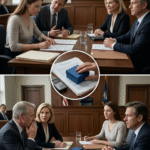
On sentencing day, Leo looked back once before the marshals led him away.
Dominic sat three rows behind Clara in cuffs, awaiting transfer to another facility.
For one brief moment, father and son looked at each other without hatred.
It was not forgiveness.
**It was recognition.**
Sometimes that is the first mercy a family can afford.
Afterward, Clara moved out of the Falcone mansion.
The government seized most of it.
The chandeliers came down.
The wine cellar was cataloged.
The portraits disappeared into storage or auction, their painted arrogance wrapped in brown paper.
Reporters gathered outside the gates until boredom moved them elsewhere.
Clara took only three things: the silver rattle, the burned wedding veil, and the photograph of herself holding Michael by the lake.
She rented a small brick house in Oak Park with a maple tree in front and a kitchen that caught morning light.
Anthony Russo came on Sundays for coffee and complained that she bought terrible biscotti.
“You’re free,” he told her one afternoon in April, watching robins hop across the grass.
Clara sat beside him on the porch.
“That word feels too large.”
“You’ll grow into it.”
“I’m nearly sixty.”
“All the more reason not to waste time being dramatic.”
She laughed then, unexpectedly.
It startled her.
The sound seemed to belong to someone else, someone younger, someone in a yellow dress on courthouse steps.
Anthony smiled.
“There she is.”
Clara looked away before her eyes filled.
She visited Dominic in prison on the first Thursday of every month.
The visiting room was beige, loud, and heartbreaking.
Children pressed drawings against glass.
Wives pretended not to count the years.
Men in khaki uniforms tried to look less diminished than they were.
Dominic always stood when Clara entered.
Always.
For the first few visits, they spoke like strangers forced to share an inheritance of sorrow.
Then, slowly, they learned a new language.
Not husband and wife.
Not exactly.
Not enemies.
Not absolved.
Something older than romance and more difficult than hate.
One Thursday in November, rain streaked the window behind him.
Dominic looked thinner, his hair fully gray now, but his eyes were clearer than Clara remembered seeing them in years.
“I had a dream about the lake house,” he said.
Clara folded her hands.
“Was it burning?”
He looked down.
“That surprised me.”
“What happened?”
“You were making coffee.
Michael was in the high chair hitting a spoon against the tray.
I was trying to read the paper, pretending the noise annoyed me.”
“Did it?”
He smiled faintly.
“I loved it.”
Clara’s heart ached with such gentleness she almost resented it.
“Do you hate me?”
She considered lying.
Kindness sometimes tempts people into dishonesty.
“Not anymore.”
He closed his eyes briefly.
“But I remember what you did,” she added.
“To others.
To this city.
To yourself.”
“I won’t spend my old age polishing your sins into tragedy.”
His mouth curved sadly.
“You always did know how to remove romance from a room.”
“I learned from professionals.”
He almost laughed.
Then he reached into his pocket and placed something on the table between them.
A wedding ring.
Not his.
Hers.
Charred on one side, warped by heat, but still whole.
“They found it in the house after the fire,” he said.
“Gabriel kept it.
The FBI recovered it from one of his boxes.”
Her fingers trembled as she picked it up.
Thirty years disappeared.
There was the lake.
The kitchen.
The baby.
The yellow dress.
The foolish belief that love could outrun blood.
She slid the ring onto her finger.
It no longer fit.
Time had changed even her hands.
Dominic watched, tears standing openly in his eyes now.
“I’m sorry,” he said.
There were many answers to that.
Too many.
So Clara chose the only true one.
The final twist came not in a courtroom, not in a prison, not beneath gunfire or snow, but in a cardboard box delivered to Clara’s porch the following spring.
There was no return address.
Inside were Gabriel Walsh’s prison letters, bundled with twine, along with a note from the warden explaining that Gabriel had died of a stroke and named Clara Hayes as recipient of his personal effects.
Anthony, who happened to be there, urged her to burn the box unopened.
“Dead snakes still have venom,” he said.
Clara almost agreed.
But patience had been her companion too long for her to turn away from a sealed truth.
That night, she sat at the kitchen table with the box before her.
Rain ticked against the windows.
The maple tree moved in the dark like an old witness.
Most of the letters were rants.
Some blamed Dominic.
Some blamed Stefano.
Many blamed Clara, which was how she knew Gabriel had died unchanged.
At the bottom was a sealed envelope marked: FOR THE WOMAN WHO THINKS SHE WON.
Inside was one page.
Clara read it once.
Her coffee cooled beside her.
The letter was not an apology.
It was a confession of a different kind.
Gabriel wrote that the fire had not begun as murder.
It had begun as leverage.
He had planned to frighten Dominic back into the family and force Stefano into negotiation.
But someone else had arrived first.
A young Marino soldier.
A frightened man with orders to retrieve Clara and the baby.
The soldier found smoke already building from a heater Gabriel’s men had rigged badly.
He broke through the nursery window, carried Michael out, and refused to hand the child to Gabriel.
That soldier had been shot later that night.
Before he died, he hid something in the lining of the blue blanket.
A hospital tag.
A second tag.
Not one infant name.
Two.
Clara stopped breathing.
Her hand shook as she unfolded the final page.
Gabriel had written only one sentence beneath a copy of the old medical record:
**You did not lose a son that night, Clara—you lost twins.**
The room tilted.
Twins.
She gripped the edge of the table.
Impossible.
She would have known.
A mother would have known.
But memory is not a photograph.
Trauma cuts it.
Doctors lie.
Records disappear.
Women recovering from childbirth are told what powerful men need them to believe.
Clara read the attached record through blurring eyes.
MALE INFANT A: MICHAEL DOMINIC FALCONE.
MALE INFANT B: JONAH CLARE FALCONE.
Jonah.
A second son.
A child erased so completely that even grief had been denied him.
Clara covered her mouth to keep from crying out.
Then she saw the last line of Gabriel’s letter.
The younger twin was not given to Stefano.
He was kept closer.
Raised under another name.
Placed where Dominic would trust him without question.
Clara stood so fast the chair fell backward.
Her mind rejected it before her heart understood.
She ran to the old Falcone files stacked in the hall closet, files released after trial, files she had not had the courage to finish reading.
Her hands tore through folders until she found Gabriel’s personnel records.
Beneath them was a sealed adoption reference from 1995, hidden under a false corporate name.
A child taken in by an Irish widow on the South Side.
A child later recruited into Dominic Falcone’s organization.
A child who became a driver, then a guard, then a trusted captain.
Clara whispered the name aloud.
“Nicky Bell.”
Nicky Bell, who had sneered at her in the library.
Nicky Bell, whose nervous sweat had looked like cowardice.
Nicky Bell, who had vanished after testifying against Gabriel.
Nicky Bell, who had sat across from Leo in federal court and never once known he was looking at his brother.
The final sheet in the file contained a recent address.
Des Moines, Iowa.
A hardware store.
A wife named Ellen.
Two daughters.
A life.
Not clean.
Not innocent.
But alive.
Clara sank to the floor with the paper in her hand.
For thirty years, she had believed the cruelest thing was losing a child.
She had been wrong.
**The cruelest thing was discovering that one child had been turned into a weapon, while the other had been hidden in plain sight as a stranger.**
At dawn, Anthony found her at the kitchen table, dressed in her navy coat, the locket around her neck, the address folded in her glove.
He looked at her face and understood enough not to ask the wrong question.
“Where are you going?” he said.
Clara picked up the silver rattle and slipped it into her purse.
“To buy a hammer,” she said.
Anthony blinked.
“A hammer?”
She smiled through tears, and for the first time in years, the smile was not a weapon.
“My son owns a hardware store.”
Des Moines was nothing like Chicago.
It had wide skies, modest houses, and streets that did not seem to be waiting for someone to bleed on them.
The hardware store stood on a corner beneath a striped awning, its windows filled with snow shovels, paint cans, bird feeders, and a sign advertising senior discounts every Wednesday.
Clara stood across the street for nearly twenty minutes.
Through the window, she saw Nicky Bell lift a little girl onto the counter so she could tape a hand-drawn picture beside the register.
He was softer here.
Still broad, still watchful, but the hardness had loosened around him.
He wore a flannel shirt instead of a suit.
His hair was thinning.
He laughed when the little girl put a sticker on his nose.
Clara pressed one hand to her chest.
Michael had come back as a monster.
Jonah had come back as an ordinary man.
Both had survived.
Neither had been spared.
She crossed the street before courage could abandon her.
A bell chimed above the door.
Nicky looked up with a customer’s smile.
Then the smile vanished.
He recognized her, of course.
As Dominic’s impossible wife.
As the woman who had helped collapse the only world he had known.
“Mrs. Falcone,” he said carefully.
Clara stood among garden gloves and paintbrushes, suddenly unable to speak.
The little girl behind the counter looked between them.
“Daddy, who’s that?”
Daddy.
The word struck Clara with such force she nearly reached for the shelf beside her.
Nicky lowered the girl gently.
“Go find your mom, sweetheart.”
“But—”
“Now, please.”
The child obeyed, glancing back with wide eyes.
Nicky came around the counter.
“If this is about court, I told them everything I knew.”
“It’s not about court.”
“I’m out.
I mean it.
I’m done with Chicago.”
His suspicion deepened.
“Then why are you here?”
Clara opened her purse and took out the silver rattle.
Nicky stared at it.
Something moved across his face.
Not recognition, exactly.
Something older than recognition.
A body remembering what the mind could not.
“Where did you get that?” he asked.
Clara’s voice shook.
“I bought it before you were born.”
He went very still.
Behind him, in the back room, a woman called, “Nick?
Everything okay?”
Nick.
Not Nicky Bell the captain.
Nick the husband.
Nick the father.
Nick the man who had learned another way to live without knowing why escape felt like breathing.
Clara held out the rattle.
“I think,” she said softly, “we have been strangers long enough.”
Nicky looked at the rattle, then at her face.
Outside, morning light spread across the quiet Iowa street.
Inside the hardware store, surrounded by nails, seed packets, and ordinary tools for repairing ordinary homes, Clara Hayes—Clara Marino, Clara Falcone, mother, widow of a life not yet ended—watched the last locked door of her past begin to open.
Nicky did not take the rattle at first.
His eyes filled with fear.
Then with anger.
Then with something so fragile Clara barely dared name it.
Hope.
“What are you saying?” he whispered.
Clara smiled, and tears slipped freely down her face.
“I’m saying you had a brother before you had enemies,” she said.
“I’m saying your name was Jonah.
I’m saying I have spent my whole life looking for one son, and God help me, I found two.”
For a long moment, the world held still.
Then Nicky Bell, who had once carried guns for Dominic Falcone and secrets for dead men, reached out with a trembling hand and touched the silver rattle.
It chimed once.
A tiny, bright sound.
Not enough to erase the past.
Not enough to forgive the dead.
But enough to begin.
And in that sound, Clara finally understood the truth that had taken thirty-one years, two crime families, a ruined theater, and a lifetime of grief to learn:
**Some empires fall with gunfire.**
**Some families rise in a hardware store.**
**And the woman nobody noticed had not come back to destroy the world after all.**
**She had come back to find the pieces of her heart still living in it.**