She did not sound ashamed.
She sounded victorious.
As though my beginning were a weapon she had finally decided to use.
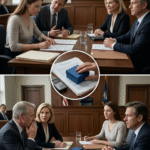
The judge’s expression changed.
“This court will recess for fifteen minutes.”
Every face turned toward me.
Miriam touched my arm.
“I do not want a recess.”
The judge studied me.
“Miss Thompson, this is sensitive information.”
“It has been used to control my family for twenty-eight years.”
I stood.
“I would prefer that it stop controlling the room.”
The judge considered this.
“Proceed carefully.”
My mother smiled at me.
It was the same smile she had worn in my living room.
“You see?” she said.
“Your grandparents knew what you were.”
Ruth rose so quickly that her chair scraped the floor.
“What she is?”
My mother’s smile faltered.
Ruth stepped toward the witness rail.
“Clare is your granddaughter.”
“She is also the child you raised.”
“She is the living evidence of a crime you concealed.”
“And you believe that makes her less entitled to dignity?”
My mother turned pale.
“I protected everyone.”
“You protected Robert.”
“I protected Julia from scandal.”
“You locked a pregnant fifteen-year-old in a psychiatric facility.”
“She was unstable.”
“She was terrified.”
“She made accusations.”
“She told the truth.”
My mother looked toward Julia.
“You do not remember what she was like.”
“I remember everything.”
Her voice trembled, but it did not break.
The judge allowed her to take the witness stand.
Julia swore to tell the truth.
My mother watched her with an intensity that would once have silenced her.
This time, Julia looked back.
“Did you cooperate in the attempted transfer of Hawthorne Lane?” Miriam asked.
“In what capacity?”
“I allowed Robert and Diane Thompson to believe I supported their plan.”
“To gather evidence.”
My mother laughed bitterly.
“She will say anything to save herself.”
Julia continued.
“Four months ago, I contacted Detective Vale and provided bank records connecting my father to Briar Lane Services.”
“Why did you have those records?”
“Dad asked me to sign documents related to an account he had used to pay my business debts.”
“I copied everything before returning them.”
“Did you send anonymous information to Clare?”
“Why anonymously?”
“I was afraid she would reject it if she knew it came from me.”
That hurt because it was true.
“Did Robert Thompson discuss the red box?”
“What did he say?”
“He said Grandpa had kept documents that could destroy him.”
“He believed Grandma had hidden them in the house before she died.”
“Did he explain what the documents concerned?”
“Not at first.”
“What did he later tell you?”
Julia looked at my father’s face on the screen.
“He said Clare’s inheritance could be challenged if we proved she was not Diane’s biological child.”
“He said the original hospital records had to disappear.”
“Did he mention the DNA results?”
Julia’s fingers tightened around the witness rail.
“He said biology did not matter because he had raised Clare.”
My father’s voice came through the courtroom speaker.
“I did raise her.”
The judge ordered him to remain silent.
He ignored her.
“I fed her.”
“I paid for her.”
“I gave her my name.”
I turned toward the screen.
“You gave me a lie.”
His face hardened.
“You had a good life.”
“Because my grandparents gave me one.”
“I was your father.”
“You were the man who taught me to lock my bedroom door.”
The courtroom became silent.
I had never told anyone that.
Not even my grandparents.
I had been eleven when my father began entering my room at night to inspect my drawers, my diary, and the messages on my phone.
He called it supervision.
I had called it normal because children have no other word for the world adults build around them.
My father leaned closer to the camera.
“You have no idea what Julia was like.”
Julia stared at him.
“I was fifteen.”
“You were manipulative.”
“You tried to ruin your mother’s marriage.”
Each repetition grew stronger.
My mother stood again.
“I did what I had to do.”
Julia turned toward her.
“You chose him.”
“I chose the family.”
“You chose the picture of a family.”
“You chose the house, the church, the dinners, and the Christmas cards.”
“You chose everything that made you look respectable.”
Then Julia looked at me.
“And you made Clare live inside the lie.”
My mother’s face twisted.
“She was loved.”
“She was displayed.”
The words left my mouth before I understood them.
My mother had dressed me for photographs.
She had praised me in public when my accomplishments reflected well on her.
At home, she criticized my laugh, my weight, my friends, my ambitions, and the amount of food I placed on my plate.
She had not loved me.
She had curated me.
Ruth testified next.
She described the conversations Grandmother had recorded after discovering the hospital bracelet.
She presented the DNA results confirming that Julia was my biological mother and Robert was my biological father.
Then she produced an audio file from the digital recorder in the red box.
My grandmother’s voice filled the courtroom.
The recording had been made nine months before her death.
“Robert,” she said, “Julia has told us what happened.”
My father answered.
“She has told you a story.”
“The DNA test is not a story.”
A long silence followed.
Then my father spoke again.
“You need to think about what happens if this becomes public.”
Grandmother’s voice remained calm.
“Is that a threat?”
“It is reality.”
“Clare will be destroyed.”
“Clare will be freed.”
“She will learn what she came from.”
“She came from a child who survived you.”
My father’s voice became colder.
“You are old, Eleanor.”
“Old people fall.”
“Old people forget medication.”
“Old people sign papers they do not understand.”
The recording ended.
Detective Vale later explained that the statement was not enough by itself to prove attempted murder.
The red box, however, contained more.
Grandmother had preserved two medication capsules she believed had been altered.
Laboratory testing found a dangerous concentration of a heart medication she had never been prescribed.
My grandfather’s medical records showed an unexplained level of the same drug after his fatal stroke.
My father had access to the house and to both medication cabinets.
Briar Lane Services had paid a former nursing assistant who worked temporarily in my grandparents’ home.
The assistant had disappeared two years earlier.
Detective Vale was still looking for her.
The courthouse seemed to recede around me.
My grandparents had not simply been protecting an inheritance.
They had believed their lives were in danger.
My mother covered her face.
For one second, I wondered whether she was finally feeling grief.
Then she whispered to her attorney, “Can they prove I knew?”
That was the end of my hope.
Not hope that she was innocent.
Hope that somewhere beneath the control and cruelty there remained a mother capable of horror at what had been done.
The judge upheld every provision of the trust.
She declared the attempted transfer void.
She issued a permanent order barring my parents from entering the property or contacting me outside legal channels.
She referred the evidence to the district attorney and froze the accounts connected to Briar Lane Services.
Then she addressed my mother.
“Mrs. Thompson, you repeatedly described your decisions as efforts to protect your family.”
The judge removed her glasses.
“A family is not protected by sacrificing its most vulnerable member to preserve the comfort of its most powerful one.”
My mother looked down.
Outside the courthouse, reporters shouted questions again.
This time, Julia stopped.
She looked at the cameras.
“My name is Julia Mercer Thompson,” she said.
“When I was fifteen years old, I gave birth to a daughter.”
“My mother and stepfather raised her as their child and forced me to pretend she was my sister.”
“My daughter’s name is Clare.”
She began to cry.
“I failed her for many years because I was ashamed of what was done to me.”
“I will not protect the people who did it anymore.”
She stepped away from the microphones.
I stood beneath the courthouse awning, unsure whether to follow her or leave.
Ruth came beside me.
“You do not owe anyone immediate forgiveness,” she said.
“I don’t know what I owe.”
“Start with yourself.”
Rain began falling across the courthouse steps.
Julia stood at the curb without an umbrella.
She looked lost.
I remembered her at sixteen, although I had only known her as my glamorous older sister.
I imagined a frightened girl returning from a locked facility to find another woman holding her baby.
I also remembered the adult who mocked me, lied to me, accepted stolen money, and stood in my living room with fraudulent papers.
Both versions were true.
Love does not require us to erase one truth in order to honor another.
I walked to the curb and held the umbrella above us.
“I’m sorry,” she whispered.
“Will you ever forgive me?”
She nodded.
It was not the answer she wanted.
It was the first honest answer either of us had been allowed to give.
## PART FIVE — THE LAST INHERITANCE
Three weeks after the hearing, Ruth returned to Hawthorne Lane with one final envelope from my grandmother.
The criminal investigation had expanded.
My father remained in custody after prosecutors argued that he had attempted to destroy evidence and might flee.
My mother was charged with conspiracy, obstruction, financial exploitation, and falsifying records connected to Julia’s confinement.
The district attorney had not yet announced whether either of them would face charges related to Grandfather’s death.
Gavin Price accepted a plea agreement and began cooperating.
He admitted my father hired him to create the Northstar assignment and promised him a percentage of the estate after the house was sold.
The former nursing assistant was located in Arizona.
According to Detective Vale, she had information that could change everything.
I stopped asking for daily updates.
For years, my family’s secrets had occupied every corner of my life.
I no longer wanted their crimes to become the only subject I knew how to discuss.
Julia moved into a small apartment across town.
She began trauma counseling twice a week.
She sold her remaining interest in the beauty business and used the money to repay part of what she had received from Briar Lane Services.
We met for coffee once.
The conversation lasted thirty-seven minutes.
Most of it was uncomfortable.
She told me she had kept every school photograph my grandparents sent her.
She had copies of my report cards, newspaper clippings from my college scholarship, and a program from my graduation.
“Why didn’t you come?” I asked.
“Mom said it would confuse you if I showed too much interest.”
“You were already living with us.”
“Not emotionally.”
I understood what she meant.
In our family, people could sit at the same table while living in separate countries of silence.
Julia asked whether she could show me the photographs someday.
I told her someday was not the same as yes.
She accepted that.
It was the first sign that she might be learning the difference between love and possession.
On the afternoon Ruth brought the envelope, winter sunlight lay across Grandfather’s study.
The broken window had been replaced.
I had considered changing the room, but every time I moved one of his books, I heard his voice telling me tools worked best when returned to their proper place.
Ruth set the envelope on the desk.
“Eleanor instructed me to give you this only after the red box had been opened and the trust had survived any challenge.”
“Did she know all of this would happen?”
“She knew your parents.”
“That is not the same thing.”
“Sometimes it is.”
The envelope contained a letter and a small brass key.
The letter was written in Grandmother’s sloping handwriting.
My dearest Clare,
If you are reading this, then the truth has arrived in the cruel manner truth often chooses when frightened people delay it.
I am sorry.
Your grandfather and I spent years believing silence could protect you.
We were wrong.
Silence is not a wall.
It is a room where harm learns to speak without being interrupted.
You may wonder why we left the estate to you.
It was not because you cared for us, although you did.
It was not because Julia failed us, although she did.
It was not because Diane and Robert took money, although they did.
We left it to you because the house was the only place where you were consistently told that your life belonged to you.
We wanted that truth to become permanent.
The house is yours.
But there is one final matter you must understand.
The estate described at the will reading was not the complete estate.
I stopped reading.
Ruth watched me quietly.
“What does that mean?”
“Keep going.”
I returned to the letter.
Years ago, your grandfather discovered that Robert had diverted money from the company through Briar Lane Services.
Henry could have reported him immediately.
Instead, Robert threatened to expose the circumstances of your birth in a way designed to shame Julia and destroy you.
Your grandfather began buying back the stolen interests quietly.
He recovered funds through insurance claims, civil settlements, and the sale of patents he had never disclosed to the family.
Those funds were placed in a separate trust.