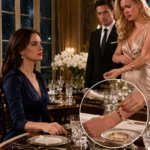
The tiny, vicious precision of it.
Judith had not chosen any blanket from any closet. She had chosen that one. She had opened my cedar chest at the Whitmore estate, lifted out the piece of my childhood I had trusted inside their home, and handed it to the woman carrying her son’s child.
There are betrayals of the body.
There are betrayals of the heart.
And then there are betrayals that tell you the people around you have been studying your softest places for years, waiting to press their thumbs into them.
I sat down before my knees could give out.
Margaret Keene arrived twenty minutes later in a charcoal suit, carrying a leather folder and the expression of a woman who had never once in her life been surprised by male arrogance.
She was sixty-two, silver-haired, sharp-eyed, and the most feared divorce attorney in King County.
She looked at the blanket.
Then at me.
“Tell me exactly what happened.”
I did.
Every word.
Every face.
Every silence.
Nathan’s especially.
Margaret listened without interrupting. When I finished, she opened her folder.
“They’ve made a mistake,” she said.
“They’ve made several.”
“Yes,” she said. “But today they made a useful one.”
I almost laughed. “I’m glad my public humiliation has legal value.”
“Public cruelty often does,” Margaret replied. “It clarifies character.”
She slid several documents across my desk.
The first was the prenuptial agreement Nathan had signed eleven years earlier.
The second was the postnuptial amendment he had begged me to sign four years ago, when Whitmore Hospitality was ninety days away from defaulting on two major loans.
The third was a notarized copy of the Monroe Family Trust terms.
My name appeared again and again.
Controlling beneficiary.
Primary shareholder.
Secured creditor.
Separate property.
Non-marital asset.
And then there was the clause Nathan had laughed about when he signed it, kissing my forehead and calling lawyers “romance killers.”
Public Morality and Reputational Harm Clause.
Margaret tapped the paragraph with one red fingernail.
“Adultery alone would have cost him some,” she said. “Publicly presenting an extramarital child as a Whitmore heir while still married to you, using your separate inherited property in a religious ceremony, and allowing his family to imply your consent?” She paused. “That is reckless. Expensive reckless.”
I looked out the window.
Far below, traffic crawled through wet streets. People hurried under umbrellas. The world continued, rude in its normalcy.
“What about the baby?” I asked.
Margaret’s expression softened slightly. “The child is not your responsibility.”
“I know that.”
“But?”
“But I don’t want him punished because Nathan is weak.”
Margaret nodded once. “That’s why we separate accountability from cruelty.”
Those words stayed with me.
Accountability from cruelty.
I could do that.
I could burn a man’s lies down without setting fire to an innocent child.
“What else?” I asked.
Margaret opened another file.
“Savannah Vale has been receiving monthly transfers from Whitmore Hospitality for eighteen months. Labeled as consulting fees.”
I turned back slowly.
“She worked for the company?”
“No official role. No tax documents consistent with employment. No deliverables. The money appears to have come from an executive discretionary account Nathan controlled.”
“How much?”
“Four hundred and eighty-six thousand dollars.”
My hands went cold.
Nathan had told me the company couldn’t afford to restore employee health benefits after the layoffs.
He had sat beside me at our dining table, exhausted and noble-looking, and said sacrifices had to be made.
All while paying Savannah nearly half a million dollars to be hidden.
“There’s more,” Margaret said.
Of course there was.
Men like Nathan rarely betrayed in one direction.
She showed me hotel invoices. Suite upgrades. Jewelry purchases charged through a vendor account. A private lease on a waterfront condo in Bellevue, paid through a shell company connected to Whitmore Hospitality.
Then she showed me the custody petition.
I stared at it.
“What is this?”
“Filed in draft but not submitted yet,” Margaret said. “Our investigator found it through counsel correspondence.”
Nathan intended to petition for primary residential custody of Elliot Maxwell Whitmore once he and Savannah married.
My stomach turned.
“He’s already planning to marry her?”
“Yes.”
“Why would custody involve me?”
Margaret’s mouth tightened. “Because the draft references you.”
She turned the page.
There, in polished legal language, Nathan’s attorney had described me as emotionally unstable, infertile, resentful of the child, and potentially harmful to the family’s public image.
I read the sentence three times.
Emotionally unstable.
Potentially harmful.
I thought of myself in fertility clinics, injecting hormones into my stomach while Nathan missed appointments because of “investor calls.” I thought of the baby blanket folded on my desk. I thought of Nathan in the church telling me I was embarrassing myself.
For the first time that day, tears came.
Not many.
Just two.
They slipped down quietly.
Margaret did not pretend not to see them. She simply pushed a box of tissues closer.
“They were going to make me look dangerous,” I said.
“They were going to make you look inconvenient.”
I wiped my face.
“And now?”
Margaret’s smile was small and cold.
“Now we make you look documented.”
By sunset, the story had already begun to move.
Not publicly, not yet. But among the right people.
Someone from the church had texted someone from the club. Someone from the club had called someone on the hospital board. Someone from the board had called Naomi, who called me screaming so loudly I had to hold the phone away from my ear.
“Savannah posted a photo,” she said.
I closed my eyes.
“Of course she did.”
“It’s not from the baptism. It’s from outside the church. She’s holding the baby, no blanket, but the caption says, ‘Some people can’t stand watching love create what they never could.’”
For a moment, I heard nothing.
Then my heartbeat returned, slow and steady.
“What did Nathan do?”
“He liked it.”
Of all the things he had done, that should not have hurt.
It did.
But hurt was no longer steering.
Evidence was.
“Screenshot it,” I said.
“Already did.”
“Send it to Margaret.”
“With pleasure.”
That night, I returned to the house Nathan and I had shared in Madison Park.
The house was dark except for the security lights along the garden path. I had bought it seven years earlier through my trust, though Judith loved telling people it was “the Whitmore lake house.” Inside, the rooms smelled faintly of cedar, rain, and the peonies our housekeeper replaced every Monday.
Nathan was waiting in the living room.
He still wore his baptism suit, though his tie was loose and his hair looked as if he had run his hands through it too many times.
On the coffee table sat two glasses of untouched whiskey.
“I was worried,” he said.
“No, you weren’t.”
His face tightened. “Evelyn.”
I took off my coat and hung it carefully in the hall closet.
He watched me as if my calmness were a locked door he could not open.
“You humiliated my family today,” he said.
I turned.
It was almost impressive.
The way guilty people rearrange furniture inside a burning house.
“Your family used my dead grandmother’s blanket to baptize your mistress’s baby.”
He flinched at the word mistress.
Good.
“Savannah is the mother of my son,” he said.
“She is also the woman you slept with while married to me.”
“We were broken.”
“No,” I said. “We were struggling. You were cheating.”
He looked away.
The silence between us held eleven years.
At twenty-eight, I had loved his charm.
At thirty-nine, I recognized it as a survival skill.
Nathan Whitmore could make a waiter feel appreciated, an investor feel brilliant, a mistress feel chosen, and a wife feel unreasonable for noticing.
“I didn’t know about the blanket,” he said finally.
I believed him.
That was the saddest part.
Nathan had not needed to plan the cruelty. He had only needed to permit it.
“You saw it,” I said. “You heard me ask for it. You watched your mother lie, Savannah mock me, and an entire church wait to see what you would do.”
His eyes were damp now.
Too late.
“You have to understand,” he said. “My parents are attached to the baby. It’s complicated.”
“It became simple when you looked at the floor.”
His mouth opened.
No words came.
I walked past him toward the staircase.
“Evelyn,” he said, voice cracking. “What are you going to do?”
I paused with one hand on the banister.
“The mistake all of you made,” I said, “was thinking I came to that church unprepared.”
Then I went upstairs and locked the bedroom door.
Chapter 3: The Mistress at the Club
Savannah Vale became louder after the baptism.
Women like her often confuse silence with surrender.
Three days later, she arrived at the Rainier Club charity luncheon wearing pale pink satin and the diamond bracelet Nathan had bought her with company funds. I knew because Margaret had the receipt.
She brought the baby with her.
Judith brought them both to the head table.
I attended because I chaired the foundation benefiting Seattle Children’s Hospital. My name was printed on the invitation. My money underwrote the event. My grandmother’s portrait hung in the entry hall because she had funded the pediatric oncology wing before half the guests were born.
Judith knew that.
Savannah knew that.
Nathan knew that.
They still thought I would stay home out of shame.
When I walked into the ballroom, the conversation dipped.
The Rainier Club glittered with chandeliers, white orchids, crystal glasses, and women who could detect scandal faster than bloodhounds. Outside the tall windows, Seattle rain blurred the city into silver. Inside, Savannah sat in my usual seat beside Judith.
My name card had been moved.
Not removed.
Moved.
To the far end of the table near the silent auction baskets.
A small cruelty.
A public one.
Judith looked up and gave me the kind of smile that women use when they are holding a knife under linen.
“Evelyn,” she said. “We weren’t sure you’d come.”
“I gave the keynote,” I replied. “It would have been rude not to.”
Savannah adjusted the baby against her shoulder.
Little Elliot slept in a navy cashmere outfit. He was beautiful. None of this was his fault, and that made the adults around him look even uglier.
“We saved you a seat,” Savannah said sweetly.
“Yes,” I said. “I see that.”
The women at the table froze behind their champagne flutes.
Nathan stood near the bar, talking to two board members. When he saw me, his face changed.
Not guilt.
Alarm.
He crossed the room quickly.
“Evelyn,” he said under his breath, “can we not do this here?”