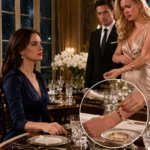
Silence.
Then, quietly, “Yes, ma’am.”
I stood in my kitchen overlooking Lake Michigan. The winter water was the color of steel. Emma’s school backpack sat on a chair near the island, one strap twisted, a math worksheet sticking out of the front pocket.
The house was too large when she was at school.
It had been built in 1928, all limestone and slate roof and old money restraint. My father bought it after my mother died because he believed grief required solid walls. Nathan used to call it “our fortress.”
Now his attorney wanted it sold.
I asked Brian, “Who sent you the playlist?”
“Ms. Vale’s assistant.”
“Did she say where it came from?”
“She said Mr. Ellison wanted it exactly like the Whitmore anniversary event. Her words were, ‘Same emotional arc, but make it bridal.’”
I closed my eyes.
Same emotional arc.
Somewhere in downtown Chicago, Vanessa had reduced my marriage to an aesthetic.
“Brian,” I said, “I need you to forward the full thread to my attorney.”
“I can do that?”
“You can do that if you would like to be paid properly and avoid being subpoenaed without notice.”
Another silence.
“Yes, ma’am.”
“Also,” I said, “do not cancel the event.”
“Don’t cancel it?”
“No. Continue as instructed. But from now on, every invoice, update, song change, and payment record goes to Marjorie Bell’s office.”
He cleared his throat. “Mrs. Ellison, do you want me to approve the final order?”
I looked at the gray water.
After I hung up, my phone lit with a text from Nathan.
We need to discuss last night. Vanessa felt you were cold.
I stared at the message until the screen dimmed.
Then another came.
You can’t punish her for loving me.
I laughed once.
It startled me. Not because it was joyful, but because it sounded like something breaking cleanly instead of cracking slowly.
Nathan had always believed love was a room he owned. Whoever stood inside it had to obey his version of reality.
When he loved me, I was graceful, loyal, brilliant.
When he wanted someone else, I became cold, unstable, punitive.
Same woman.
Different usefulness.
Instead, I drove to Bell & Sparrow.
Marjorie’s office had a view of the Chicago River and no photographs on the desk. She believed personal items made clients emotional.
She read the DJ’s email without blinking.
Then she said, “Company funds?”
“It appears so.”
“Good.”
That was Marjorie. Other people saw an insult. She saw a lever.
She pressed the intercom. “Daniel, bring in the Ellison file and the emergency injunction draft.”
Daniel Kim entered carrying two banker’s boxes and wearing the expression of a man who had survived law school by never sleeping. He was thirty, precise, and deeply afraid of Marjorie in the way intelligent people fear natural disasters.
Marjorie turned to me. “Nathan’s team filed a motion yesterday afternoon.”
“For what?”
“To restrict your access to corporate accounts pending divorce resolution. They claim you’ve threatened to damage company operations.”
I leaned back.
There it was.
Last night had been theater.
Humiliate me publicly. Provoke a reaction. File papers claiming I was vindictive. Then use my reaction to separate me from company control and custody.
Nathan had always been better at strategy than honesty.
Marjorie slid the filing across the table.
Attached were statements from Paul Mercer, Nathan’s mother, and two board members who owed Nathan favors. They described me as “visibly distressed,” “socially withdrawn,” and “emotionally unpredictable.”
Last night had not gone as planned because I had been none of those things.
Marjorie tapped the DJ invoice.
“This helps us. If they put the wedding expenses through the company after filing that motion, they walked into misuse of corporate funds. If the company is marital property, it’s dissipation. If your trust controls it, it’s unauthorized spending. Either way, ugly.”
“Can we stop the wedding?”
“Legally? Perhaps. Strategically? I’d rather let them decorate the trap.”
I looked at her.
She smiled without warmth.
“We request emergency review of corporate spending, subpoena the event vendors, and bring the custody issue forward. The judge will not appreciate a man claiming you are unstable while billing his mistress’s wedding to a company you control.”
I thought of Vanessa in champagne silk.
“She’ll spin it,” I said.
“Let her.”
“His mother will lie.”
“Paul Mercer is at every event now. He’ll coach them.”
Marjorie’s eyes sharpened. “Mrs. Ellison, people who lie in groups tend to forget they need to lie the same way.”
That afternoon, Nathan came to the house.
He did not knock. He used his old code.
The security system rejected it.
I watched from the hallway camera as he stood outside in a charcoal coat, looking annoyed and handsome and slightly confused. Snow dusted his shoulders.
My phone rang.
“Caroline,” he said. “Why doesn’t my code work?”
“Because you moved out.”
“This is still my house.”
“No,” I said. “It is still our marital residence. There’s a difference.”
He exhaled. “Open the door.”
“Emma isn’t home.”
“I came to talk to you.”
“We can talk through attorneys.”
“Don’t do that.”
The softness in his voice arrived like a trained dog.
I had loved that softness once.
“Don’t turn into one of those women,” he said.
One of those women.
A woman who noticed.
A woman who kept records.
A woman who refused to be grateful for betrayal wrapped in expensive apologies.
I opened the door because the camera was recording and because I wanted to see his face.
Nathan stepped into the foyer and looked around as if expecting the house to have changed in his absence. It had. The family portrait above the console was gone. So were his golf trophies from the study and the silver-framed photograph of us in Paris.
Small absences can be louder than screams.
His eyes lingered on the blank space where our wedding photograph had hung.
“You redecorated.”
“I corrected the inventory.”
He looked at me then.
“I know last night was hard.”
“Do you?”
“Vanessa was nervous. She jokes when she’s uncomfortable.”
“She called me sentimental in front of your family.”
He rubbed the bridge of his nose. “You are sentimental, Caroline.”
I waited.
He made the mistake of continuing.
“You attach meaning to things. Songs. Rooms. Dates. That anniversary party was years ago.”
“Our daughter was there.”
“Emma will adjust.”
My voice stayed even. “To what?”
“To the new family structure.”
New family structure.
People invent clean phrases when they cannot defend dirty choices.
I walked into the living room. He followed. The fire was burning low, and outside the windows, the lawn sloped white toward the lake.
Nathan stood near the piano. Emma’s piano. The one he had promised to teach her on, then abandoned after three lessons because Vanessa started booking weekends in Aspen.
“Caroline,” he said, “we need to make this easier. For everyone.”
“Everyone?”
“For Emma.”
“Do not use her name as furniture in this conversation.”
His face hardened.
There he was again. The man beneath the charm. Not cruel in the obvious way. Cruel in the polished, reasonable way that makes you question whether pain is simply bad manners.
“I want primary weekdays,” he said.
“No.”
“You travel for the foundation.”
“I control my schedule.”
“I have Vanessa now. There will be two adults in the home.”
I almost admired the audacity.
“You want the court to believe your mistress improves your parenting?”
“My fiancée,” he corrected.
I looked at him for a long moment.
“You are still married.”
His eyes flicked away.
“It’s a formality.”
“Our vows were a formality too, apparently.”
His jaw tightened. “I didn’t come here to fight.”
“No. You came here because your attorney told you to see whether I’d unravel.”
That landed.
For the first time, his expression shifted.
“Paul said you might be influenced by Marjorie.”
“Good. I pay her to influence me toward excellent decisions.”
He stepped closer. Not threatening. Nathan was too civilized for anything that could be photographed. But he knew how to fill a room.
“I can be generous,” he said. “More generous than the court will be.”
I looked up at him.
“You mean you can offer me pieces of things I already own.”
He laughed under his breath. “You never understood the company.”
I felt something cold and old move through me.
For years, I had let him say versions of that sentence in boardrooms and dining rooms and interviews. Caroline is the heart, I’m the engine. Caroline loves the mission, I handle the numbers. Caroline has a gift for people; I handle reality.
He built a throne out of my silence and mistook it for surrender.
“You should leave,” I said.
He looked toward the stairs.
“I want to see Emma’s room.”
“I’m her father.”
“You are also a litigant in a custody dispute.”
His face flushed.
“You’re making this ugly.”
“No, Nathan,” I said. “I’m making it documented.”
He stared at me for one second too long.
Then he smiled.
It was not the smile I married. It was the one he used before destroying competitors.
“Fine,” he said. “Let’s document everything.”
He left five minutes later.
At 6:14 p.m., Emma came home from school wearing her navy uniform and carrying a violin case. She found me in the kitchen making grilled cheese because betrayal may destroy a marriage, but children still need dinner.
“Dad came by,” she said.
I turned slowly.
“He texted me.”
“What did he say?”
She pulled out her phone and showed me.
Your mom is making it hard for me to see you. Remember I’m fighting for us.
My daughter watched my face.
The old Caroline would have softened the truth to protect Nathan.
The new one understood that children do not need lies. They need safety.
“Your father and I are going through adult legal things,” I said. “You are not responsible for making either of us feel better.”
Emma looked at the grilled cheese.
“Vanessa says you hate her because she’s younger.”
I turned off the stove.
“What do you think?”
Emma’s mouth trembled. She was twelve, which meant she was old enough to understand humiliation but too young to know what to do with it.
“I think she talks like she’s already my mom,” she whispered.
I crossed the kitchen and put my arms around her.
Only then did I let myself close my eyes.
Not to cry.
To remember why I had to win cleanly.
Not loudly.
Not bitterly.
Cleanly.
Because someday, Emma would be a woman sitting at a table where someone tried to make her feel replaceable.
And I needed her to remember that her mother did not beg for a chair.
She owned the room.
Chapter 3: The Bride Who Laughed Too Loud
Vanessa’s wedding shower was held at the Beaumont Hotel in Chicago, in a private room overlooking the river.
I was not invited.
My name, however, was on the floral invoice.
That was how I learned about it.
White orchids again.
Not roses. Not lilies. Not peonies.
Orchids.
My orchids.
The same flowers from my fifteenth anniversary party, billed to Ellison Strategic Holdings under “client retention event.”
Marjorie called it “a pattern.”
I called it theft with better lighting.
By then, we had three vendor threads, two invoices, one catering contract, and a signed ballroom deposit tying Vanessa’s wedding directly to company accounts. Nathan’s assistant, a nervous woman named Priya, had forwarded everything to Vanessa’s assistant with the subject line: Per NE, keep off Caroline’s calendar.
NE.
Nathan Ellison.
People think powerful men are undone by dramatic confessions. Mostly, they are undone by initials in email chains.
Marjorie filed for an emergency evidentiary hearing in Cook County Domestic Relations Court. She also petitioned for a temporary restraining order against unauthorized corporate spending pending review.
The hearing was scheduled for the morning after the wedding shower.
Which meant Vanessa had one more night to be cruel in public before consequences arrived.
She used it well.
I saw the footage because Meredith sent it to me.
Meredith had been my closest friend since college, the kind of woman who wore red lipstick to hospital waiting rooms because she believed fear should never get the good lighting. She had been invited to the shower by mistake, likely because Vanessa assumed every woman in our social circle would eventually defect to the winning side.
Meredith attended for exactly twenty-two minutes.
Long enough to record Vanessa’s toast.
The video began with laughter.
Vanessa stood beneath a floral arch in a pearl-colored mini dress, holding a microphone. Behind her, a table glittered with champagne coupes and small boxes tied with gold ribbon.
“I know people have opinions,” Vanessa said, rolling her eyes prettily. “People always do when a man chooses happiness over obligation.”
The room laughed.
My mother-in-law, Evelyn Ellison, sat in the front row wearing ivory. Ivory. At another woman’s wedding shower while her son was still married.
Vanessa continued, “But Nathan told me something beautiful. He said his first marriage taught him what love wasn’t.”
There was a small collective gasp. Then more laughter, because once cruelty crosses a line, some people clap just to prove they are not on the wrong side of it.
My fingers tightened around the phone.
Meredith’s camera shifted slightly. I could hear her whisper, “Oh, sweetheart, keep talking.”
Vanessa smiled wider.
“And I’m grateful to Caroline, truly. She trained him. Now I get the healed version.”
This time, Evelyn laughed.
That sound did more damage than Vanessa’s words.
For sixteen years, I had hosted Evelyn’s birthdays, driven her to appointments, arranged her medication after hip surgery, chosen Christmas gifts she later told people Nathan had picked himself. When my father died, she held me and said, “You’re my daughter now.”