The Plate He Thought I Would Drop
My husband gave me three days to leave our house so his mistress could move in before Labor Day weekend.
He said it at 6:42 p.m. in our Fairfax County kitchen while I stood barefoot beside the sink with soap bubbles on my wrists and one of our Charleston anniversary plates balanced in my hands.
“I need you out before Friday,” Graham Westcott said.
Not “we should talk.”
Not “I’m sorry.”
Not even “I made a mistake.”
Just an eviction notice delivered in the same dry voice he used for roof inspections on his commercial properties.
Outside, late August light poured through the oversized windows and turned half his face gold while the other half disappeared into shadow. It made him look like two men standing in the same suit: the husband who once carried me over the threshold of that house, and the stranger who now believed he could remove me from it with a calendar deadline.
The ceramic plate felt suddenly heavy.
We had bought that set in Charleston during our fifth anniversary, back when Graham still held my hand in hotel lobbies and spoke about our future like it was a building we were designing together. The plate had a thin blue rim and a hairline crack near the edge from the night I dropped it while laughing too hard over burned salmon.
I lowered it onto the quartz countertop carefully.
It still made a sound.
Small.
Sharp.
Final.
“Is there someone else?” I asked.
Graham did not blink.
“That isn’t really the issue anymore.”
The issue.
Fifteen years of marriage had become an issue.
He adjusted one cuff link, polished steel flashing at his wrist. “The marriage expired a long time ago, Maren. I’m not interested in dragging this out just because you need time to process it.”
Expired.
He described our marriage the way grocery stores describe spoiled milk.
Behind him, our living room looked impossibly normal. Brass candleholders on the mantel. Architectural magazines stacked beside the fireplace. A woven basket of unopened mail near the refrigerator. Pale linen curtains hanging from custom brass rods I had chosen myself after three months of pretending drapery decisions mattered more than the loneliness spreading through the house.
Beautiful rooms can lie better than people.
Graham looked around as if inventorying a property he had already acquired.
“I’ll have my attorney send the proposed terms tomorrow,” he said. “I want to avoid unnecessary hostility.”
“You want me gone in three days.”
“I want a clean transition.”
“For whom?”
His mouth tightened.
That was when she appeared in the reflection of the patio glass.
A woman standing near the front entry, half-hidden by the open archway, holding a cream leather handbag against her hip.
Not a stranger.
Not a client.
Rebecca Langford.
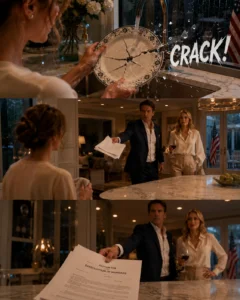
I knew her from donor dinners and real estate development receptions, the kind of woman who touched men’s elbows while laughing and called every wife “darling” with a softness that never reached her eyes. She was thirty-four, elegant, glossy, and apparently confident enough to stand inside my house before I had even been formally discarded from it.
She stepped into the living room wearing ivory trousers and a pale silk blouse.
“Graham,” she said gently, “maybe we should give Maren a moment.”
Her voice was careful.
The kind of careful that performs kindness while enjoying the wound.
I looked at her shoes first. Nude leather heels. No rain on them. She had been inside long enough for the soles to dry.
Then I looked at the wineglass in her hand.
My wineglass.
From the crystal set my mother gave us after the closing on the house.
Rebecca followed my gaze and smiled faintly.
“I’m sorry,” she said. “This must feel sudden.”
Must feel.
Not is.
Some women apologize like they are polishing a knife.
Graham exhaled, impatient now. “We’re not doing this.”
“No,” I said quietly. “We’re not.”
He seemed relieved, which told me how badly he had misunderstood me.
I wiped the soap from my hands with a kitchen towel, folded it once, and set it beside the plate. Then I looked past Rebecca toward the living room, at the curtain rods above the tall windows, at the brass end caps gleaming in the dying light.
Hollow rods.
Custom-made.
Installed last spring.
Graham had complained they were overpriced.
I had remembered every invoice.
There are moments when grief arrives like weather. Heavy, unavoidable, surrounding everything. But there are other moments when grief becomes a blueprint. Lines sharpen. Measurements matter. Weak points reveal themselves.
My husband thought he was giving me three days.
He had no idea I had been measuring the rot for months.
The Architecture of a Lie
My name is Maren Westcott, and for nearly twenty years I made a career out of finding what expensive men paid architects to hide.
I reviewed commercial real estate acquisitions across Northern Virginia, D.C., and Maryland. I inspected glass office towers, mixed-use developments, luxury condominiums, boutique hotels, and waterfront retail spaces with marble lobbies designed to distract from bad plumbing. I knew where moisture gathered first. I knew which support beams developers quietly underfunded. I knew the difference between a cosmetic crack and a structural warning.
A building tells the truth eventually.
So does a marriage.
Graham’s decay began in June.
At first, it was ordinary enough to insult my intelligence. Late meetings. New investors. Weekend site walks in Baltimore. Emergency calls from lenders who apparently only experienced emergencies after dinner. He changed his cologne without mentioning it, something smoky and expensive that did not belong to the man who once smelled like cedar soap and coffee.
Then came the garage calls.
He would step through the mudroom door and pull it almost shut, leaving a thin line of light across the floor while he spoke in a voice too low for business. Sometimes he laughed. Not his public laugh, the one he used for investors. A softer one.